8 Best AEO Software Platforms in 2026
Compare Dageno, Profound, Peec AI, Otterly AI, Scrunch, AthenaHQ, Semrush and Ahrefs Brand Radar for AEO monitoring, citations and execution.
Track AI search visibilityNo install
Updated by
8 Min Read
Updated on Sep 11, 2026
Answer engine optimization software should help a brand become accurately mentioned, recommended, or cited in generated answers. The category includes four different jobs: visibility monitoring, source and competitor analysis, technical accessibility, and content execution. A tool that performs only one job should not be evaluated as if it covers the whole AEO workflow.
The 8 best AEO software platforms at a glance
| Platform | Best for | AEO strength | Main limitation |
|---|---|---|---|
| Dageno | Monitoring-to-execution workflows | Connects prompts, citations, gaps, content, and measurement | Requires traditional SEO tools for crawling and links |
| Profound | Enterprise diagnostics | Deep answer, source, prompt, and market intelligence | Higher organizational commitment |
| Peec AI | Focused analytics | Clear competitor, sentiment, and citation reporting | Execution occurs elsewhere |
| Otterly AI | Small teams | Accessible recurring prompt monitoring | Lighter enterprise controls |
| Scrunch | Technical agent accessibility | Links visibility with crawler and agent experience | Needs engineering ownership |
| AthenaHQ | Cross-functional GEO programs | Shared research and optimization workspace | Process quality depends on internal governance |
| Semrush | Existing SEO teams | AI visibility with conventional SEO context | Broad packaging can add cost |
| Ahrefs Brand Radar | Source discovery | Large-scale brand and citation research | Less prescriptive about execution |
How we evaluated AEO software
We looked for exact prompt and answer evidence, citation URLs, competitor comparison, country and language controls, history, source analysis, technical diagnostics, content actions, exports, integrations, roles, and transparent plan limits. During a trial, use the same prompts and markets in every platform.
1. Dageno — best full AEO workflow for SEO teams
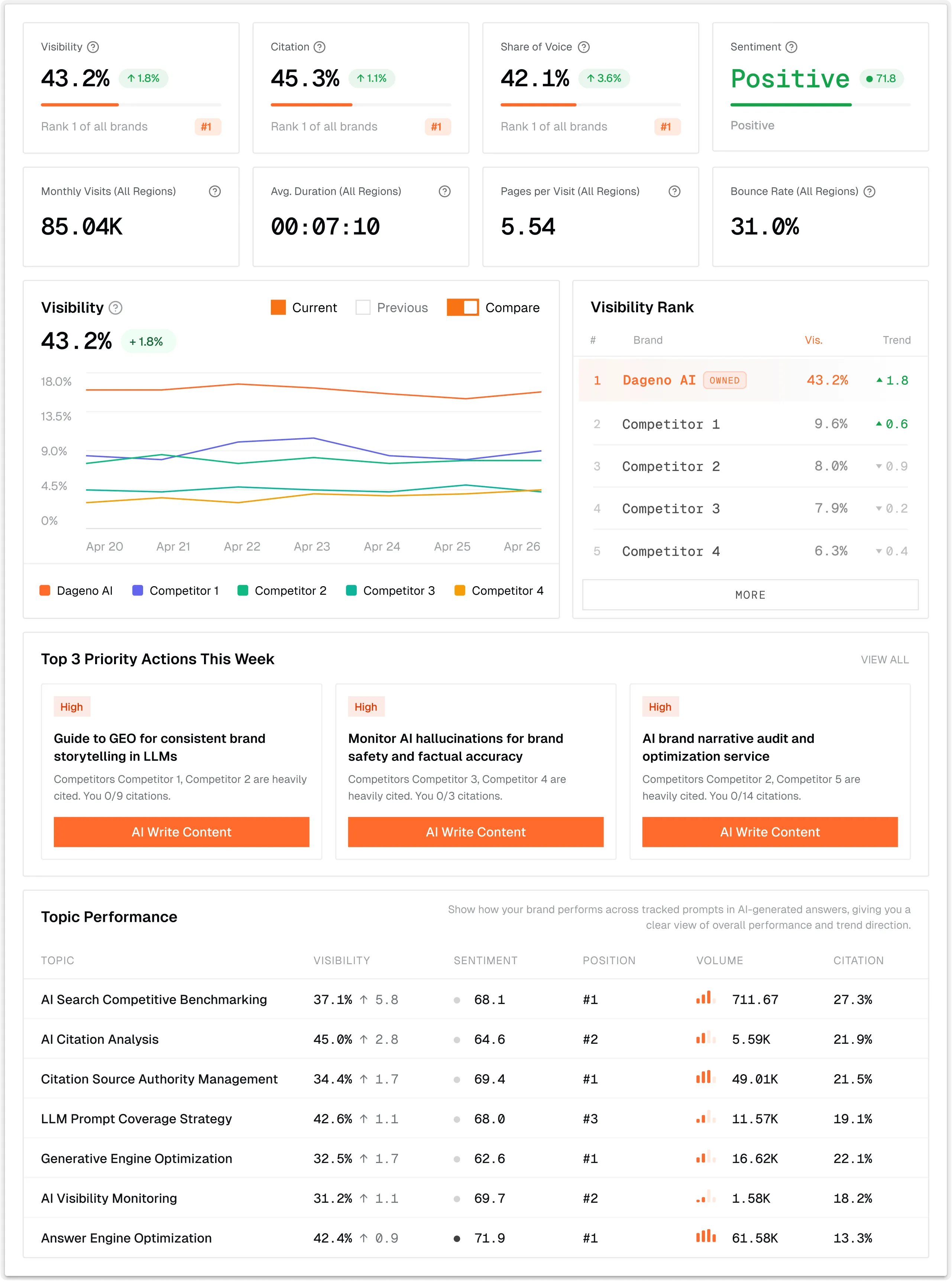
Dageno joins AI visibility, prompt monitoring, competitors, sentiment, cited sources, opportunity discovery, and content workflows. That connection matters because AEO is not finished when a dashboard detects a loss; the team needs to decide which page, fact, source, or authority signal to improve.
Best fit: SEO and content teams responsible for both diagnosis and publishing. Test: Ask the platform to convert three persistent prompt gaps into measurable actions, then rerun the same cohort after implementation. Limit: It complements rather than replaces a technical crawler or backlink database.
See the answer engine optimization guide and the comparison of AEO tools.
Ready to dominate AI search?
Get started - it's free! >2. Profound — best for enterprise answer intelligence
Profound supports enterprise analysis of prompts, generated answers, sources, competitors, and markets. It is strongest when several departments need a common intelligence layer.
Test: Use your own product taxonomy, regional prompts, raw exports, permissions, and executive reports. Limit: Small teams may not use its full depth or support the required operating model.
3. Peec AI — best for focused AEO reporting

Peec AI presents visibility, competitors, sentiment, prompts, and sources in a focused analytics workflow. It is useful for recurring stakeholder scorecards.
Test: Verify raw answers, citation URLs, history, market controls, alerts, exports, and prompt limits. Limit: Content production, technical SEO, and backlink research remain in other systems.
4. Otterly AI — best accessible AEO starter
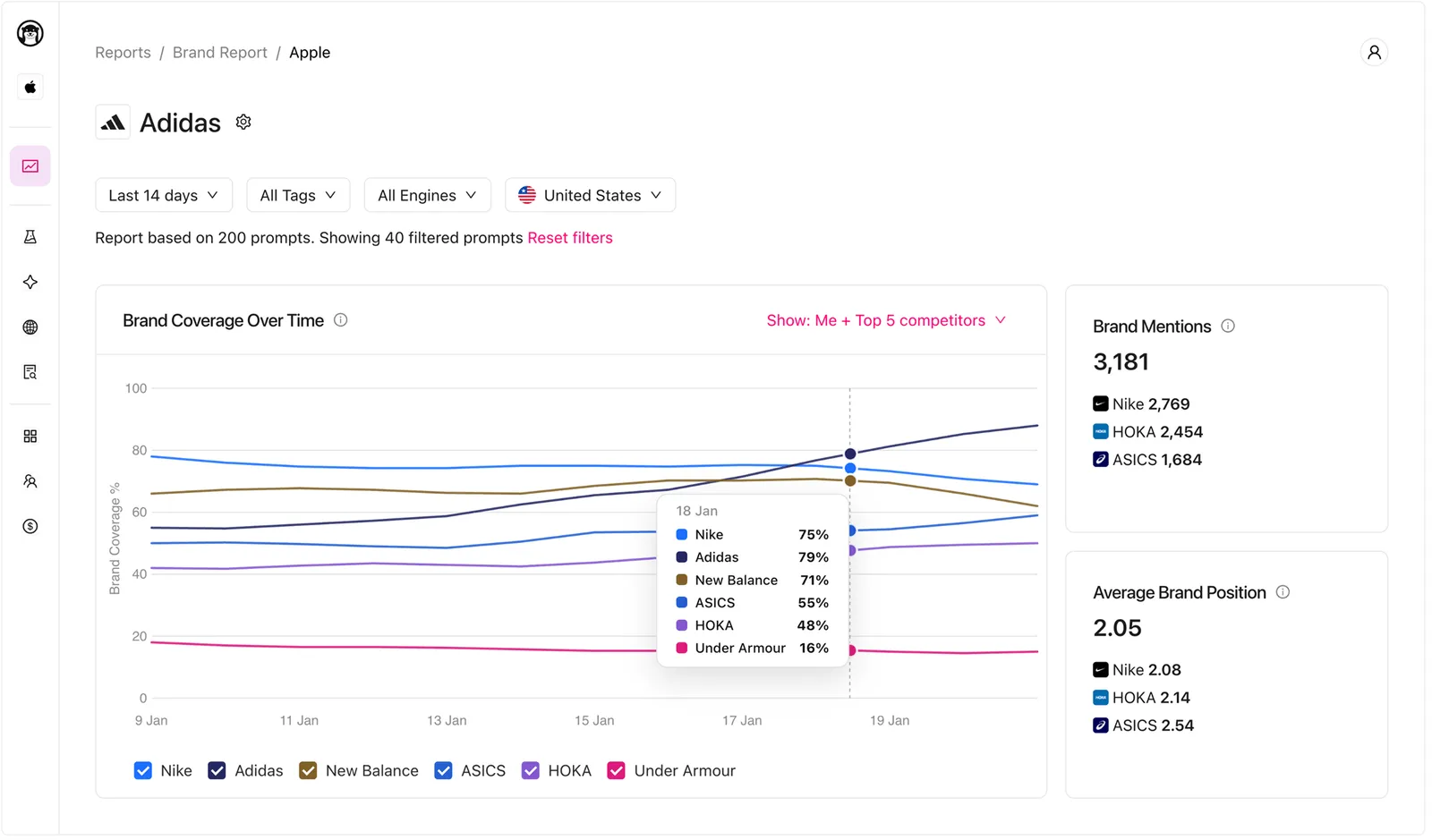
Otterly AI monitors prompts, mentions, links, citations, and competitors on a schedule. It suits a team beginning with a small, controlled prompt set.
Test: Model cost using required engines, prompts, projects, markets, and run frequency. Limit: Advanced APIs, permissions, and global governance may require a broader platform.
5. Scrunch — best for technical AEO diagnosis
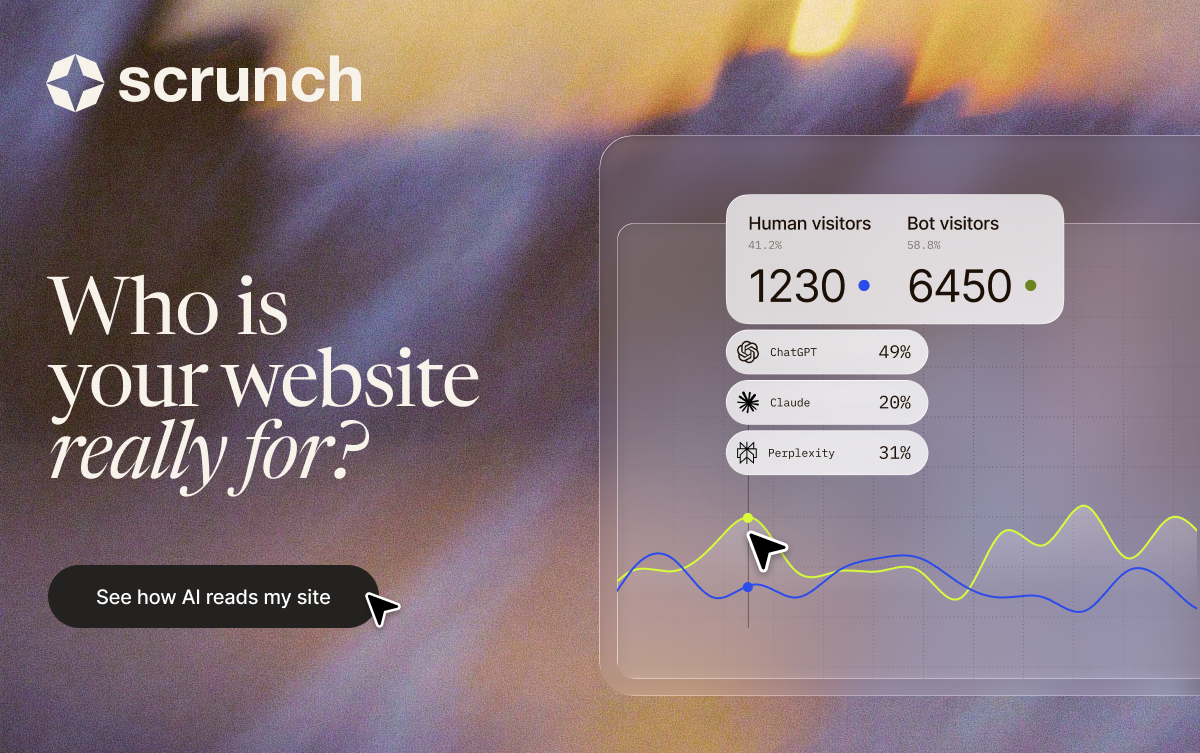
Scrunch connects answer visibility with the ability of AI crawlers and agents to access, interpret, and act on site information.
Test: Review rendered templates, crawler controls, structured facts, bot evidence, and referral measurement. Limit: Technical findings create value only when engineering teams can implement them.
6. AthenaHQ — best cross-functional AEO workspace
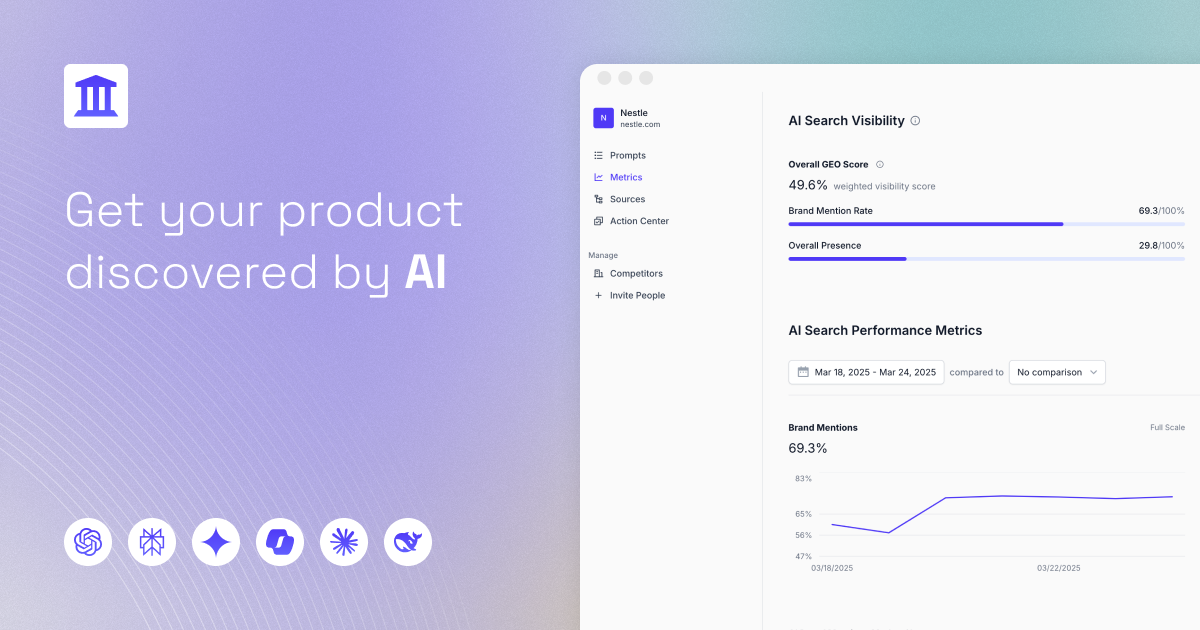
AthenaHQ treats GEO and AEO as shared research and optimization programs across SEO, content, brand, and communications.
Test: Evaluate prompt discovery, source evidence, content recommendations, roles, approvals, and exports. Limit: The organization still needs one owner, a stable prompt taxonomy, and a publishing standard.
7. Semrush — best for an existing SEO organization

Semrush AI Visibility Toolkit places AI visibility near keyword, competitor, audit, and reporting workflows already used by many search teams.
Test: Confirm domain packaging, engines, prompts, users, markets, reports, and integration with current projects. Limit: A dedicated AEO buyer may pay for unused suite breadth.
8. Ahrefs Brand Radar — best for source and market research

Ahrefs Brand Radar helps teams explore brands, topics, competitors, mentions, and citations before deciding which prompts and sources require continuous work.
Test: Separate database exploration from custom monitoring and verify available indexes, markets, and exports. Limit: Research does not automatically identify the next page-level action.
A practical AEO operating cycle
- Build prompts by discovery, comparison, problem, and purchase intent.
- Establish a repeatable baseline by engine and market.
- Classify gaps as content, product evidence, third-party authority, inconsistent facts, or technical access.
- Assign one accountable action and page or source.
- Rerun the same prompt cohort and annotate the change.
- Connect visibility with AI referrals, branded demand, assisted conversions, and revenue.
Frequently asked questions
Is AEO software different from SEO software?
Yes. SEO software focuses mainly on ranked results, crawlability, keywords, links, and search traffic. AEO software observes generated answers, brand representation, citations, sources, and competitors. Most teams need both layers.
Can AEO software guarantee that a brand appears?
No. It improves observation, diagnosis, and execution. Independent answer systems still decide which information to use for each prompt and context.
Should a team choose a tracker or a full platform?
Choose a tracker when the immediate need is a reliable baseline. Choose a broader platform when the same team must diagnose gaps, produce or update content, coordinate tasks, and validate results.
About the Author

Updated by
Ye Faye
Ye Faye is an SEO and AI growth executive with extensive experience spanning leading SEO service providers and high-growth AI companies, bringing a rare blend of search intelligence and AI product expertise. As a former Marketing Operations Director, he has led cross-functional, data-driven initiatives that improve go-to-market execution, accelerate scalable growth, and elevate marketing effectiveness. He focuses on Generative Engine Optimization (GEO), helping organizations adapt their content and visibility strategies for generative search and AI-driven discovery, and strengthening authoritative presence across platforms such as ChatGPT and Perplexity
Related Articles
Track Competitor Ranking Shifts Across Multiple LLM Platforms

Tim • Jun 15, 2026
8 Best Rank Tracking Tools by Budget and Use Case
Ye Faye • Sep 10, 2026
8 Best LLM Visibility Tracking Tools for SEO in 2026
Tim • Sep 10, 2026
LLM Cheap Rank Tracking Tools: Best Affordable AI Visibility Trackers for 2026

Dageno • Sep 11, 2026