Bluefish AI Review 2026: Pricing, Features & Alternatives
An evidence-based Bluefish AI review covering pricing, features, audience analytics, citations, security, global coverage, and four alternatives.
Track AI search visibilityNo install
Updated by
14 Min Read
Updated on Sep 11, 2026
TL;DR
Bluefish AI is an enterprise marketing platform for brand teams that need audience-based visibility, citation-impact analysis, brand accuracy monitoring, and GEO measurement, with plans evaluated through a sales consultation.
- Best for: Enterprise brand teams comparing audience visibility, citation impact, and brand accuracy.
- Main limitation: Public plan prices and exact usage limits require a sales evaluation.
- Alternative to compare: Dageno AI for visibility monitoring connected with content creation and optimization.
This Bluefish AI review separates what the company publicly documents from what buyers still need to verify in a demo. It also compares Bluefish with Dageno, Profound, Scrunch, and Peec so you can choose based on use case rather than marketing language.
Bluefish AI Review 2026: Quick Verdict
Bluefish is best suited to enterprise brand teams that need audience-level AI visibility, citation-impact analysis, brand accuracy, and coordinated GEO measurement. Its fit depends on the scope and cost established through a sales consultation.
| Evaluation area | Review finding |
|---|---|
| Best for | Enterprise brand, search, content, PR, and commerce teams |
| Distinctive capabilities | Audience-based visibility, Citation Impact, and brand-accuracy monitoring |
| Main limitation | No standardized public pricing; exact usage limits and coverage require confirmation |
| Alternative to compare | Dageno AI for visibility monitoring, citation analysis, and content workflows |
Before signing, confirm the exact AI engines, countries, languages, prompt volume, data retention, integrations, service levels, implementation support, and total contract cost included in the proposal.
What is Bluefish AI?
Bluefish describes itself as an “agentic marketing platform” for enterprise brands. Its platform covers four connected jobs:
- AI monitoring: measure visibility, favorability, risk, accuracy, audiences, and the sources influencing AI answers.
- AI optimization (GEO): turn observed gaps into prioritized recommendations and content briefs.
- GEO measurement: benchmark changes over time and connect source or content changes with AI-performance movement.
- Agentic commerce: monitor product performance and shopping behavior in AI-assisted buying environments.
The company says it processes millions of brand-relevant prompts and responses across channels including ChatGPT, Google AI, Claude, Perplexity, and Amazon Rufus. Those are vendor claims rather than an independent audit, so procurement teams should ask to see their own sample data before treating coverage or accuracy as proven for a specific market.

See the official Bluefish platform overview for the current product modules.
Bluefish AI features: what the platform publicly documents
AI visibility, favorability, risk, and accuracy
Bluefish monitors whether a brand appears in AI answers, how it is represented, which narratives form around it, and which sources shape those narratives. This is more useful than a single visibility score because teams can distinguish four different problems:
- Presence: the brand is absent from relevant answers.
- Positioning: the brand appears but loses to competitors.
- Favorability or safety: the answer describes the brand negatively or in an off-brand way.
- Accuracy: the answer contains a factual error about a product, policy, or company.
Bluefish’s 2026 AI Accuracy release adds Brand Vault, a first-party source of truth against which factual claims in AI responses can be checked. The vendor says mismatches can be traced to a response and channel, scored by severity, and filtered by product line, topic, and audience. This is especially relevant for regulated industries and retailers managing frequently changing product data.
Audience-based analytics
Custom audiences are one of Bluefish’s clearest differentiators. Instead of treating every prompt as an isolated keyword, Bluefish configures intents and contexts around audience segments, generates prompt sets for those segments, and tracks performance consistently over time.
That design can answer questions such as:
- Which buyer persona is most likely to see our brand recommended?
- For which use cases does a competitor replace us?
- Does brand favorability change between an expert audience and a first-time buyer?
- Which narrative or source influences a particular segment?
The important limitation is methodological: these are simulated, controlled prompt sets—not a direct feed of every real prompt typed by consumers. Bluefish itself explains that AI platforms do not disclose all user prompts. Buyers should therefore ask how audiences are defined, how prompt samples are generated, how frequently they run, and how variance is handled.
Citation and source-impact analytics
Bluefish says its Citation Impact capability identifies the content sources with the greatest influence on AI responses. GEO Measurement also includes source tracking so teams can observe whether specific source or content changes coincide with performance changes over time.
For a useful proof of concept, do not settle for a list of cited domains. Ask Bluefish to demonstrate:
- the exact prompt and full response behind a citation;
- the cited URL rather than only the root domain;
- first-party versus third-party source segmentation;
- source influence by model, audience, country, and topic;
- historical retention and export options;
- how non-citation influence is inferred and labeled.
GEO recommendations and content briefs
Bluefish is not positioned as a generic article generator. Its documented workflow is closer to a research-and-briefing system. Daily recommendations are ranked by likely impact, while Content Briefs can specify the topic, product area, facts, proof points, language, and pages most likely to address an observed visibility or favorability gap.
This is an important distinction for buyers comparing “content generation” features. Bluefish provides data-grounded direction for a content or agency team; the public materials do not establish that it replaces a complete writing, editing, approval, publishing, and localization stack. Confirm which steps are automated and which still require people or external tools.
GEO measurement and reporting
Bluefish documents benchmarking, customized GEO tracking, collections, trend analysis, and source tracking. Together, these features are intended to close the loop between an optimization and the subsequent change in AI representation.
A demo should show the raw evidence behind every dashboard metric. Ask whether users can drill from a summary score to the exact prompt, response, timestamp, model, region, and cited sources. Also confirm exports, API access, scheduled reporting, role-based views, and whether the platform distinguishes correlation from causation when reporting impact.
Agentic commerce and shopping analytics
For retail brands, Bluefish offers product-performance monitoring, AI shopping insights, and brand-data transformation. Its public materials specifically discuss Amazon Rufus and Alexa for Shopping, in addition to broader AI discovery channels.
This makes Bluefish more relevant than a basic chatbot tracker when the real goal is product discoverability and factual product representation. Buyers should verify supported marketplaces and countries, SKU-level depth, feed requirements, refresh frequency, attribution methodology, and integration with existing product information management systems.
Bluefish AI pricing
Bluefish does not publish standardized plan prices on its official website. The contact page asks prospects to request a demo or discuss pricing. Therefore, exact dollar figures found in third-party reviews should be treated as unverified unless they match a current written quote from Bluefish.
Ask for a total-cost proposal that specifies:
- annual platform fee and minimum contract term;
- included brands, markets, languages, users, prompts, and AI engines;
- implementation, onboarding, custom research, and consulting fees;
- API, data warehouse, CRM, analytics, or product-feed integration costs;
- overages, additional seats, and premium support;
- data retention, export rights, and renewal increases.
The lack of public pricing is not automatically a negative for a complex enterprise deployment, but it makes independent comparison harder. It also means Bluefish is less practical for teams that need a low-risk trial before procurement.
Integrations, security, and data transparency
Bluefish publicly describes “robust data integrations,” brand-data management, enterprise security, compliance, and scale. Its public materials also mention SSO, role-based access, permissioned data governance, and SOC 2-aligned controls. However, a marketing page is not a substitute for security documentation or a signed data-processing agreement.
Before purchase, request and verify:
- the current SOC 2 report or other applicable independent assurance;
- data-processing locations, subprocessors, retention, deletion, and backup policies;
- GDPR and CCPA contractual provisions relevant to your organization;
- whether customer content or prompts train any shared model;
- encryption, SSO, SCIM, roles, audit logs, and incident-response terms;
- documented CRM, ERP, data warehouse, PIM, CMS, analytics, and LLM integrations;
- public or private API availability, limits, authentication, and support.
Bluefish’s privacy policy explains website/service personal-data practices and provides a contact route for access, correction, or deletion requests. It does not by itself answer every enterprise product-data question. Treat security, privacy, and integration details as due-diligence items until Bluefish supplies account-specific documentation.
Global coverage and multilingual support
Bluefish says it supports international customers and languages, and its AI-channel list includes platforms with global reach. Yet the public product pages do not provide a complete, current matrix of supported countries, languages, models, regional endpoints, or sampling depth.
Global teams should ask for a coverage table and run a proof of concept using their own brand, language, and market. A platform can technically accept a language while still producing shallow or unstable insights because model access, shopping surfaces, prompt design, and source ecosystems differ by country.
Bluefish AI pros and cons
Pros
- Enterprise depth: custom audiences, topics, sources, products, and team-specific workflows go beyond a generic visibility score.
- Accuracy and brand governance: Brand Vault and response-level claim checking address factual misrepresentation, not only mentions.
- Action-oriented GEO: prioritized recommendations and content briefs connect monitoring with execution.
- Commerce focus: shopping and product-data capabilities serve retail use cases often missed by SEO-centric tools.
- Cross-functional design: search, content, brand, PR, data, and commerce teams can work from a shared measurement framework.
Cons
- No public pricing: buyers cannot estimate total cost without entering a sales process.
- No obvious self-serve evaluation: the official path is demo-led, which creates friction for smaller teams.
- Critical details require verification: exact integrations, regional coverage, limits, data retention, and support terms are not fully documented publicly.
- Complex implementation: custom audience, data, governance, and measurement programs require internal ownership; software alone will not execute the strategy.
- Limited independent review evidence: vendor case studies and claims should be validated against a customer-specific proof of concept.
Who should choose Bluefish AI?
Choose Bluefish when you are a global or regulated enterprise, have multiple marketing functions involved in AI discovery, need custom audience and product analysis, and can support a consultative implementation.
Consider another tool when you need public pricing, immediate self-serve access, a lightweight tracker for a small set of prompts, or a simpler workflow that combines AI visibility with everyday SEO execution.
Best Bluefish AI alternatives in 2026
| Platform | Best fit | Main reason to consider it |
|---|---|---|
| Dageno | SEO, content, growth, and agency teams | AI visibility, citations, prompt opportunities, AI-bot behavior, and content workflows in one accessible platform |
| Profound | Enterprise AI-search intelligence | Broad enterprise monitoring and analytics capabilities |
| Scrunch | Enterprise brand presence and knowledge | Strong focus on how AI systems understand and represent a brand |
| Peec | Lean marketing teams | Straightforward AI-search visibility and competitive tracking |
1. Dageno
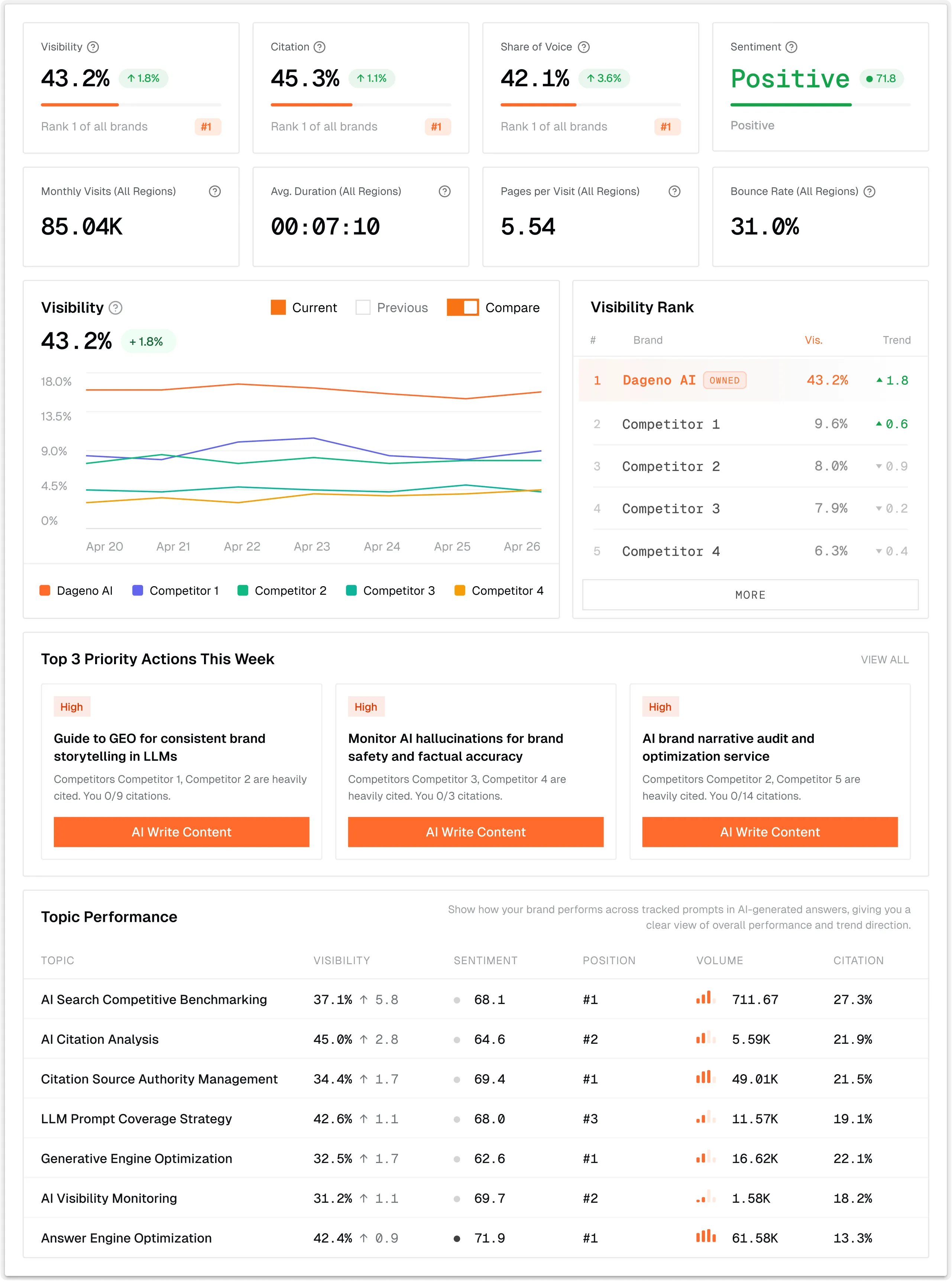
Dageno combines AI visibility monitoring with prompt-level evidence, citation analysis, opportunity discovery, AI-crawler behavior, and content optimization. It is a practical alternative for teams that want to move from “Where are we missing?” to “Which page should we improve next?” without beginning with a long enterprise procurement process.
Explore Dageno’s AI visibility platform or compare more AI visibility tools.
Turn AI visibility gaps into content priorities
Get started - it's free! >2. Profound
Profound is another enterprise-oriented option for teams that need AI-search monitoring, competitive intelligence, and large-scale reporting. It belongs on the same shortlist when procurement depth and enterprise workflows matter more than a lightweight self-serve experience.
Visit the official Profound website to verify current modules and pricing.
3. Scrunch
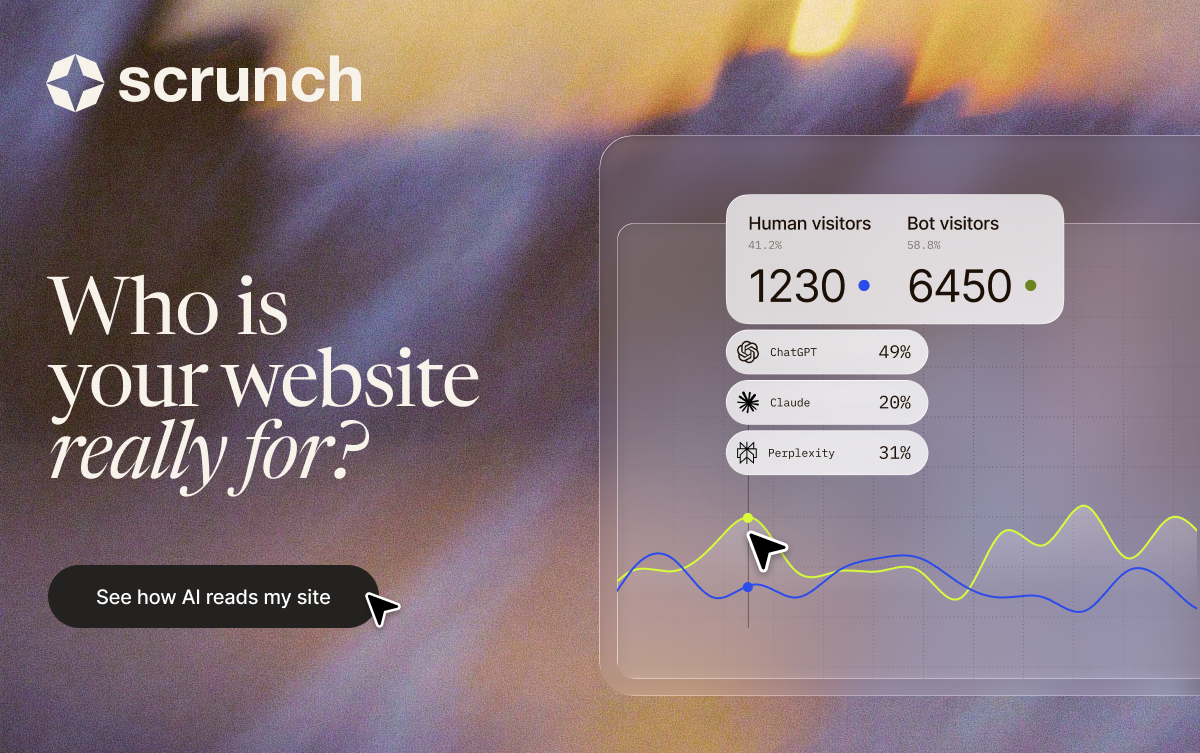
Scrunch focuses on brand presence and the information AI systems use to understand a company. It is worth evaluating when brand knowledge, accuracy, and cross-functional enterprise governance are central requirements.
Review the official Scrunch platform for its current capabilities.
4. Peec
Peec emphasizes simple tracking of brand visibility, sentiment, sources, and competitors in AI search. It is a useful comparison point for smaller teams that value faster setup and a narrower operating model.

See the official Peec website for current plan and feature details.
How to evaluate Bluefish in a demo
Use a controlled proof of concept instead of a generic sales presentation:
- Provide one brand, two competitors, two countries, two languages, and three audience segments.
- Ask Bluefish to show the prompts, complete responses, timestamps, models, citations, and scoring logic behind every summary metric.
- Introduce a known content or product-data change and measure whether the platform detects it over time.
- Review false positives, response variance, and missing-source cases with your search and analytics teams.
- Test an export or integration using your real workflow—not a slide showing that integration is possible.
- Have security and legal teams review the current evidence and contract terms.
- Compare the same use case in Dageno, Profound, Scrunch, or Peec before selecting a vendor.
Final verdict
Bluefish AI is not merely another rank tracker. It is an enterprise AI-marketing system built around audience-level measurement, source influence, brand accuracy, GEO activation, and agentic commerce. Those capabilities make it compelling for large brands with complex governance and shopping requirements.
The trade-off is transparency and accessibility. Pricing, exact coverage, integration depth, and operational limits need to be established in a sales process and verified in a customer-specific proof of concept. Bluefish is a strong choice when its enterprise depth matches the problem; it is not automatically the best choice for every team that wants to monitor AI visibility.
Frequently asked questions
Is Bluefish AI a GEO or AEO tool?
Yes. Bluefish is an enterprise platform for monitoring, optimizing, and measuring brand performance in generative AI and AI-assisted commerce. It uses the terms GEO, AI optimization, and agentic marketing across its product materials.
How much does Bluefish AI cost?
Bluefish does not publish standardized prices on its official website. Prospective customers need to request a demo and obtain a written quote. Treat precise prices in third-party articles as estimates unless Bluefish confirms them for the current contract.
Does Bluefish generate complete articles?
Bluefish publicly documents data-driven Content Briefs and prioritized recommendations. These guide content teams with topics, facts, proof points, language, and target pages. Buyers should confirm whether their package includes complete draft generation, editing, approval, localization, and publishing integrations.
How does Bluefish measure audience-based AI visibility?
Bluefish defines audience segments, generates controlled prompts around their intents and contexts, and repeats those prompts over time. This enables directional comparison by audience, but it should not be interpreted as direct access to every real consumer prompt.
Does Bluefish support citations and source analysis?
Yes. Bluefish documents Citation Impact and source tracking designed to identify which content shapes AI responses and how source or content changes relate to performance. Confirm URL-level evidence, export access, history, and model coverage during a demo.
Does Bluefish support multiple countries and languages?
Bluefish says it operates globally and supports international markets and languages, but its public pages do not provide a complete coverage matrix. Ask for a current market-by-language-by-model table and test your priority regions.
What is the best Bluefish AI alternative?
For SEO and growth teams that need AI visibility monitoring connected with content workflows, Dageno AI is one alternative to compare. Profound and Scrunch belong on enterprise shortlists, while Peec is an option for lean teams seeking focused analytics.
References
Bluefish AI Platform
Bluefish AI Sales
Dageno AI Answer Engine Insights
Dageno AI Content Creation
Dageno AI Content Optimization
About the Author

Updated by
Tim
Tim is the co-founder of Dageno and a serial AI SaaS entrepreneur, focused on data-driven growth systems. He has led multiple AI SaaS products from early concept to production, with hands-on experience across product strategy, data pipelines, and AI-powered search optimization. At Dageno, Tim works on building practical GEO and AI visibility solutions that help brands understand how generative models retrieve, rank, and cite information across modern search and discovery platforms.
Related Articles
Peec AI vs. Profound: Choosing the Right LLM Brand Visibility Tool
Tim • Sep 11, 2026
Otterly AI vs LLM Pulse: Which AI Visibility Tracker Should You Choose in 2026?

Ye Faye • Apr 10, 2026
AirOps Review: Features, Pricing, Pros, Cons, and the Best GEO Alternative

Dageno • Sep 11, 2026
Conductor AI Review: A Real-World Look at Strengths, Trade-offs, and Better-Fit Alternatives
Ye Faye • Feb 26, 2026