How AI Content Detectors Work: Complete Technical Guide

Ye Faye • Apr 16, 2026

Updated by
Updated on Feb 28, 2026
You're operating with incomplete intelligence. Your SEO dashboard shows stable organic traffic and improving keyword rankings, yet your brand remains invisible where decisions actually form. When B2B buyers ask ChatGPT for vendor recommendations or consumers query Perplexity for product comparisons, traditional analytics provide zero visibility into whether you appear, how you're positioned, or what sentiment AI systems attach to your brand.
This tutorial addresses the measurement crisis facing marketing teams in 2026: how to establish geo metrics that accurately track performance across generative AI platforms. Unlike SEO—where rankings correlate predictably with traffic—GEO requires measuring citation frequency, answer positioning, and semantic authority within dynamically generated responses.
Who this is for: Marketing directors, SEO leaders, and growth teams at B2B SaaS, e-commerce, and enterprise brands who need to quantify AI search visibility and connect it to business outcomes.
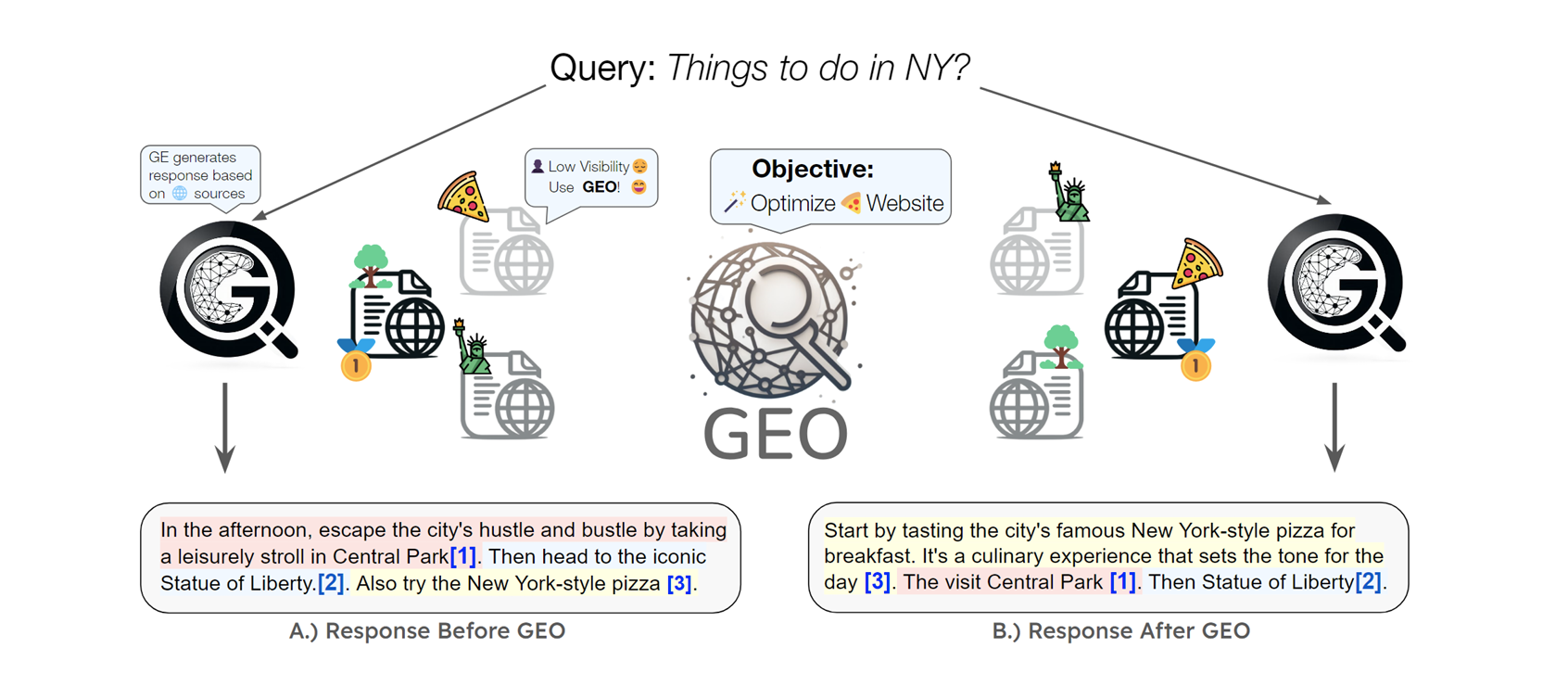
Traditional SEO optimizes for position in ranked lists. GEO optimizes for inclusion in synthesized answers. This distinction changes everything about how you measure success.
The old model: Google displays ten blue links; you optimize to occupy position one; users click; you track sessions and conversions through Google Analytics. This linear funnel has measurable touchpoints at every stage.
The new model: ChatGPT or Perplexity generates a comprehensive answer citing 2-7 sources; users read the synthesis directly; they may never visit your site; decisions form within the AI interface. According to Gartner, traditional search volume will decline 25% by 2026 as AI chatbots capture early-stage discovery .
This shift renders traditional KPIs insufficient. Rankings become irrelevant when there are no positions to hold. Click-through rates drop toward zero for queries answered entirely within AI interfaces. You need geo metrics designed for answer engines, not search engines.
What it measures: The percentage of AI responses that cite your brand or content as a source for target queries .
Why it matters: LLMs typically cite only 2-7 domains per response—far fewer than Google's ten results. If you're not cited, you don't exist in that conversation. Full stop.
How to calculate: Run systematic queries across your target prompt set. For each response, document whether your brand appears, in what position, and whether the citation includes a link. Divide citations by total queries to generate your rate.
Benchmark targets:
Common mistake: Tracking mentions without requiring citations. A brand name appearing in AI-generated text without source attribution builds awareness but drives no traffic and signals weak authority.
Dageno application: Dageno's Answer Engine Insights automates citation tracking across ChatGPT, Perplexity, Gemini, Claude, and other major platforms. The system distinguishes between passive mentions and active citations with URLs, providing the accuracy metric that correlates most strongly with authority building.
What it measures: Your brand's citation frequency relative to competitors for identical query sets .
Why it matters: GEO is inherently competitive. Being cited means another brand was excluded. Share of Voice reveals whether you're gaining or losing ground in the AI knowledge economy.
Calculation methodology: Track citations for your brand and top 3-5 competitors across your target prompt universe. Your Share of Voice equals your citations divided by total citations for all tracked brands.
Strategic insight: A 15% citation rate might seem adequate until you discover competitors hold 35%. GEO success requires not just absolute visibility but relative dominance within your category.
Dageno integration: Dageno's competitive intelligence module tracks Share of Voice across time, topics, and platforms. The system identifies which competitors gain visibility through stronger topical authority versus broader content coverage, enabling targeted counter-strategies rather than blind content production.
What it measures: Whether AI systems describe your brand positively, neutrally, or negatively when citing you as a source .
Why it matters: A citation accompanied by "expensive but reliable" drives different outcomes than one describing you as "the leading solution for enterprise teams." AI sentiment shapes user perception before they reach your site.
Key sentiment indicators:
Risk management: Negative sentiment in AI answers often reflects outdated training data or misinterpretation of review content. Proactive monitoring enables rapid response through content updates and reputation management.
Dageno capability: Dageno's sentiment monitoring tracks how AI systems characterize your brand across thousands of responses. The platform identifies negative context patterns—such as "pricing concerns" or "integration limitations"—enabling targeted content updates that shift AI characterizations toward accurate, favorable positioning.
What it measures: Where your brand appears within AI-generated lists and comparisons .
Why it matters: Position signals authority. Being listed first in "top project management tools" carries different weight than appearing fourth with "also consider" framing.
Position value hierarchy:
Optimization target: Move from footnote to primary list through authoritative content that answers user intent more comprehensively than competitors.
What it measures: Actual visits to your website originating from AI platforms .
Why it matters: While citation rates measure visibility, referral traffic measures engagement. Low traffic despite high citations suggests weak call-to-action or user satisfaction with AI-provided summaries.
Key insight: AI referral traffic typically shows higher conversion rates than traditional organic search—often 2-3x higher—because users arriving via AI citations have already received pre-qualifying information and demonstrate strong intent .
Attribution challenge: Many AI platforms don't pass referral headers, making traffic appear as "direct" in analytics. UTM parameters in cited URLs and specialized tracking tools are essential for accurate measurement.
Dageno tracking: Dageno's Botsight Analytics correlates citation data with traffic patterns, identifying which AI platforms drive qualified visitors and which generate visibility without engagement. This enables platform-specific optimization rather than uniform strategies across dissimilar engines.
What it measures: The percentage of your target query set where your brand appears in AI responses .
Why it matters: Limited prompt coverage indicates narrow topical authority. You may dominate "best CRM for startups" while remaining invisible to "how to choose CRM software"—missing users earlier in the decision journey.
Gap analysis: Compare your coverage against competitors to identify high-value prompts where you're absent. These represent the lowest-hanging fruit for GEO expansion.
Dageno research: Dageno's Prompt Volumes Explorer maps query frequency and competitive coverage across your category. The tool identifies high-volume, low-competition prompts where targeted content creation can rapidly improve visibility.
Before optimizing, document current performance across all six core metrics. Run 50-100 target prompts through ChatGPT, Perplexity, Gemini, and Claude. Record:
This baseline enables meaningful progress measurement. Without it, you'll mistake activity for impact.
Manual measurement becomes unsustainable beyond 100 prompts. Implement geo metrics tracking through specialized platforms that monitor:
Dageno implementation: Dageno's monitoring infrastructure provides automated daily tracking across all major AI platforms with historical trend analysis. The system alerts on significant visibility changes—positive or negative—enabling rapid response to algorithm updates or competitive moves.
Visibility without business impact is vanity. Establish correlations between:
This requires integrating GEO data with your CRM, marketing automation, and analytics platforms. The goal is demonstrating that geo metrics improvements drive revenue, not just awareness.
What it measures: Your website's perceived authority within AI knowledge graphs, independent of specific query performance .
Why it matters: High domain influence increases citation likelihood across all related queries, not just optimized ones. It represents the AI's "default" trust in your brand.
Influence factors:
What it measures: The contextual value of citations, not just frequency .
Calculation components:
Benchmark: Top-performing brands achieve quality scores of 75-95, while market average falls in the 35-54 range .
What it measures: Whether AI-generated information about your brand is factually correct .
Why it matters: AI hallucinations and outdated training data frequently produce inaccurate brand characterizations. A citation describing discontinued products or outdated pricing damages credibility despite the visibility.
Monitoring requirement: Regular manual review of AI responses for factual accuracy, with correction workflows through content updates and structured data clarification.
Lead with metrics that connect to revenue:
Provide granular data for execution teams:
Dageno reporting: Dageno's enterprise reporting provides both executive summaries and tactical deep-dives through customizable dashboards. The platform translates citation data into business impact estimates, enabling budget justification and resource allocation conversations with leadership.
Q: How do geo metrics differ from traditional SEO KPIs?
SEO metrics track rankings, organic traffic, and click-through rates. Geo metrics measure citation frequency, answer positioning, sentiment, and share of voice within AI-generated responses. While SEO focuses on driving traffic to your website, GEO focuses on ensuring your brand appears accurately and favorably where users increasingly form decisions—inside AI interfaces .
Q: What is the most important GEO metric to track?
Citation Rate serves as the primary indicator of GEO success. If AI systems don't cite you as a source, you don't exist in that answer. Secondary priority depends on your goals: Share of Voice for competitive positioning, Sentiment for reputation management, or AI Referral Traffic for direct response measurement .
Q: How frequently should I measure GEO performance?
Establish baseline metrics monthly for trend analysis. Active optimization campaigns require weekly tracking to identify what content changes move the needle. Real-time monitoring becomes essential during product launches, PR crises, or competitive threats when AI visibility shifts rapidly .
Q: Can I use Google Analytics to track GEO success?
Partially. Google Analytics captures AI referral traffic but misses the full picture. Many AI platforms don't pass referral headers, and Analytics cannot measure citations that don't result in clicks. Dedicated geo metrics platforms are necessary for comprehensive visibility tracking .
Q: How long before GEO optimization shows measurable results?
Expect 60-90 days before seeing meaningful citation rate improvements. AI engines need time to recrawl content, and measurement variability requires time to average out. Set quarterly targets rather than weekly expectations, though prompt-level gaps can close faster with targeted content creation .
GEO metrics transform generative search from an opaque black box into an optimizable channel. By tracking citation rates, share of voice, sentiment, and positioning, you gain the visibility necessary to compete in AI-mediated discovery.
Why this framework works: As AI search adoption accelerates—from 13 million users in 2023 to a projected 90 million by 2027—brands that master geo metrics gain first-mover advantage in the new knowledge economy . Those relying solely on traditional SEO metrics operate with blindspots that competitors will exploit.
Immediate action steps:
The brands winning in generative search aren't guessing—they're measuring systematically and optimizing based on data that traditional analytics cannot provide.
Richard is a technical SEO and AI specialist with a strong foundation in computer science and data analytics. Over the past 3 years, he has worked on GEO, AI-driven search strategies, and LLM applications, developing proprietary GEO methods that turn complex data and generative AI signals into actionable insights. His work has helped brands significantly improve digital visibility and performance across AI-powered search and discovery platforms.
Read full bio