Google AI Overviews Rank Tracking: Measure Visibility
Measure AI Overview trigger rate, brand mentions, citations, URL coverage, competitors, source volatility, and accuracy alongside Search Console and analytics.
Track AI search visibilityNo install

Updated by
AI-assisted for research support
5 Min Read
Updated on Sep 11, 2026
AI Overviews rank tracking measures whether Google shows an AI-generated result for a query and whether a brand or URL is mentioned or cited inside it. This is different from a conventional organic position: an AI Overview can appear, disappear, change sources or cite a page that does not hold the same traditional rank.
Metrics for Google AI Overviews
| Metric | Definition | Decision supported |
|---|---|---|
| Trigger rate | Queries showing an AI Overview | Size of the observable opportunity |
| Brand mention rate | AI Overviews naming the brand | Entity/category visibility |
| Citation rate | AI Overviews linking to the brand domain | Owned-source visibility |
| Citation share | Brand citations relative to tracked competitors | Competitive source presence |
| URL coverage | Which pages receive citations | Content prioritization |
| Source volatility | Sources gained or lost across runs | Stability and risk |
| Accuracy | Correctness of material brand claims | Reputation response |
Build a reliable keyword and prompt set
Start with existing Search Console queries, commercial keyword research, support questions and sales language. Include non-branded discovery, comparisons, problems and constraints. Tag by country, device, language, page and funnel stage.
Keep a stable core set. If query wording or location changes, treat it as a separate observation rather than merging it into the trend.
Capture the complete result
For every check, store date, market, device, query, whether an AI Overview appeared, answer text, brand mentions, citations, cited URLs and conventional organic position. Screenshots help auditing but should not be the only dataset.
Combine tools without merging metrics
Google Search Console
Use Search Console for Google impressions, clicks, queries and pages available in the property’s reporting. It does not provide a complete transcript and source log for every AI Overview observation.
Analytics
Use analytics for visits, engagement and conversions reaching the site. A zero-click brand mention may influence demand without a directly attributable visit.
AI Overview monitoring
Use a tracker for answer-level triggers, mentions, citations and competitors. Preserve the methodology because different vendors may sample queries and locations differently.
Track AI Overviews with Dageno
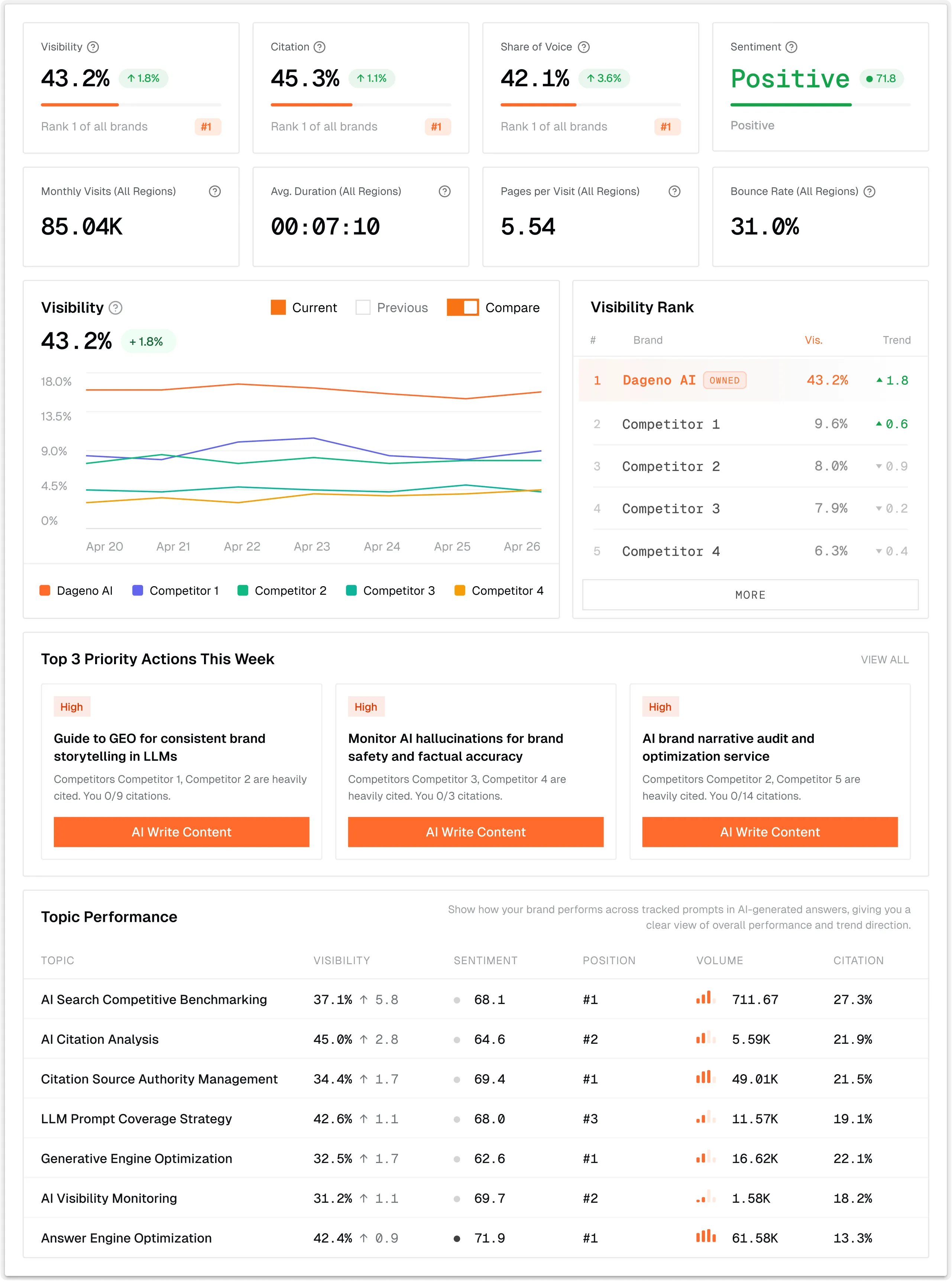
Dageno helps teams monitor prompt- and query-level brand visibility, competitor presence and citations across Google AI experiences and other answer engines according to selected coverage.
Turn data into action
- Find high-value queries where an AI Overview appears but the brand is absent.
- Identify cited competitors, pages and source types.
- Classify the gap as access, content, evidence, entity or authority.
- Improve the most appropriate existing page.
- Record the deployment date and remeasure the same cohort.
See the Google AI Mode tracking guide and top AI citation sources.
Ready to dominate AI search?
Get started - it's free! >How to improve AI Overview visibility
Make pages crawlable and canonical, answer the query clearly, provide original evidence, maintain consistent entity facts and earn relevant third-party authority. Use structured data only when it matches visible content. Do not create thin pages for every query or optimize solely for AI extraction.
Reporting template
Report trigger rate, mention and citation rates, winning and losing URLs, competitor citation share, top source domains, volatility, material inaccuracies and completed interventions. Keep organic rank and AI Overview inclusion as separate columns.
Common tracking mistakes
- Treating an AI citation as organic position one.
- Tracking only branded queries.
- Ignoring country, device and language.
- Using one screenshot as trend data.
- Comparing vendor scores with different sampling.
- Claiming causal impact without a control or deployment log.
Frequently asked questions
Can a page be cited without ranking first organically?
Yes. AI Overview source selection and conventional ranking are related but not identical observations.
Does AI Overview visibility guarantee clicks?
No. Measure citations and mentions separately from site visits and conversions.
About the Author

Updated by
Tim
Tim is the co-founder of Dageno and a serial AI SaaS entrepreneur, focused on data-driven growth systems. He has led multiple AI SaaS products from early concept to production, with hands-on experience across product strategy, data pipelines, and AI-powered search optimization. At Dageno, Tim works on building practical GEO and AI visibility solutions that help brands understand how generative models retrieve, rank, and cite information across modern search and discovery platforms.
Related Articles
GEO for Brand Storytelling in LLMs: Complete 2026 Guide | Dageno AI

Ye Faye • Sep 14, 2026
How to Track Your Visibility in AI Search: The Complete 2026 Guide
Tim • Sep 14, 2026
How to Monitor Large Language Model Brand Visibility
Tim • Jun 03, 2026
How to Monitor AI Crawler Access to Website Content

Dageno • Sep 14, 2026