AI Search Visibility: A Complete Guide to Mentions, Citations, and Recommendations
AI search visibility is more than a brand mention or a website citation. This guide explains how to distinguish mentions, explicit recommendations, citations, and factual accuracy; establish separate baselines across AI search interfaces; and use Dageno's market, intent, and source views to identify the next useful investigation. It also explains when to check product fit, correct information, or investigate a mismatch between Google rankings and AI mentions before changing content.
Track AI search visibilityNo install
Updated by
AI-assisted for research support
18 Min Read
Updated on Sep 14, 2026
1. TL;DR
- Brand AI search visibility involves four separate outcomes: being mentioned, recommended, cited, and accurately described. Your website appearing in a source list does not mean AI has recommended your product.
- SEO focuses on how pages perform in search results. AI search visibility also examines the answer text, recommendation reasons, and cited evidence. The two share some search foundations, but website rankings cannot substitute for brand recommendation performance.
- Platforms differ in how they retrieve information, use context, and display sources. Their published search mechanisms can guide an investigation, but they do not provide a complete formula for brand recommendations.
- Use Dageno to identify the markets, buying needs, and platforms where your brand performs less well. Then open the original answers and cited pages to understand the issue.
- Prioritize factual corrections, complete purchase conditions, and supporting evidence. After making changes, repeat the same questions and measure recommendations, accuracy, website visits, and sales separately.
What Is Brand AI Search Visibility?
Brand AI search visibility describes whether your brand appears when users ask relevant questions, and how AI presents it.
Suppose a buyer is choosing a watch. The brand name appearing in the answer is only one outcome. You also need to check whether AI presents the product as a suitable option, what conditions apply to the recommendation, and whether its features are described correctly.
Assess Four Outcomes Separately
| Outcome | How to identify it | What can be confused |
|---|---|---|
| Mention | The answer body names the brand or a product that clearly belongs to it | “We do not recommend this brand” still counts as a mention |
| Recommendation | The answer presents the product as suitable for the current need | Appearing in a comparison list is not automatically a recommendation; recommendations can be conditional |
| Citation | The answer lists a page or another source as supporting information | Sources can be brand-owned or third-party; identify ownership separately |
| Accuracy | Key statements agree with current, verifiable product facts | Positive wording does not establish that features, prices, or usage conditions are correct |
An AI answer such as “You can compare A, B, and C” mentions three brands. “If you need this feature, you could consider A, but you will need to buy an additional accessory” recommends brand A with a condition attached.
To assess citations, ask where AI's supporting information comes from. A third-party review may support a recommendation for A even when A's website does not appear in the source list. Conversely, AI may cite A's website to explain a technology while recommending other brands for the purchase.
Dageno calls it a ghost citation when an answer cites a brand-owned page but does not mention the brand in its body. Read the cited page and the answer together. Is the page about the brand's own product, or third-party content hosted on that domain? How does the cited fact relate to the buyer's choice?
These four outcomes can overlap. When reviewing an answer, record brand presence, recommendation reasons, sources, and fact-checking results separately.
How Is AI Search Visibility Different from Traditional SEO?
Search engine optimization (SEO) helps users find pages by searching for specific keywords. AI search visibility focuses on which products appear in responses to particular prompts, which products AI presents as candidates, and the reasons it gives.
| Comparison | Traditional SEO | AI search visibility |
|---|---|---|
| What you observe | Pages in search results | Brands, products, and statements in answers |
| Competitors | Websites appearing for related search terms | Candidate brands addressing the same buying need |
| Main evidence | Search results, page impressions, and clicks | Complete answers, recommendation reasons, and cited pages |
| What to check next | Whether the page meets the search need and users visit it | Whether the product is considered and accurately described |
The two share some foundations. Google says existing SEO principles still apply to AI Overviews and AI Mode. To appear as a supporting link, a page must be indexed and eligible to appear in Search with a snippet. Google: AI Features and Your Website
A page may rank well for “smartwatch battery life” without helping the brand enter a shortlist of watches suitable for long-distance hiking, within budget, and available locally. The two questions require different information.
When Google rankings and AI mentions do not align, first match the question intent, geography, language, and time period. Then check whether the page provides the information needed to make that choice.
What Do AI Search Platforms Look for When Citing Sources and Recommending Brands?
To serve as evidence for an answer, a page first needs to provide the information the user is seeking. FAQs, specification tables, comparison tables, and clear subheadings can organize that information, but formatting cannot replace facts. A page provides the material needed to support a recommendation when it explains who the product suits, which requirements it meets, and what evidence supports those claims.
Platforms differ in the content guidance and selection factors they disclose. The sections below distinguish those disclosures from writing recommendations based on them.
ChatGPT: Answer Buying Questions Directly and Completely
For content intended to inform ChatGPT answers, a useful structure is a specific question, a direct answer, the applicable conditions, and supporting evidence. FAQs work well for questions about compatibility, pricing, usage requirements, and product limitations.
For example, “Can this watch make calls without a phone nearby?” is a clear buying question. The answer should first state whether that is supported, then identify the relevant models, network requirements, and service-plan conditions. Compared with “offers convenient communication,” this provides facts that help establish product fit.
Three writing practices can help:
- Use subheadings that name the question. “Is it compatible with Android phones?” helps readers find an answer more readily than “Connect to more possibilities.”
- Identify the product in the answer. Include the brand or model in key passages so that an extracted answer does not simply say “it supports this feature.”
- Keep conclusions and limitations together. Do not say “supported” in the main text while placing essential conditions in a distant note.
This is a recommendation for clear question-and-answer writing. The available evidence is insufficient to establish FAQs or FAQPage structured data as independent ChatGPT ranking factors, or to promise that adding FAQs will increase citation rates.
Perplexity: Provide Specific, Relevant, Verifiable Information
Perplexity says its answer engine ranks sources by authority and relevance. For shopping, it also states that merchants providing detailed information about availability, reviews, pricing, and specifications are more likely to be recommended. Perplexity: Source and Product Recommendations
Product pages should therefore support direct comparison, rather than offering only a brand introduction:
- Specification tables should identify models, specifications, units, and applicable conditions.
- Pricing explanations should include required accessories, subscriptions, and other additional costs.
- Comparison pages should use consistent criteria and link to factual sources.
- Tests and reviews should identify what was assessed, how, and when, so readers can judge whether the findings apply to the current product.
When a user asks which product fits a budget and supports a particular feature, the model, full cost, and feature requirements are directly relevant to the answer. FAQs can supply this information, but unsupported marketing Q&As still lack the evidence needed for a recommendation.
Google AI Overviews: Offer Useful Answers and Evidence of Your Own
Google recommends distinctive, useful, reliable content rather than repeating general information already available elsewhere. Its guidance highlights genuine firsthand testing, specific experience, original material, and clear explanations. Google: Content Guidance for Generative AI Search
On a page, this can mean:
- Identifying applicable models and conditions when answering feature questions.
- Explaining the method, environment, and limitations when citing test results.
- Stating the relevant region and effective date when describing prices or policies.
- Explaining key findings in text when using images or videos as evidence.
For example, when discussing battery life, the method and usage conditions behind a genuine test help readers make a judgment more than repeated claims of “long battery life.”
FAQs are not a required format for appearing in AI Overviews. Google says no special AI files or special structured data are needed. Choose a format that serves the content rather than trying to satisfy a nonexistent “AI page template.” Google: AI Feature Requirements
Google AI Mode: Organize Content Around the Complete Buying Decision
Google AI Mode may use query fan-out to run several related searches around a question. A buying question can therefore involve price, features, compatibility, and purchase channels, rather than a single keyword. Google: How Related Searches Expand an Answer
For these questions, a page can follow the buyer's decision process:
- Explain which needs the product suits.
- Compare key features and usage limitations.
- Set out total costs, regional availability, and purchase conditions.
- Use FAQs to answer remaining questions.
Comparison tables suit differences between products evaluated under the same conditions. Subheadings can separate costs, compatibility, and deployment requirements. Each section should identify its subject clearly so that someone reading an isolated passage can still tell which product it describes.
You do not need a separate page for every rephrasing of a question. Google also cautions against producing content at scale to cover imagined query variations. Google: Guidance on Content for Query Variations
Gemini: Describe Features Alongside Their Usage Conditions
Google says Gemini combines the user's question, interaction context, and retrieved information to generate an answer. A page that lists feature names alone may not answer a buying question with specific conditions. Google: How Gemini Works
Based on this, product pages can explain features together with their use cases:
- Who needs the feature.
- Which devices, regions, or environments support it.
- What must be in place before using it.
- When it is not suitable.
For example, “supports team collaboration” can be expanded to explain member permissions, sharing scope, applicable plans, and user limits. That gives the page information to answer questions such as “Does this suit a team working across regions?” or “Does it support these permission requirements?”
FAQs, use-case explanations, and compatibility tables can all organize this content. The purpose is to explain the conditions, rather than assume that Gemini prefers a particular page format.
Microsoft Copilot: Make Key Passages Understandable on Their Own
Microsoft's content guidance recommends clear headings, direct Q&As, lists, and comparison tables. It explains that assistants such as Copilot parse passages from pages, assess their relevance and authority, and combine multiple sources into an answer. Microsoft: Writing Content for AI Search Answers
The most direct writing implication is to make each important passage self-contained:
- Lead a Q&A with the answer. Follow it with conditions and evidence, rather than burying the answer in a long introduction.
- Keep comparison-table headings complete. Products, models, units, and cost periods should be clearly identified.
- State prerequisites in instructions. Readers should still know when the steps apply if they encounter them separately from the rest of the page.
- Provide important facts in text. Do not leave them only in images, where interpretation can be less clear.
For example, an answer about subscription costs should identify the product, applicable plan, billing period, and additional fees together. This reduces the chance that an extracted sentence presents a monthly fee as the total cost.
Grok, Mistral Vibe, and Dola: Keep Public Information Accurate, Clear, and Consistent
Grok can search the web and public discussions on X. For announcements, version updates, and product explanations, state the date, model, changes, and original evidence. Keep social posts consistent with website information. This helps distinguish old and new versions, and user experiences from official facts. Grok: Official Documentation
Mistral Vibe supports research across webpages, documents, and connected tools. For these research tasks, product documentation should identify titles, versions, applicable scope, and terminology clearly, so that the same fact can be compared across materials. Mistral Vibe: Product Information
For Dola, there is currently insufficient direct evidence to support a platform-specific page format. Clear Q&As, specifications, and source explanations remain useful ways to organize information, but a particular tag or layout should not be presented as earning extra credit from the platform.
Alexa for Shopping: Match Product Information to Specific Buying Needs
Amazon says Alexa for Shopping combines product knowledge, web information, user preferences, shopping history, and conversations to provide buying recommendations. Amazon: Alexa for Shopping
For these buying questions, product pages should clearly explain:
- Exact models, specifications, and differences between versions.
- Current prices, included items, and required accessories.
- Where the product can be purchased and its usage conditions.
- Suitable use cases and needs it does not meet.
- Documentation, tests, or reviews supporting product claims.
If you want a product considered for “devices suitable for travel,” provide information that supports that judgment, such as weight, dimensions, and usage conditions, rather than simply calling it a “travel essential.”
Product FAQs can address questions buyers might otherwise miss: whether accessories must be purchased separately, whether the product works with existing equipment, or whether a feature costs extra. Their role is to complete the selection information. The product must still meet the user's budget and usage requirements.
How Do You Measure AI Search Visibility?
Dageno organizes brands, competitors, buying intents, and citation information by market. When starting, choose a target market, review the brand's position, and identify weaknesses relevant to the business. Then use representative questions and answer evidence to examine those findings.
Step 1: Review Overall Visibility, Rank, and Competing Brands
Open Brand overview and read Visibility, Visibility rank, and the brand leaderboard together.
Visibility reflects the proportion of answers in the current sample that mention the brand. Rank reflects its position within the comparison set. A highly ranked brand may still be absent from an important buying task. If its mention rate is reasonably strong but its rank is not, check which brands appear more often within the same scope.
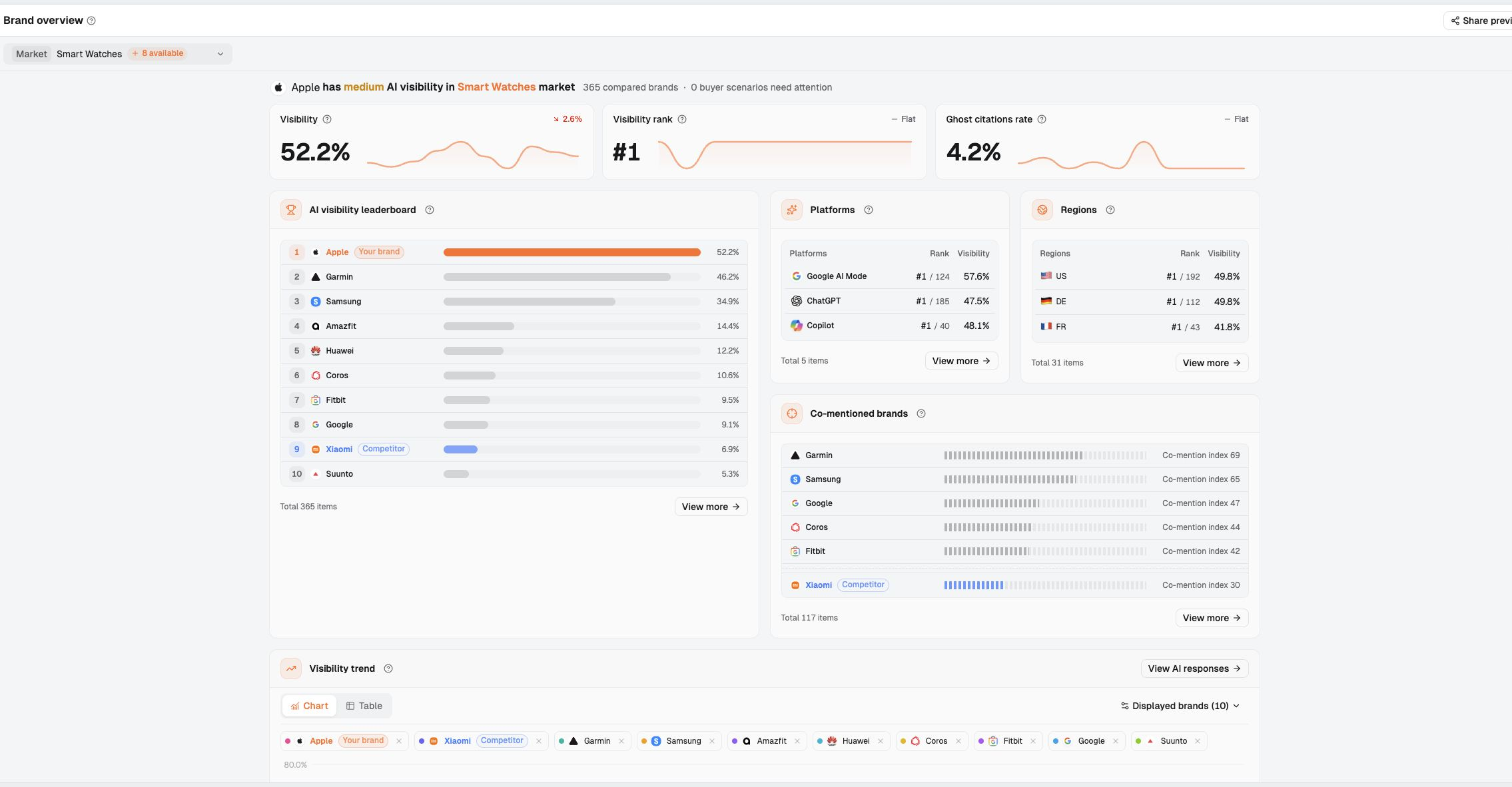
Confirm the Market, then read Visibility and Rank. Use the leaderboard and co-mentioned brands to choose which brands to compare further.
Co-mentioned brands can reveal options outside your manually configured competitor list. They may be alternatives, complementary products, or background comparisons; read the answers to establish their role. If rank changes while visibility barely moves, open Market overview → Trends and check whether competitor performance or the comparison set has changed.
Next, select a commercially relevant buying need and open Search intents.
Step 2: Identify Specific Weaknesses by Buying Intent
Open Demand & insights → Search intents and review categories such as Recommendations. Then compare the brand's position within sub-intents such as Choose by budget or tier and Choose for your needs.
If overall performance is strong but the brand appears less often in an important sub-intent, click View AI responses in that row. Distinguish whether the brand is absent, mentioned without a recommendation, or explicitly excluded because of a requirement.
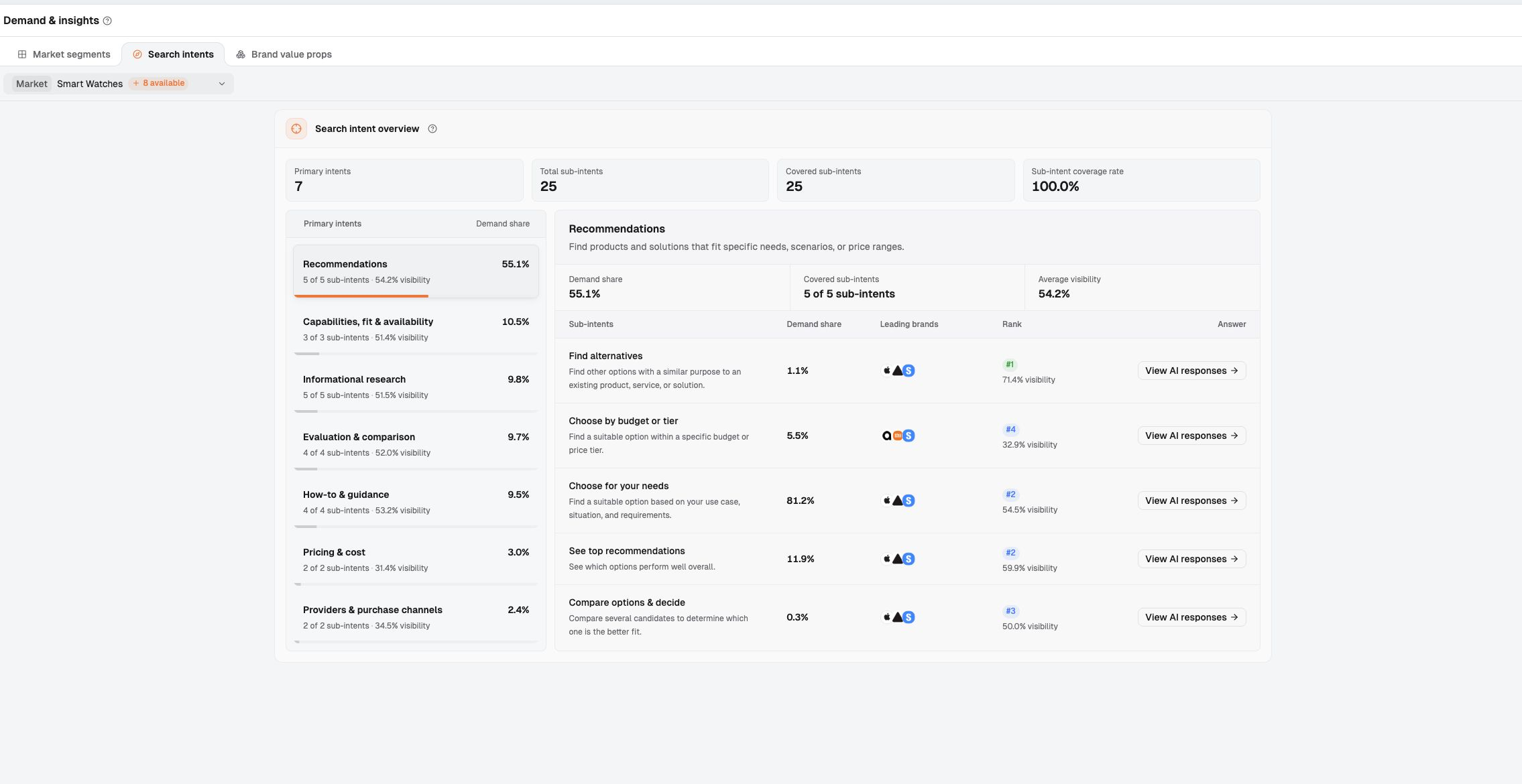
Choose a buying intent on the left, then review the leading brands, rank, and answer links for its sub-intents on the right.
Covering an intent means the brand appears within that scope, not that it is recommended every time. Demand share describes the mix of intents within the current analysis; it is not actual search volume. Use customer interviews and questions from sales and support to judge whether the need warrants investment.
If buyers want a feature or price range the product does not offer, absence may be appropriate. If the product does meet the requirements, examine the recommendation reasons and evidence further.
Step 3: Narrow the Investigation by Platform and Region
Open Market overview → Platforms & regions and compare visibility, rank, and the leading brands for the same brand.
If performance is weak on one platform, start with that platform's answers and sources. If it is weak in one region, focus on local models, language, availability, and service conditions. Brand values in the cross-platform matrix can open the associated answers.
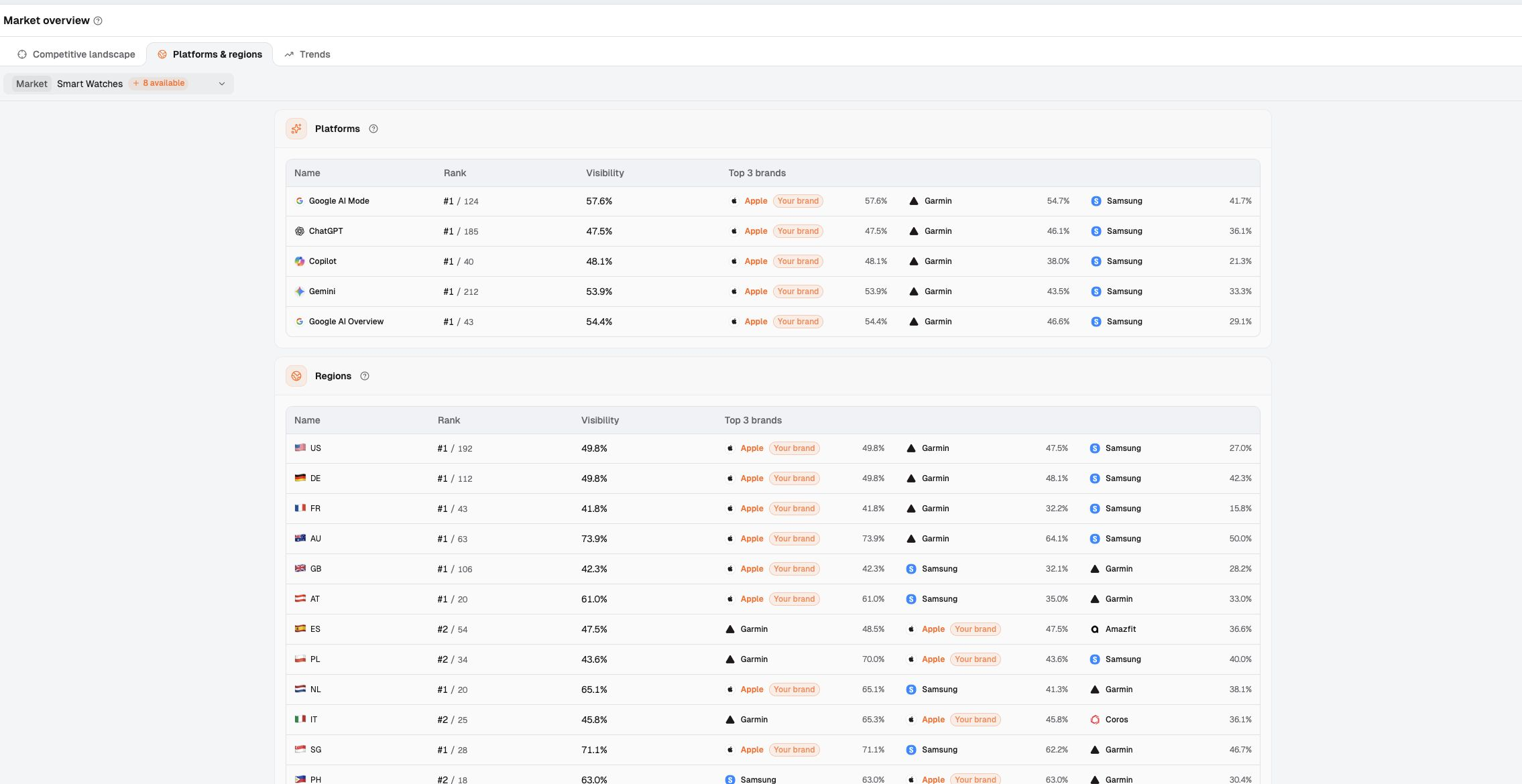
Compare platforms and regions separately. The number of compared brands after the slash in Rank is not the answer sample size.
Before comparing, confirm that question types, sample sizes, and time periods are comparable. If one side mainly tests general knowledge and the other mainly tests buying questions, the difference does not directly show that a platform favors the brand. Dashes and missing data should not automatically be recorded as zero mentions.
Step 4: Measure Mentions, Recommendations, Citations, and Accuracy Separately
Dageno's visibility, citation, and ghost-citation views provide starting points for examining brand performance. To establish whether an answer explicitly recommends the product or gets its facts right, you still need to review the answer. A visibility score cannot substitute for a recommendation rate or accuracy rate.
Teams can use the following definitions to build an answer-audit table.
| Metric | Calculation or recording method | How to interpret it |
|---|---|---|
| Brand mention rate | Answers mentioning the brand ÷ valid, complete answers within the selected scope | A high rate means frequent appearances; check tone and role as well |
| Explicit recommendation rate | Answers explicitly recommending the brand ÷ valid answers to the preselected recommendation-seeking questions | When mentions are frequent but recommendations are not, examine fit requirements and the reasons competitors are selected |
| Owned-source citation coverage | Answers citing agreed owned sources ÷ answers with citation records that can be assessed | Few website citations can coexist with brand recommendations supported by third parties |
| Ghost-citation rate | Answers citing owned sources without mentioning the brand in the body ÷ answers citing owned sources | Check whether the cited fact should be associated with the brand in this answer |
| Descriptive accuracy | Mark key claims as correct, incorrect, or unverified, with supporting evidence | An answer with no verifiable brand description should not be recorded as “accurately described” |
To check accuracy, start with product documentation, help articles, and pricing terms for the current model and market. Compare the answer's statements one by one. When sources conflict, check their versions, update dates, and applicable conditions.
Step 5: Open the Answer and Cited Pages to Locate the Issue
Open the original answer for the selected buying intent or platform and read it in full. Then use Related citation analysis to inspect relevant domains and pages. You can also start from the source leaderboard, competitor citations, or top cited pages in Citation analysis.
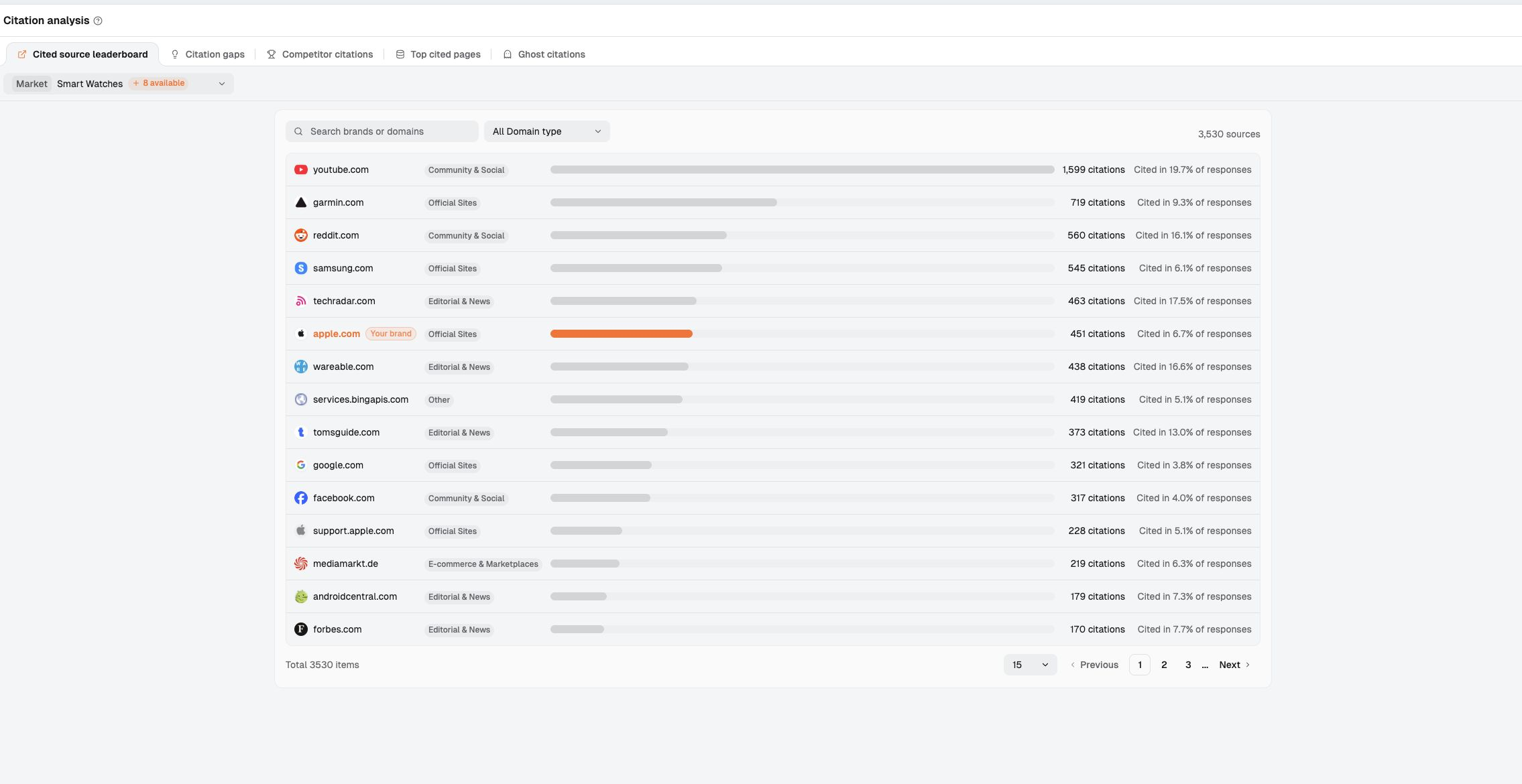
Citation counts and the proportion of answers citing a source are different measures. Choose a source relevant to the current question, then read the specific page.
For a priority answer, check four things:
- What features, budget, region, or usage conditions did the buyer specify?
- Which brands did AI recommend, and what reasons did it give?
- Does the cited page support those reasons, and which model or version does it describe?
- Does your product meet the same requirements, and does the existing page explain that accurately?
If the website receives a citation but the brand is absent from the answer body, open Citation analysis → Ghost citations. Select the relevant URL and compare the answer text with the source list. A third-party product page hosted on a platform's domain does not necessarily justify a recommendation for the platform brand.
If a third party already includes the brand but describes an older model, check the version. If the website explains the features fully, check whether local purchase conditions are missing. Let the findings determine the page task.
Build a Minimum Baseline with Buying Questions and an Observation Record
An initial baseline is a saved set of answers to buying questions, together with their collection conditions, that provides a starting point for later comparisons.
After reviewing the market and its intents, choose questions representing real needs. Start with question types like these, filling in actual products, markets, and requirements:
- In [market], which [product types] suit [use case]?
- Which options support [required feature] and work with [existing device or system]?
- Which options have a total cost no higher than [budget] over [cost period]?
- For [the same need], how do [brand A] and [brand B] differ?
The first three do not supply a brand name and suit discovery and recommendation research. The last is a branded comparison and should be counted separately. Record which customer needs informed the questions. Test volume cannot substitute for search demand.
Keep the following information for each observation:
| Record field | Entry |
|---|---|
| Market and buying task | ______ |
| Complete question | ______ |
| Platform and visible mode or model | ______ |
| Region, language, date, and time | ______ |
| New conversation or existing history, and any supplied material | ______ |
| Mention, recommendation wording, cited sources, and fact-checking results | ______ |
| Complete answer and source URLs | ______ |
| Next question to investigate | ______ |
How Can You Increase How Often AI Recommends Your Product?
Start with how different AI platforms make recommendations, and use Dageno's capabilities to keep improving your brand's presence.
Let the Observed Issue Determine What to Change
Dageno's Issues & opportunities brings together observed gaps, comparisons, and related evidence to help teams prioritize needs. After selecting a relevant diagnosis, use the original answers and sources to establish whether the task concerns product information, selection criteria, or facts in external sources.
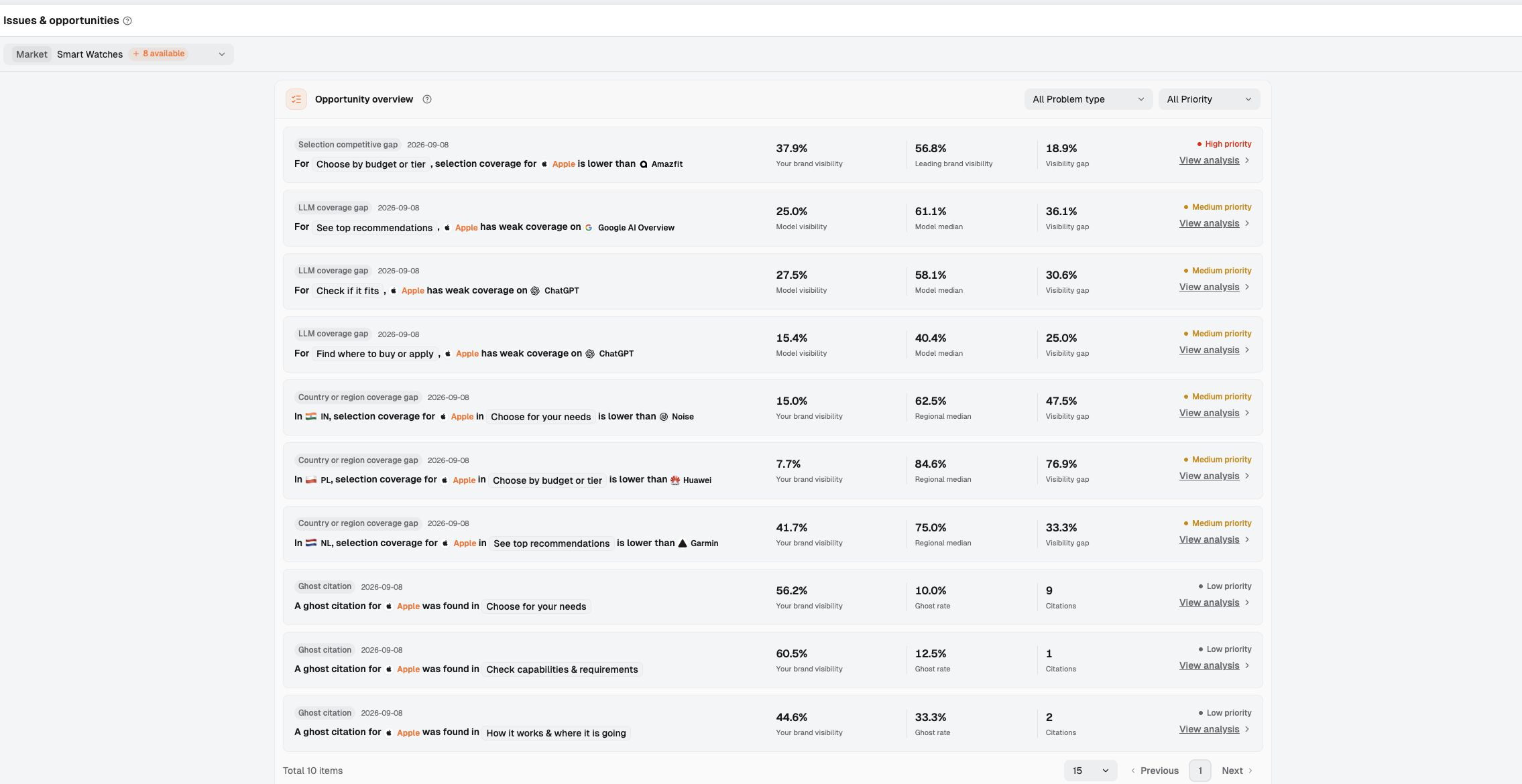
Start with the buying task, compared brands, and priority for each issue, then click View analysis to open the related diagnosis.
| Observed issue | Confirm before acting | Task to assign once supported by evidence |
|---|---|---|
| Frequent mentions but fewer recommendations for relevant buying tasks | Whether the product fits and why competitors were selected | Update the relevant product, use-case, or comparison page with selection information and limitations |
| Website cited but brand absent from the answer body | Whether the citation concerns the brand's own product and whether the brand fits the question | If a connection is genuinely missing, explain which product the cited fact describes and which need it serves |
| Weaker performance in a particular region | Whether local models, availability, costs, and service differ | Correct the relevant regional page, rather than only translating global copy |
| AI gets a key fact wrong | Whether website or third-party information is outdated or contradictory | Correct the authoritative page; provide factual corrections and evidence to relevant external sources where necessary |
| No complete answer or citation record | Whether collection failed, search was not triggered, or content access was a problem | Complete the observations or check access before producing content at scale from missing data |
If page access is blocked, address access first. If the page is already cited, investigate the evidence it supplies. When third-party content already exists, read its version, method, and selection criteria before deciding whether information needs updating or adding.
Turn “Choose by Budget” into a Specific Page Task
Suppose a brand performs well overall in the watch market, but is often mentioned and rarely recommended in budget-based buying questions. Here is how to investigate.
Open the AI answers for the relevant sub-intent. Check whether the budget covers the device price alone or the total cost including a required service plan. If the answer compares ongoing costs, record the period it uses.
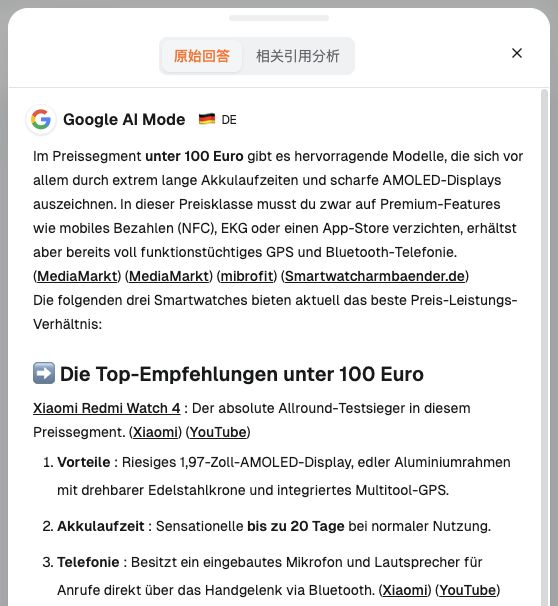
Open the original answer for a budget scenario. First check the price range and region set by the question, then read why each product was selected and which sources are cited.
Compare the product and sources. Review the recommendation reasons, cited pages, current models, local prices, and required fees. A device priced below the budget does not necessarily fit the budget once its service plan is included.
Choose an action based on the findings. If the total cost exceeds the requirement, the absence may reflect poor product fit. If the product fits the budget but the page shows only the device price, the content team has a specific task: add a “Purchase and Usage Costs” section to the existing regional product page.
That section needs to explain:
- What the one-time purchase price includes.
- Which recurring fees are required and which are optional.
- The period used to calculate total cost.
- The models, regions, and service conditions covered.
- The sources for current fees and when the information was updated.
First check whether the existing page can accommodate this information. Consider a new comparison or buying-guide page only when it needs to serve a distinct buying task that the current page cannot explain clearly.
The task can be written directly: “Update [regional product page URL] with device and required service costs over [cost period], the applicable models and conditions, and links to current evidence.” This is easier to execute and review than “write an article about budget options.”
Recheck the Same Issue After Making Changes
Save the change date, page URL, and original buying question. Repeat the observation on the same platform, in the same language and region, and with comparable context. Check whether the answer describes costs correctly, attributes facts to the right product, and gives a recommendation with appropriate conditions.
Dageno's URL tracking can provide a reference for subsequent page citations and brand performance. More page citations should still be assessed separately from recommendations and accuracy. A higher overview score also does not establish that the selected issue has been resolved.
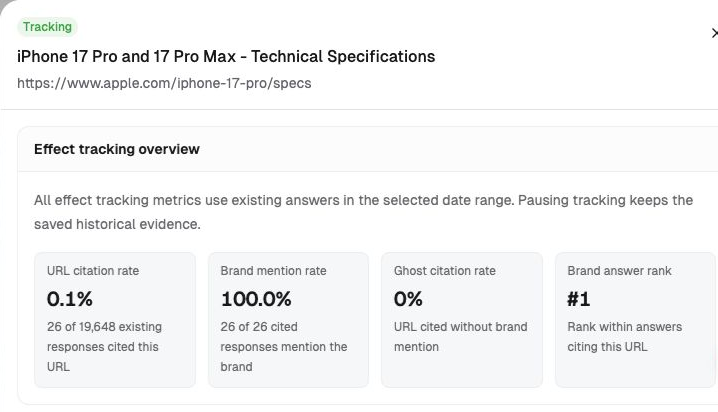
This is the tracking overview for an iPhone technical specifications page. Read the citation rate, brand mention rate, and ghost-citation rate separately.
If the product fits and its information is complete, but recommendations remain absent, investigate competitors' selection reasons and sources further. That is the point to move into a deeper diagnosis of why AI does not recommend your product.
Conclusion: Use the Baseline to Choose Your Next Investigation
Your first review should leave you with three things: a set of real buying questions, a reviewable answer record, and one clearly scoped issue to investigate.
Choose the next investigation based on what you find:
- The product fits but is not recommended: Investigate “Why AI Doesn't Recommend Your Product,” comparing competitor reasons, page explanations, and external evidence.
- Google rankings and AI mentions do not align: Investigate “Why SEO Performance and AI Brand Visibility Differ,” first matching questions, regions, time periods, and the distinction between pages and brands as observation units.
Verify and correct important factual errors first. Complete missing observations before interpreting them. Neither situation requires an immediate expansion of content production.
Start with Dageno's public market search to explore brands and competitors. Public queries and the first brand-overview layer are free. Deeper evidence and ongoing monitoring are available within the relevant product access scope. See what the free overview includes
Frequently Asked Questions
Does a Website Citation Mean the Brand Has Been Recommended?
No. A citation means the answer lists that source; a recommendation means the product is presented as suitable for the current need. Read the exact wording, then check which fact the citation supports. A brand can also be recommended based on third-party reviews without its own website being cited.
What Is a Good Brand Visibility Score?
Compare your brand with relevant competitors in the same market, buying intent, platform, and time period rather than applying a universal threshold. Even a high overview rank should be followed by checks of recommendations and accuracy in important buying tasks. Keep sample counts and confirm that the figures come from comparable question sets.
Which Buying Questions Should I Start With?
Choose needs your product can genuinely serve, covering use cases, required features, budgets, and local purchase conditions. Start with questions from sales, support, and customer interviews. Record unbranded discovery questions separately from branded comparisons, then add important needs that are missing.
Why Should AI Platforms Be Examined Separately?
Platforms may use different information, search mechanisms, and conversation context. The same brand can also perform differently across question sets. Saving each interface's results separately helps locate the differences. Align observation conditions before combining the results.
What Does Dageno Show Directly, and What Needs Further Review?
Dageno provides brand and market overviews, buying intents, platform and regional comparisons, and access to cited sources, pages, and related answers. These help locate issues, but explicit recommendations require a review of the wording, and accuracy requires comparison with current product facts. Visibility cannot substitute for either assessment.
When Should I Change a Page, and When Should I Collect More Evidence?
When you have identified a specific missing fact, incorrect condition, or outdated explanation, you can assign the corresponding page task. If the full question, answer, or source record is missing, complete the evidence first. If the product does not meet the buyer's requirements, decide whether the need belongs in your target market before trying to win recommendations through content.
References
Google Search Central: AI Features and Your Website
Perplexity: Source and Product Recommendation Factors
Google Search Central: Generative AI Search Optimization Guide
Microsoft: Writing Content for AI Search Answers
About the Author

Updated by
Dageno
Dageno is the research and insights team at Dageno AI, publishing industry reports and expert analysis on AI Search Visibility, Generative Engine Optimization (GEO), and AI-powered search discovery.
Related Articles
Gemini AI Brand Mention Tracking: Complete Guide

Ye Faye • Sep 14, 2026
How to Check If Your Web Page Is Indexed on Google (4 Methods + AI Visibility)

Tim • Mar 18, 2026
Guide to Managing Brand Entity Data for AI Models
Tim • Sep 14, 2026
Your Brand Ranks on Google but AI Rarely Mentions It: Pages or Proof?
Dageno • Sep 16, 2026