8 Best AI Visibility Optimization Tools in 2026 (Pros & Cons)
Compare AI visibility tools by strengths and limits.
Track AI search visibilityNo install

Updated by
AI-assisted for research support
17 Min Read
Updated on Sep 11, 2026
Short answer: the best AI visibility optimization tools do more than report whether a brand appeared in an AI answer. They reveal the prompt, competing brands, cited sources, content gap, and next action, then let a team measure whether the change improved visibility over time.
For most SEO and content teams, the strongest shortlist is Dageno AI, Profound, Scrunch AI, AthenaHQ, Semrush, Ahrefs Brand Radar, Peec AI, and OtterlyAI. Dageno AI is the best fit here for connecting visibility gaps to prioritized content work; Profound is stronger for enterprise intelligence; Scrunch AI stands out for AI-agent accessibility; and OtterlyAI is easier for a small team to pilot.
Reviewed: September 2, 2026. Capabilities, model coverage, and prices change quickly. Verify the current plan on each vendor's official site before making a purchase.
Best AI Visibility Optimization Tools: Pros and Cons
| Rank | Tool | Best for | Optimization strength | Main limitation |
|---|---|---|---|---|
| 1 | Dageno AI | SEO teams turning visibility gaps into content priorities | Connects prompt, citation, and competitor findings to execution | Does not replace a full technical SEO suite |
| 2 | Profound | Enterprise AI search intelligence | Broad prompt and answer analysis for large programs | Can be too complex or costly for smaller teams |
| 3 | Scrunch AI | AI visibility plus agent accessibility | Combines answer monitoring with technical readiness | Best value requires cross-functional adoption |
| 4 | AthenaHQ | Cross-functional GEO workflows | Brings analysis and optimization into one workspace | Broad workflows need clear internal ownership |
| 5 | Semrush | Existing Semrush customers | Connects AI visibility with wider SEO and content data | A dedicated GEO team may want deeper prompt workflows |
| 6 | Ahrefs Brand Radar | Researching brands, competitors, and cited sources | Strong discovery context within an established SEO dataset | Less prescriptive about the next content action |
| 7 | Peec AI | Focused AI search analytics | Clear source and competitor reporting | Content execution still happens elsewhere |
| 8 | OtterlyAI | Small teams and pilots | Accessible prompt, mention, and citation monitoring | May be light for enterprise governance and attribution |
This is a forced ranking for a typical SEO team that wants to improve visibility, not a universal product score. An enterprise may reasonably put Profound or Scrunch first. A small consultancy may get more value from OtterlyAI. The correct choice depends on the action the data must support.
What “AI Visibility Optimization” Actually Means
No software can directly set a brand's position in ChatGPT, Google AI Overviews, AI Mode, Gemini, Perplexity, or another generated answer. A credible tool should not promise guaranteed inclusion.
An AI visibility optimization platform helps a team complete a measurable cycle:
- Observe generated answers for a controlled set of prompts.
- Identify missing mentions, weak positioning, citation gaps, or inaccurate descriptions.
- Compare the pages and third-party sources used for competing brands.
- Prioritize a content, technical, digital PR, or entity-consistency action.
- Repeat the same observations and assess whether the gap persists.
The optimization is the work performed after diagnosis. The tool provides evidence, workflow, and measurement. This distinction separates a genuine optimization platform from a dashboard that only charts mention counts.
Essential Features in an AI Visibility Optimization Tool
1. Raw Answer and Citation Evidence
A visibility score must be traceable to the exact prompt, generated answer, cited URL, engine, market, and observation date. Without raw evidence, an SEO manager cannot explain why a metric moved or verify a recommended action.
2. Prompt Strategy and Clustering
The platform should support more than a list of keywords. Useful prompt libraries include category discovery, best-product comparisons, alternatives, problems, use cases, and brand-specific questions. Tags and clusters should let teams separate commercial prompts from informational prompts and evaluate them independently.
3. Historical Performance Tracking
Generated answers vary. A tool must show repeated observations over time so teams can distinguish one changed response from a durable trend. Look for prompt-level history, model and country filters, exportable dates, and comparable observation methodology.
4. Competitor and Source Analysis
Knowing that your brand is absent is only the start. The useful questions are which competitors appear, which attributes are associated with them, which domains are cited, and whether a source pattern repeats across the topic.
5. Content Recommendations with Evidence
Recommendations should point back to observed gaps. “Add more keywords” is not enough. A useful recommendation may identify a missing comparison, unsupported claim, unclear product definition, absent first-hand evidence, weak page structure, or third-party source opportunity.
6. AI Crawler and Technical Readiness
Technical checks can reveal whether important information is crawlable, indexable, available in text, internally linked, and consistent with structured data. These checks should follow documented search fundamentals rather than inventing unsupported requirements such as a mandatory special AI schema.
7. Workflow and Content Operations
Optimization data creates value only when it reaches the people who can act. Prioritized tasks, owners, briefs, exports, integrations, and before-and-after reporting matter more than another decorative score.
8. Transparent Methodology
Ask how prompts are selected, how often they run, which models and interfaces are used, how locations are represented, and how share of voice is calculated. Scores from two vendors are not directly interchangeable when their samples differ.
How We Evaluated These Tools
We assessed each product against five stages of an optimization workflow: measurement, diagnosis, recommendation, execution, and validation. We also considered operational fit, including exports, team use, geographic controls, and how much of the broader SEO stack remains necessary.
Public product information was reviewed on the date shown above. We did not treat a vendor's visibility score as an objective industry benchmark, and we do not claim that any tool can guarantee a citation or ranking in a generated answer.
Editorial disclosure: Dageno publishes this article and Dageno AI is included in the comparison. That is a material relationship. To make the recommendation auditable, the article links to official product pages, describes limitations, and identifies cases where another vendor is the better choice.
Detailed Tool Reviews
1. Dageno AI: Best for Prioritized Content Action
Dageno AI is the strongest fit in this ranking for SEO teams that want to move from a visibility gap to a content plan. Its value proposition is the connection between prompt monitoring, citations, competitors, and the work required to improve a page or create a missing asset.
Best for: SEO managers, SaaS content teams, and agencies that need a repeatable loop from analysis to execution.
Pros:
- Focuses on visibility gaps and what to do next.
- Connects competitor and citation observations to content priorities.
- Reduces the handoff between an analytics dashboard and a separate content process.
Cons:
- A separate crawler, backlink index, and traditional rank tracker may still be required.
- Buyers should verify current engine, geography, and prompt-run limits.
Verdict: choose Dageno AI when the team's bottleneck is prioritizing and executing the next improvement, not collecting more visibility charts.
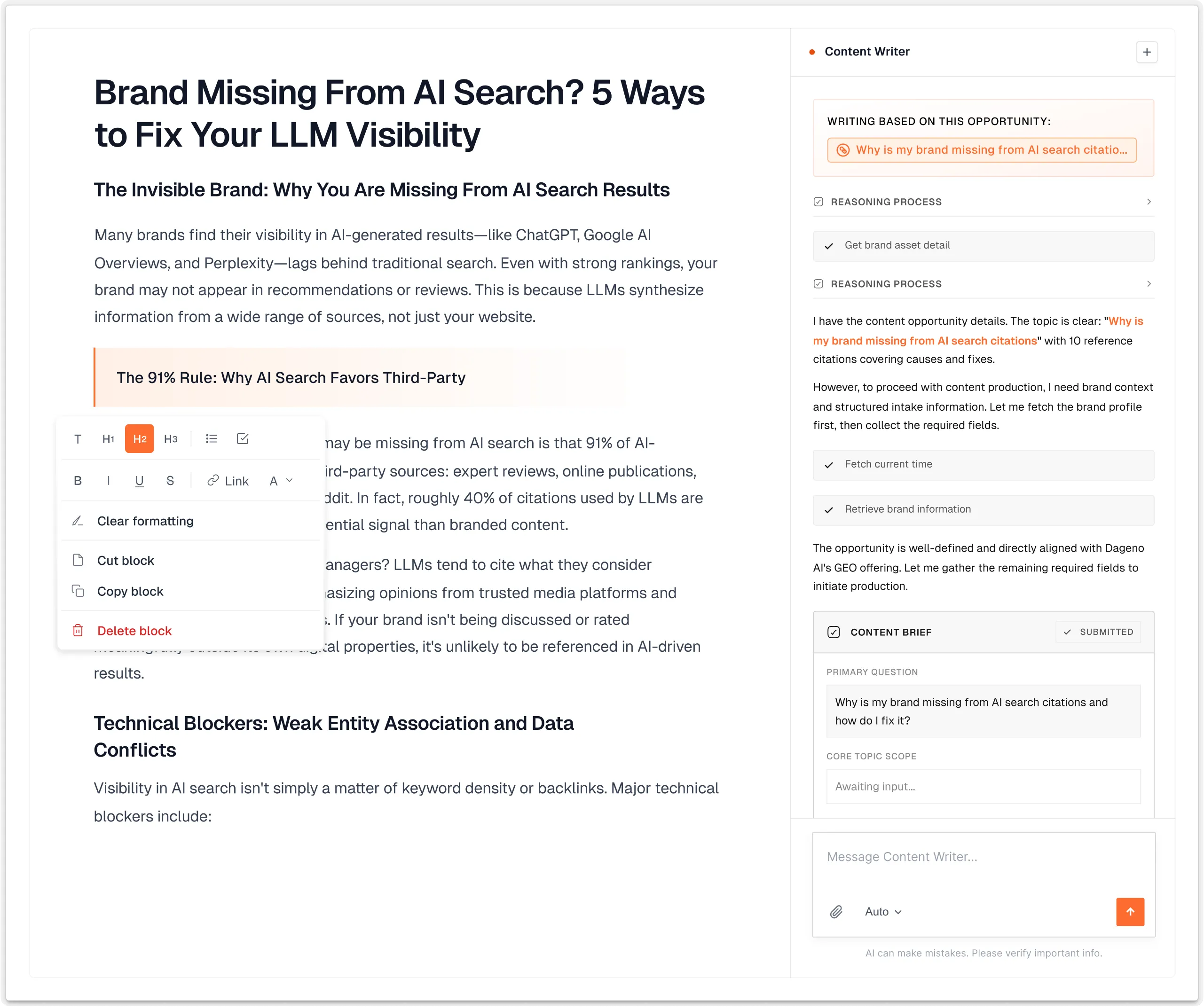
Dageno AI connects diagnosed visibility opportunities with structured briefs and content execution.
Ready to dominate AI search?
Get started - it's free! >2. Profound: Best for Enterprise AI Search Intelligence
Profound is designed for organizations treating AI search as a major intelligence channel. It is well suited to large prompt sets, category analysis, source research, and reporting across several business functions.
Best for: enterprises with dedicated analytics, SEO, content, and brand stakeholders.
Pros:
- Broad enterprise-oriented answer and prompt intelligence.
- Strong competitive and source-analysis use cases.
- Appropriate for teams that need structured reporting at scale.
Cons:
- Can require more budget, onboarding, and internal process than a small team can justify.
- Insights still need clear content owners and publishing capacity.
Verdict: choose Profound when enterprise research breadth and governance matter more than a lightweight content workflow.
3. Scrunch AI: Best for AI Crawlability and Citation Readiness
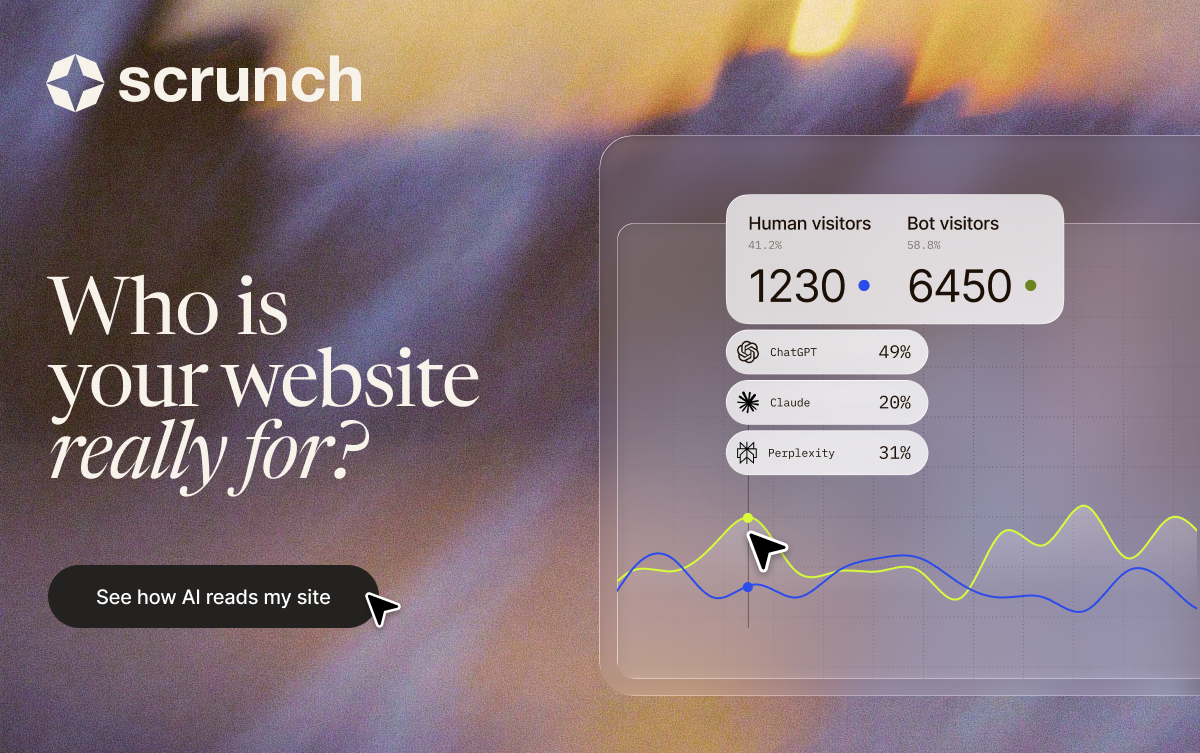
Scrunch AI combines visibility analysis with the way AI agents access and interpret a brand's digital presence. That makes it especially relevant when the team suspects a technical or accessibility issue is contributing to weak representation.
Best for: enterprise SEO and web teams coordinating answer visibility, technical readiness, and brand accuracy.
Pros:
- Connects answer monitoring with AI-agent accessibility.
- Useful when content and technical teams share ownership.
- Supports a broader diagnosis than mention tracking alone.
Cons:
- Broader scope can make adoption more involved.
- Small teams may not need every enterprise workflow.
Verdict: choose Scrunch when improving access, interpretation, and citation readiness is a central requirement.
4. AthenaHQ: Best Cross-Functional GEO Workspace
AthenaHQ combines AI search analysis with optimization workflows intended for SEO, content, PR, and brand teams. It is a strong candidate when the organization wants one GEO program rather than isolated reports owned by different departments.
Best for: teams coordinating content, communications, and search visibility.
Pros:
- Broad workspace for research and optimization.
- Useful competitor and source context.
- Supports collaborative GEO operations.
Cons:
- A broad platform still needs one accountable program owner.
- Teams should test whether recommendations map cleanly to their publishing workflow.
Verdict: choose AthenaHQ when GEO work spans more than the SEO department.
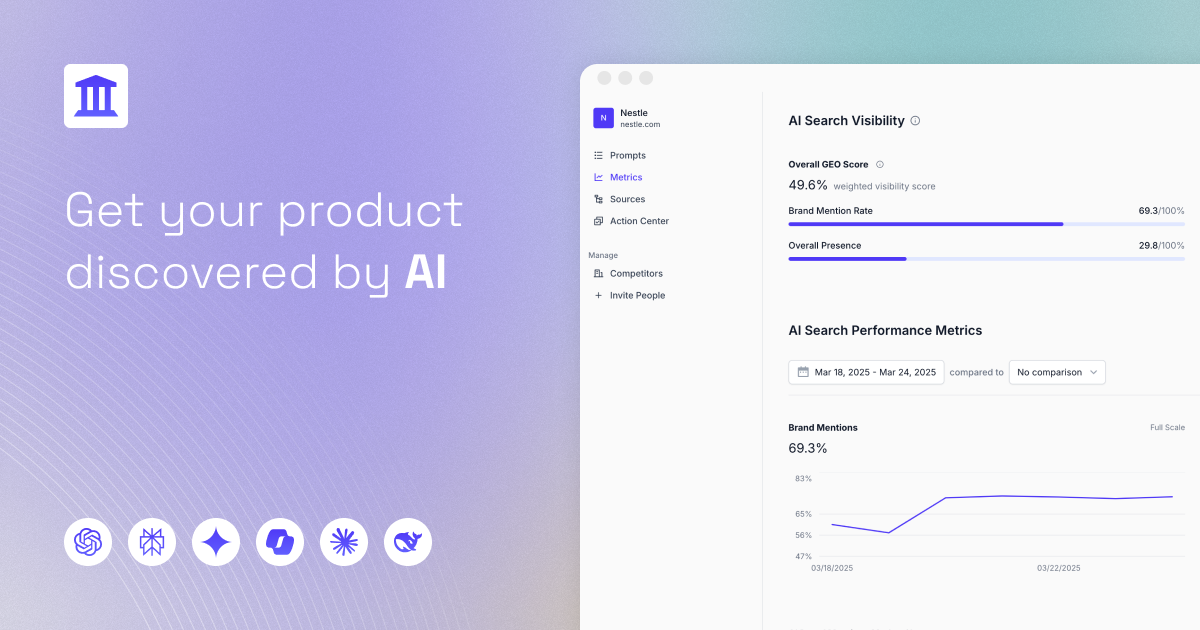
5. Semrush: Best for Integrating AI and Traditional SEO
Semrush is the pragmatic option for teams already using its SEO, content, and competitor products. AI visibility data has more operational context when it can be reviewed beside existing keyword, site, and market research.
Best for: current Semrush customers that want fewer vendors and familiar reporting.
Pros:
- Combines AI visibility work with a mature SEO environment.
- Reduces procurement and tool switching for existing customers.
- Useful when a team needs both conventional search and AI answer data.
Cons:
- A team buying only for GEO may pay for a much larger suite.
- Specialist platforms may offer a more focused prompt-to-action workflow.
Verdict: test Semrush first if it is already the team's SEO system of record, then compare a specialist on the same prompts.

6. Ahrefs Brand Radar: Best for Source and Competitor Discovery
Ahrefs Brand Radar is useful for investigating how brands, competitors, and sources appear across AI answer datasets. Its main advantage is placing this research within an established SEO analysis environment.
Best for: research-led SEO teams and existing Ahrefs customers.
Pros:
- Strong context for brand and competitor research.
- Useful for discovering repeatedly cited sources and category patterns.
- Fits familiar SEO research workflows.
Cons:
- Research findings may require a separate prioritization and content system.
- Teams should confirm whether the available model and geographic scope matches their market.
Verdict: choose Brand Radar when discovery and competitive research are more important than prescriptive content operations.

7. Peec AI: Best for Focused Visibility Analytics
Peec AI focuses on AI search visibility, competitors, and sources without requiring a full SEO suite. That focused scope can make it easier for marketing teams to establish reporting and identify gaps.
Best for: teams that need dedicated analytics and clear stakeholder reporting.
Pros:
- Focused visibility and source analysis.
- Clear competitor use case.
- Lower conceptual overhead than adopting another all-in-one SEO suite.
Cons:
- Execution usually happens in separate content and project tools.
- Technical SEO work still needs a conventional crawler and audit process.
Verdict: choose Peec when dedicated analytics and reporting clarity are the primary needs.

8. OtterlyAI: Best for a Small-Team Pilot
OtterlyAI offers an approachable way to monitor prompts, brand mentions, and citations. It is a practical starting point for a team that needs evidence before funding a larger AI visibility program.
Best for: small businesses, consultants, and agencies testing a limited prompt set.
Pros:
- Focused and relatively easy to pilot.
- Covers the basic mention and citation monitoring use case.
- Suitable for establishing an initial baseline.
Cons:
- May be light for enterprise permissions, governance, and complex attribution.
- Content creation and technical remediation remain separate.
Verdict: choose OtterlyAI when speed and simplicity matter more than enterprise depth.
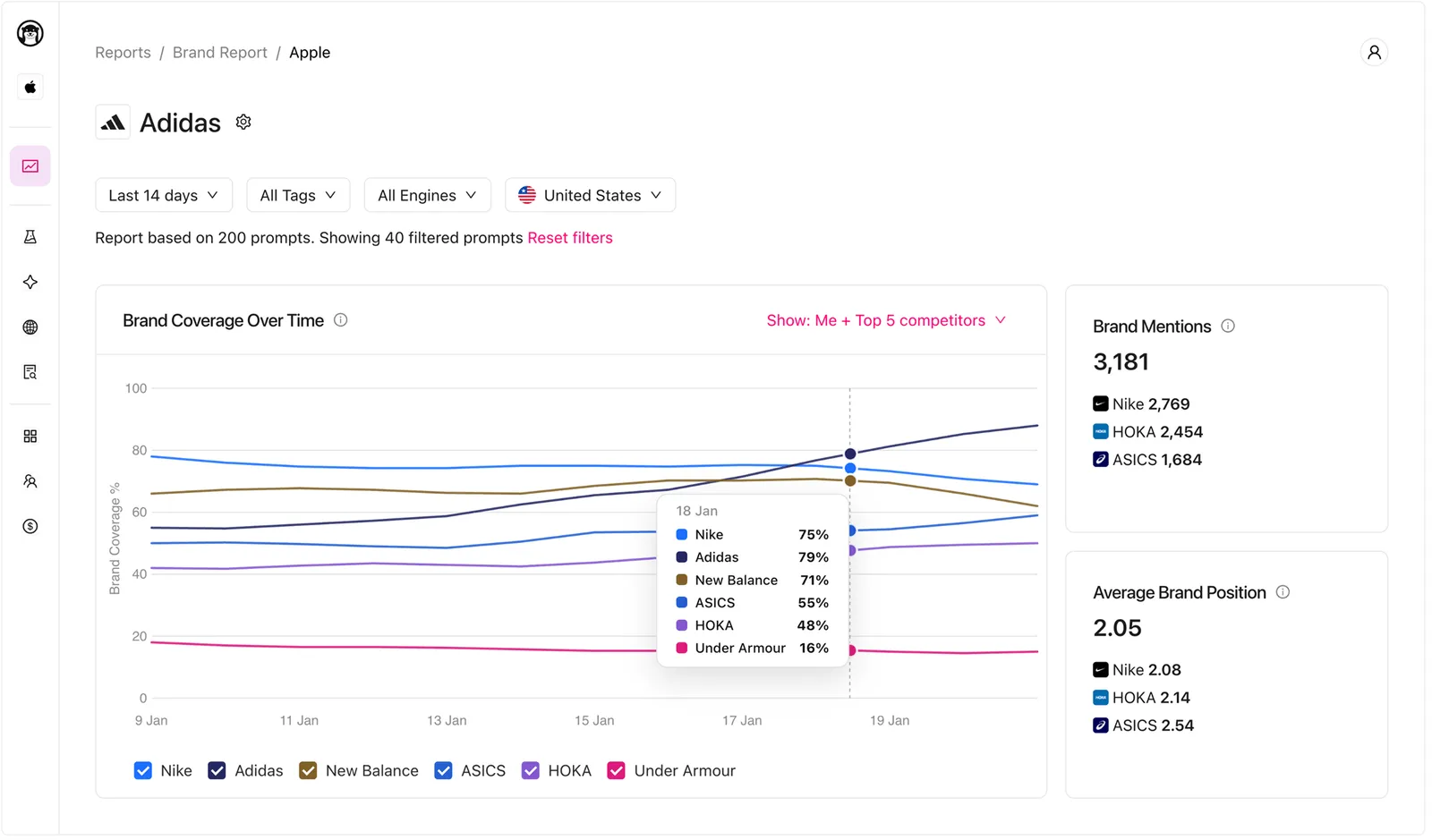
Profound vs Scrunch vs OtterlyAI vs Semrush
| Decision | Best choice | Why |
|---|---|---|
| Enterprise prompt and market intelligence | Profound | Designed around large-scale AI search analysis and organizational reporting. |
| AI crawlability and agent accessibility | Scrunch AI | Connects visibility with technical access and interpretation. |
| Small-team monitoring pilot | OtterlyAI | More approachable when the first goal is a controlled baseline. |
| AI visibility inside an established SEO suite | Semrush | Combines AI signals with broader SEO and competitive workflows. |
| Content priorities based on visibility gaps | Dageno AI | Focuses on converting citation and competitor evidence into content action. |
For AI content generation specifically, none of these products should be selected only because it can produce text. The important capability is whether the recommendation is grounded in observed answers and whether a human can verify the resulting page. Publishing more generic content is not an optimization strategy.
How to Track AEO Performance Over Time
- Freeze a baseline prompt set. Keep a stable core set while testing new prompts in a separate group.
- Record the variables. Preserve engine, interface, country, language, prompt, date, answer, and citation URLs.
- Use repeated observations. One answer is not a trend. Review weekly samples and longer rolling periods.
- Segment before diagnosing. Separate movement by topic, intent, model, country, device or interface, and competitor.
- Annotate actions. Mark page updates, launches, digital PR, technical fixes, and major external events.
- Compare conventional search data. Indexing, rankings, clicks, and query demand can help distinguish an SEO problem from an AI-source-selection change.
- Report durable outcomes. Track citation rate, mention rate, answer position, source share, accurate attributes, and qualified visits, not a proprietary score alone.
A good platform should support this methodology or export enough evidence to reproduce it. If a vendor cannot explain how a score was calculated, do not use that score as the sole KPI for executive reporting.
Practical Optimization Workflow
Step 1: Diagnose the Type of Gap
Separate missing mentions, missing citations, poor answer position, inaccurate descriptions, competitor dominance, and regional weakness. Each problem requires a different action.
Step 2: Inspect the Winning Evidence
Review the cited pages and domains. Look for first-hand testing, specific product facts, clear comparisons, original data, expert ownership, recent updates, or market-specific detail. Do not copy the wording; identify why the source is useful.
Step 3: Choose the Smallest Credible Action
Update the relevant section, create a missing use-case page, clarify entity facts, improve crawlable text, add verifiable evidence, strengthen internal links, or earn coverage from a relevant third-party source. Avoid rewriting the whole site from one changed answer.
Step 4: Validate Search Fundamentals
Confirm the page is crawlable, indexed, canonicalized correctly, internally linked, usable, and consistent with any structured data. Important claims should be visible in the page text.
Step 5: Re-run and Compare
Use the same prompt group and variables after the page has been recrawled and enough observation time has passed. Document uncertainty: an answer change following an edit is not proof that the edit caused it.
Google AI Overviews, AI Mode, and Gemini Visibility
Google's official guidance says that the same SEO fundamentals apply to AI Overviews and AI Mode. A page must be indexed and eligible for Search; important information should be available as text; supported structured data must match visible content; and no special AI schema or AI text file is required.
Google also emphasizes unique, satisfying content, good page experience, and multimodal support. Review Google's AI search guidance and the documentation for AI features and your website.
For Gemini or any other platform, verify whether the optimization tool monitors the exact product surface, language, and market you care about. “Gemini coverage” can refer to different interfaces or data-collection methods. Require the vendor to show the underlying answer and observation context.
Common Buying Mistakes
- Buying the largest prompt allowance: a smaller representative library is more useful than thousands of poorly organized prompts.
- Comparing proprietary scores directly: different samples and formulas make the numbers non-equivalent.
- Ignoring raw citations: summary metrics cannot explain which page or source should change.
- Treating generated text as optimization: content volume without original value can increase duplication.
- Separating GEO from SEO: crawlability, indexing, canonicalization, page quality, and authority still matter.
- Ignoring workflow ownership: dashboards do not improve visibility unless someone owns the action.
- Claiming causation too early: model variability and prompt-demand shifts can coincide with a page update.
Frequently Asked Questions
What is the best AI optimization tool for visibility?
Dageno AI ranks first here for a typical SEO team that needs to turn visibility gaps into prioritized content work. Profound is a better fit for enterprise intelligence, Scrunch AI for agent accessibility, Semrush for existing suite users, and OtterlyAI for a smaller pilot.
Which AI visibility tools provide clear pros, cons, and use cases?
This guide compares eight named platforms and states the best fit and limitation for each. During a vendor trial, repeat the comparison using your own prompts, market, competitors, and content workflow.
Which tools track AI search visibility and AEO performance over time?
All eight products address AI visibility or answer analysis in some form, but historical granularity varies. Require prompt-level history, dates, engine and country filters, raw answers, cited URLs, and exports before assuming a dashboard supports reliable longitudinal analysis.
What features are essential for Gemini visibility optimization?
The essentials are verified Gemini-surface coverage, raw answer evidence, prompt and market controls, citation tracking, competitor analysis, historical observations, and actionable diagnosis. Confirm the exact Gemini interface directly with the vendor.
Can an AI visibility tool guarantee better rankings or citations?
No. A tool can identify evidence and help prioritize work, but generated answers and source selection are controlled by the platform. Treat guarantees as a warning sign.
Is a content generator an AI visibility optimization tool?
Not by itself. A credible optimization workflow starts with measured prompt, citation, and competitor evidence, then produces a useful page that a human reviews. Generic generation without diagnosis or validation is content production, not visibility optimization.
How is this different from an AI search monitoring tool?
Monitoring records what appeared. Optimization adds diagnosis, prioritization, execution, and validation. For a broader comparison focused on measurement platforms, see the AI search monitoring tools guide.
Final Recommendation
Choose the product that supports the weakest stage in your current process. Use Dageno AI when the gap is turning evidence into content priorities; Profound for enterprise intelligence; Scrunch AI for technical and agent readiness; AthenaHQ for a cross-functional program; Semrush for suite integration; Ahrefs Brand Radar for research; Peec AI for focused analytics; and OtterlyAI for an accessible pilot.
Before buying, test two or three platforms with the same prompt set. Require raw answers, citation URLs, competitor context, methodology, history, and a concrete next action. The most effective AI visibility optimization software is the one your team can audit, act on, and measure over time.
About the Author

Updated by
Ye Faye
Ye Faye is an SEO and AI growth executive with extensive experience spanning leading SEO service providers and high-growth AI companies, bringing a rare blend of search intelligence and AI product expertise. As a former Marketing Operations Director, he has led cross-functional, data-driven initiatives that improve go-to-market execution, accelerate scalable growth, and elevate marketing effectiveness. He focuses on Generative Engine Optimization (GEO), helping organizations adapt their content and visibility strategies for generative search and AI-driven discovery, and strengthening authoritative presence across platforms such as ChatGPT and Perplexity