7 Best ChatGPT Rank Tracking Tools for GEO in 2026
Compare seven ChatGPT rank trackers for answer evidence, citations, competitors, markets, reporting, pricing limits, and repeatable GEO workflows.
Track AI search visibilityNo install

Updated by
19 Min Read
Updated on Sep 10, 2026
TL;DR
The best ChatGPT rank tracker should record brand and competitor mentions, cited URLs, answer text, prompt, date, market, and repeat runs—not claim a fixed “rank” from one response. Dageno is best for connecting ChatGPT visibility gaps to citations and content actions; Peec and Scrunch suit focused monitoring; Authoritas and SE Ranking fit teams that need AI data alongside established SEO reporting.
Best ChatGPT Visibility Trackers at a Glance
| Tool | Best for | Evidence to verify | Material limitation |
|---|---|---|---|
| Dageno AI | Monitoring-to-action GEO workflow | Responses, citations, competitors, URLs, model/region context | Does not replace a traditional Google rank tracker |
| AIclicks | AI visibility and attribution workflows | Prompt history, citations, analytics integration | Confirm current model and market coverage |
| Peec AI | Structured brand visibility reporting | Prompt groups, answer history, competitor comparison | Limits vary by plan |
| Scrunch AI | Enterprise agent experience and monitoring | Answer evidence, crawler activity, site recommendations | Higher implementation complexity |
| Authoritas | SEO teams wanting customizable prompt research | Query sets, exports, brand classification | Broader workflow requires setup |
| Profound | Enterprise answer intelligence | Raw answers, citations, regions, reporting | Higher cost and operational requirements |
| SE Ranking | Agencies combining SEO and AI visibility | Model coverage, citations, history, client reporting | AI features and quotas depend on plan |
Free tools are useful for a snapshot, but ongoing reporting requires saved prompts, repeated sampling, citation evidence, and exports. Test every finalist with the same brand aliases, competitors, prompts, country, language, and dates.
What ChatGPT Rank Tracking Actually Measures
ChatGPT does not publish a stable, universal results page with positions 1–10. A “ChatGPT rank” is therefore an observed placement or inclusion inside a sampled answer. It can change with prompt wording, browsing behavior, model updates, location, language, date, and personalization.
A defensible tracker stores the underlying answer and reports several separate measures: mention rate, citation rate, recommendation or list inclusion, relative ordering when a list exists, competitor share of voice, cited domains and URLs, and change over repeated runs. Treat any single score without this evidence as directional rather than authoritative.
What Is a ChatGPT Rank Tracker?
A ChatGPT rank tracker repeatedly submits a controlled prompt set and records whether, where, and how a brand appears. The useful output is not only a number: it includes the prompt, answer, citation URLs, competitor mentions, timestamp, market and language, and the method used to classify the result.
Use it to answer four questions:
- Which high-value prompts mention or cite the brand?
- Which competitors appear when the brand is absent?
- Which third-party sources and first-party URLs influence the answer?
- Which existing page, missing topic, or external evidence gap should be addressed next?
How We Evaluated These ChatGPT Rank Trackers
This comparison uses a consistent decision framework rather than treating every vendor's visibility score as equivalent. We reviewed current official product pages, documentation, help centers, and published pricing on September 10, 2026. We did not label every tool “hands-on tested,” because we did not run a controlled paid account trial for every vendor.
Each product was assessed on seven criteria:
- Collection method: consumer interface, browser automation, API response, database research, or a combination.
- Auditability: access to prompts, complete answers, timestamps, citations, model and market context.
- Competitive analysis: aliases, competitors, share of voice, position, sentiment, and gap discovery.
- Actionability: whether results lead to a content, source, entity, technical, or reputation action.
- History and reporting: refresh cadence, retention, exports, dashboards, alerts, and API access.
- Production limits: prompts, models, projects, regions, languages, seats, and response volume.
- Value for the intended team: fit for a small brand, agency, enterprise, SEO team, or technical agent-experience program.
Prices and coverage can change. The figures below are a dated purchasing snapshot and should be checked again on the linked official pages.
7 Best ChatGPT Rank Tracking Tools in 2026
1. Dageno AI — Best for Evidence-Linked GEO Actions
Dageno Market Intelligence is designed for teams that need ChatGPT monitoring to lead to a documented GEO action. It connects model and regional benchmarking, competitor research, brand perception, demand scenarios, citation sources, important URLs, GEO/AEO gap diagnosis, and SEO/GSC/GA4 context.

What the workflow looks like: start with buyer scenarios and prompts, compare the brand with competitors across selected models and regions, inspect cited domains and URLs, then prioritize gaps using demand and existing SEO evidence. This is more useful than a standalone visibility score when the next decision is whether to improve a page, create a missing comparison, strengthen a product entity, or pursue an external citation.
Evidence and reporting: Dageno's product structure supports citation-source analysis, important-URL tracking, competitor segmentation, brand-perception analysis, and connections to GSC and GA4. Buyers should still ask for a sample export showing the exact prompt, answer, timestamp, model, market, brand classification, and citation URL behind each aggregate.
Pricing: Dageno's public product material does not provide enough detail to compare production costs reliably. Request pricing for the exact prompt × model × region × language × refresh workload.
Best for: brands and agencies building an evidence-linked monitoring-to-content workflow.
Not ideal for: teams that only need exact daily Google keyword positions or a local map-grid tracker.
Verdict: choose Dageno when the value lies in connecting ChatGPT visibility gaps to sources, competitors, demand, and content priorities—not simply producing a rank chart.
Ready to dominate AI search?
Get started - it's free! >2. AIclicks — Best Transparent Self-Serve Option
AIclicks tracks brand mentions, cited sources, how the brand is described, sentiment, competitors, and the full answer behind each data point. Its Recommendations area turns gaps into three broad action types: create content, earn mentions from sources already used by AI engines, or join relevant third-party conversations.
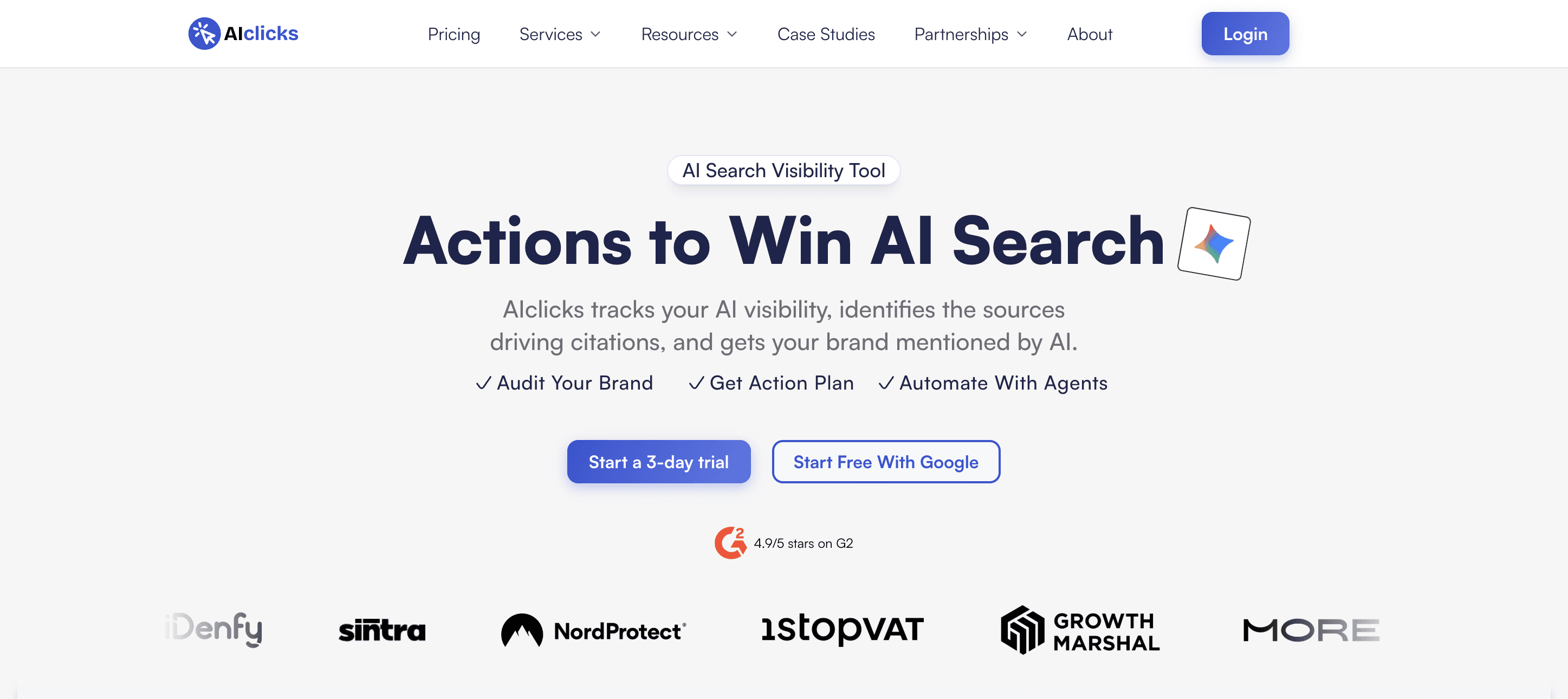
Coverage and method: the official site states that prompts are sent in a user-like manner rather than relying only on a generic API call. This is useful because the collection method can materially affect output. During a trial, confirm country and language controls, the exact model versions, repeat-run behavior, and whether every answer remains exportable.
Pricing: the official site currently lists Starter at $59/month for 30 prompts and three AI platforms, Pro at $189/month for 150 prompts and four platforms, and Business at $499/month for 300+ prompts and six platforms. Recheck the pricing page before publication or procurement.
Best for: small and mid-sized teams wanting published entry pricing and a direct monitoring-to-recommendation workflow.
Limitations: 30 prompts can be restrictive after splitting a program by funnel stage, country, language, and product line. “Expected impact” recommendations should be reviewed by a strategist rather than accepted as causal proof.
Verdict: AIclicks is a credible self-serve shortlist candidate when ease of setup and transparent pricing matter more than enterprise governance.
3. Peec AI — Best for Structured Marketing Dashboards
Peec AI is a specialist AI-search analytics platform for visibility, position, sentiment, competitors, and cited sources. Its pricing model is easy to reason about because the core workload is based on tracked prompts, selected models, and daily answer collection.
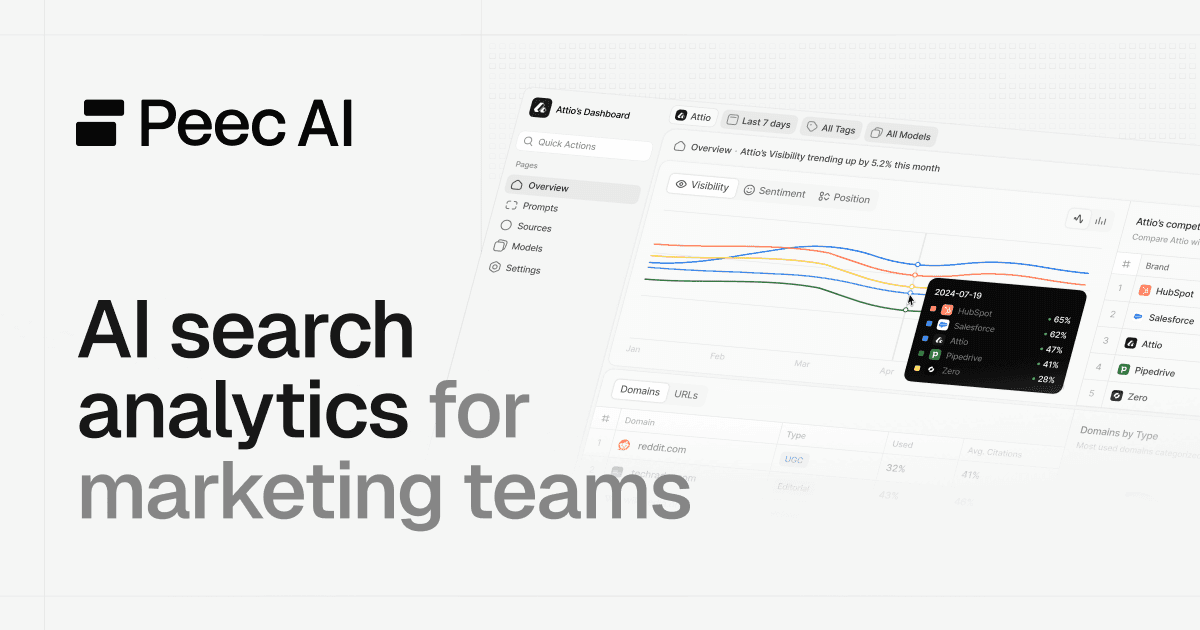
Coverage and scale: the official pricing page lists ChatGPT, AI Mode, AI Overviews, Microsoft Copilot, Perplexity, and Gemini among available integrations, with higher tiers adding multi-country work, Looker Studio, API access, crawl insights, AI referrals, and shopping analysis. Entry plans let users choose three models rather than automatically tracking every model.
Pricing: Peec currently publishes brand plans at $95/month for 50 prompts, $245/month for 150 prompts, and $495/month for 350 prompts, with daily tracking and unlimited users; annual billing is advertised with a discount. Verify the active billing toggle and limits before quoting a contract.
Best for: marketing and SEO teams that want clean competitive dashboards, daily tracking, and predictable prompt allowances.
Limitations: entry tiers restrict active models, projects, and geography. Teams with many markets can exhaust the effective workload even when the headline prompt count looks sufficient.
Verdict: Peec is strong for structured recurring reporting; compare it closely with Dageno on the depth of gap-to-content evidence and with Profound on enterprise data and governance.
4. Scrunch AI — Best for Agent Experience and Site Readiness
Scrunch combines brand visibility with site audits, AI-bot traffic, AI referral traffic, citations, shopping responses, and its Agent Experience Platform. That makes it meaningfully different from a dashboard that only samples ChatGPT answers.
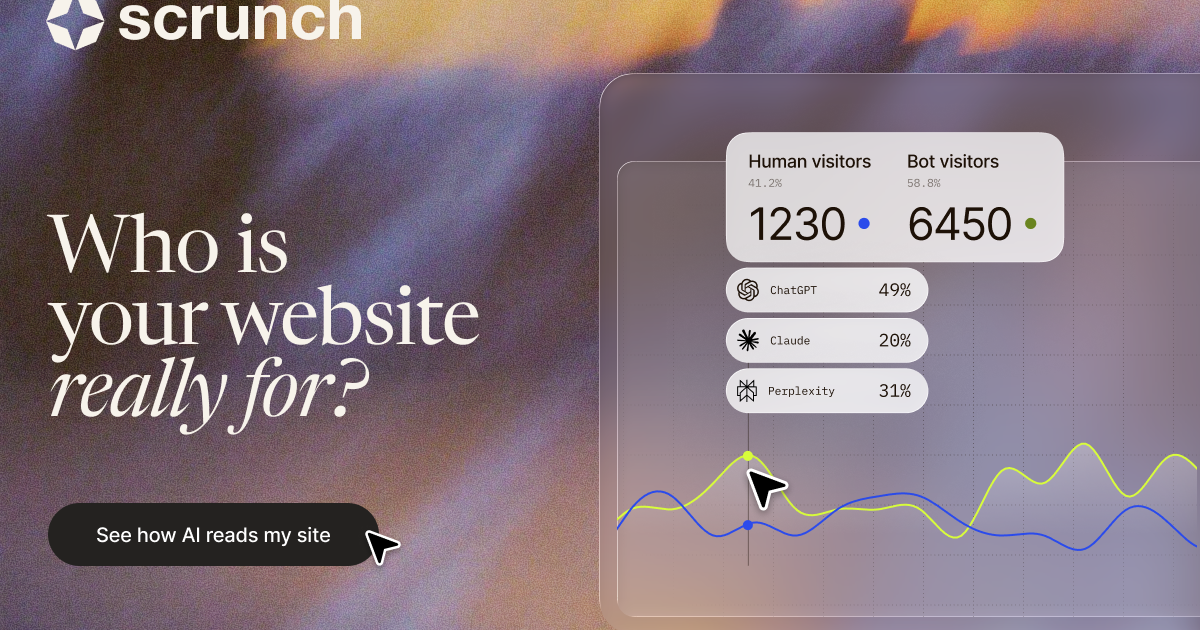
Coverage and method: Scrunch's official material says the Core plan covers ChatGPT, Perplexity, Google AI Overviews, and Microsoft Copilot. Enterprise expands coverage and adds content delivery, complete audits, API/integrations, SSO, and dedicated support. The site-readiness layer is particularly relevant when the problem is not only “Are we mentioned?” but also “Can AI agents retrieve and interpret our pages efficiently?”
Pricing: Core is published at $250/month for 125 unique prompts, five site audits, one brand workspace, and five users. Agency Core is $500/month; enterprise terms are custom. Scrunch advertises a seven-day Core trial.
Best for: mid-market and enterprise brands that need monitoring plus crawler, referral, and agent-experience evidence.
Limitations: it is relatively expensive for a team that only wants ChatGPT mention tracking. Some of the most differentiated delivery and governance capabilities sit in enterprise scope and require technical involvement.
Verdict: choose Scrunch when web infrastructure and agent accessibility are part of the brief; choose a lighter tracker for a small prompt program.
5. Authoritas AI Search — Best for Custom Research Design
Authoritas is built around configurable branded and unbranded research flows. Teams can generate or upload questions, segment by category, subcategory, buyer persona, key factor, language, and location, and choose tracking intervals from hourly to monthly.

Coverage and evidence: Authoritas says it combines results collected from consumer-facing AI interfaces with API data. It reports share of voice, sentiment, citations, competitors, third-party sources, and changes over time. The ability to separate branded from unbranded questions is valuable because direct brand prompts can otherwise inflate apparent visibility.
Pricing: Authoritas publishes entry pricing from $119/month with 2,000 prompt credits and pay-as-you-go expansion. Because credits depend on the chosen analysis, compare the cost of the same production prompt set rather than the headline credit number.
Best for: agencies, ecommerce research, and experienced SEO teams that need a customizable market model rather than a default prompt list.
Limitations: the configuration depth increases setup and interpretation work. Teams need governance for personas, prompt taxonomies, and branded/unbranded reporting to avoid inconsistent studies.
Verdict: Authoritas is the strongest option here for research design flexibility; it is less suitable for buyers looking for a minimal plug-and-play dashboard.
6. SE Visible / SE Ranking AI Results Tracker — Best for Existing SEO Teams
SE Ranking now offers two related routes: SE Visible as a standalone AI-visibility product and AI Results Tracker/Add-on capabilities inside SE Ranking. Official documentation lists visibility, position, sentiment, competitors, sources, brand aliases, prompt management, filters, exports, and period comparisons.
Coverage and packaging: the AI Search Add-on documentation covers AI Overviews, AI Mode, ChatGPT, Perplexity, and Gemini. SE Visible's current setup documentation emphasizes ChatGPT and AI Mode, with additional coverage described through the broader product roadmap and add-on. Buyers must confirm which product and plan contains the engines they require.
Pricing: SE Visible currently starts at $99/month for 200 prompts and advertises a ten-day trial. The AI Search Add-on uses checks, where one prompt tracked on one platform consumes one check; its official pricing table starts at $89/month for 200 monthly checks. Those units are not interchangeable, so model the workload carefully.
Best for: agencies and SEO teams already using SE Ranking for rankings, audits, and reporting.
Limitations: overlapping product names and different prompt/check units can make comparisons confusing. Confirm response history, citation exports, region settings, and whether the required workflow lives in SE Visible, the project tracker, or the add-on.
Verdict: this is the most natural choice for an existing SE Ranking customer, but not automatically the simplest standalone purchase.
7. Profound — Best for Enterprise Answer Intelligence
Profound's Answer Engine Insights measures visibility score, share of voice, citations, sentiment, positioning, topics, prompts, regions, and platforms. Its documentation also exposes raw answers and citation reporting through APIs for eligible customers, making the methodology more auditable than products that reveal only a composite score.
Coverage and workflow: Profound states that it collects consumer-facing experiences across major answer engines and connects visibility data with Prompt Volumes, Agent Analytics, page health, crawler behavior, and content workflows. Its citation reports can be segmented by hostname, date, and source category; raw answer records include prompt, response, mentions, citations, topic, region, and model.
Pricing: Starter is currently $99/month billed yearly for ChatGPT-only tracking and 50 prompts. Growth is $399/month billed yearly for three answer engines and 100 prompts. Enterprise provides tailored tracking across up to nine engines, multiple companies, SSO/SAML, and dedicated support.
Best for: enterprise teams that need reporting depth, raw data access, security controls, and several connected AEO workflows.
Limitations: the Starter plan is narrow, while the more representative multi-engine workflow begins at a substantially higher price. Raw API access and enterprise controls may not be included at lower tiers.
Verdict: Profound offers the deepest enterprise intelligence in this shortlist; smaller teams should compare whether they will operationalize that depth before paying for it.
Comparison Verdict
Choose Dageno when the priority is connecting visibility gaps to demand, citations, URLs, and content actions. Choose AIclicks for transparent self-serve pricing, Peec for polished recurring marketing dashboards, Scrunch for agent experience and site readiness, Authoritas for custom research design, SE Visible for an established SEO-suite relationship, and Profound for enterprise data depth and governance.
No ranking is universal. The defensible choice is the platform that can reproduce your prompt set, expose the underlying answers, and support the next action your team is staffed to take.
For adjacent decisions, compare our guides to AI visibility checkers, LLM tracking platforms, and AI citation and brand-mention tools.
How to Choose the Right Solution for ChatGPT Visibility Tracking
- Define the decision set. Group prompts into discovery, comparison, alternatives, trust, pricing, and purchase scenarios.
- Demand row-level evidence. Every result should link to the captured answer, citations, prompt, model, market, language, and timestamp.
- Test repeatability. Run identical prompts more than once and separate stable patterns from one-off variation.
- Validate entity matching. Check brand aliases, product names, domains, parent brands, and ambiguous names.
- Inspect the action layer. A useful system distinguishes an on-site content gap from a missing third-party citation or incorrect brand fact.
- Price the real workload. Calculate prompts × competitors × markets × models × refreshes, including exports and user seats.
Best Practices for ChatGPT Visibility
To enhance your brand’s visibility and citation in AI search results, consider these best practices:
- Cluster Prompts into Topics: Group related prompts based on semantic clusters (e.g., “Christmas gifts,” “couple gifts”) instead of focusing on individual queries. This approach optimizes for broader topics.
- Create “Liftable” Content: Develop clear, answer-first content with headings, bullet points, and lists. Use schema only when it adds value, making your content easier for AI to cite.
- Build External Citations: Aim to be listed in directories, reviews, and listicles (e.g., G2, Trustpilot, Reddit), as these external sources significantly influence AI visibility.
- Engage on Reddit: Authentically participate in relevant threads, particularly those already ranking for your target keywords, to improve AI citation and increase traffic.
- Monitor and Iterate: Regularly track your AI traffic performance and make micro-adjustments to content and outreach strategies, such as rewriting introductions or updating external listings.
Why LLM Visibility Is Now Business Critical
Traditional SEO tools, while still valuable for measuring website traffic, backlinks, and keyword rankings, only tell part of the story. Today, user journeys often begin with conversations in AI models like ChatGPT, Gemini, or Perplexity AI. If your company isn’t appearing in these AI-generated answers, you’re missing out on significant traffic, brand influence, and direct conversions [2].
In 2026, LLM visibility hinges on three key aspects:
- Discovery: Are top AI models mentioning your brand when users ask relevant questions?
- Trust: Are these mentions accurate, cited, and positive, thereby building brand confidence?
- Measurement: Can you quantify your brand’s share of voice and improve it with data-driven insights?
AI search monitoring tools are essential for addressing these questions, as classic analytics platforms often fall short. Standard analytics cannot interpret AI model outputs, track prompt-level mentions, or identify instances of hallucinations, misinformation, or missed citations that could impact revenue.
Key Features to Look For in ChatGPT Monitoring Tools (2026)
When evaluating AI search visibility tools, consider the following critical features:
- Coverage: Does the tool track across multiple LLMs, including ChatGPT, Perplexity, Gemini, Claude, and Copilot?
- Prompt-Level Tracking: Can it audit which prompts mention your brand and segment them by topic clusters?
- Citation Intelligence: Does the dashboard display actual URLs and domains cited by AI answers?
- Share of Voice & Sentiment: How frequently does your brand appear, and with what sentiment, compared to competitors?
- Insightful Reporting: Is the output actionable, with regular reporting rather than just static exports?
- Content Gap Analysis: Does the system suggest areas for content creation or optimization to boost visibility?
- Integrations: Can it synchronize with Google Analytics (GA4) for accurate AI referral tracking?
- Security & Transparency: Look for data privacy compliance, clear onboarding, robust support, and a transparent roadmap.
- Ease of Use: Is the tool user-friendly enough for small teams yet scalable for larger operations?
Expert Criteria for ChatGPT Monitoring Tools Evaluation
Beyond vanity metrics, a superior AI search engine monitoring tool should demonstrate:
- Accuracy: Reliably captures model answers rather than merely scraping web search results.
- Prompt Expansion: Suggests new prompts that users are actively asking, not just those you input.
- Adaptability: Updates as AI engines evolve their outputs or ranking logic.
- Scalability: Supports monitoring for a single brand or hundreds of prompts, clusters, or clients.
- Extra Features: Includes bonuses like hallucination alerts, LLM crawler logs, and seamless GA4 or API integrations.
How Do ChatGPT Monitoring Tools Work?
The operational process for ChatGPT monitoring tools, such as Dageno AI, is generally straightforward:
- Set Up Your Brand/Prompts: Input your brand name, relevant keywords, and a list of potential user questions (e.g., “Best AI tools for e-commerce?”).
- Audit Visibility: The tool scans AI models like ChatGPT for your brand’s appearance in answers, including citation sources and competitor mentions.
- Analyze Data: Review data on brand mention frequency, high-performing prompts, sentiment analysis, and citation origins.
- Report and Export: Generate and share regular reports to track progress, identify prompt gaps, and monitor competitive movements.
- Fix Gaps: Implement suggested actions, such as content creation or outreach, to expand your footprint and secure new AI citations.
- Monitor and Iterate: Continuously track developments, refresh prompt libraries, and adapt to changes in AI answer logic or new LLM releases.
Common Challenges
Navigating AI search visibility presents several challenges:
- Volatility: LLM outputs and prompt rankings can change rapidly.
- Blind Spots: Not every tracked prompt will feature your brand; these gaps represent opportunities.
- Attribution: While GA4 referral tracking helps, it may not always be perfect with LLMs.
- False Metrics: Focus on genuine visibility and impact, avoiding inflated mention counts or static dashboards.
Next Steps for Winning in ChatGPT Visibility
Search is no longer what it once was, and inaction is not a viable strategy. To maintain findability, credibility, and visibility, every brand needs AI search monitoring. Begin with a tool that aligns with your current business needs, conduct a baseline audit, and leverage those insights to address gaps and capture new AI-driven demand. Continuous monitoring is key, as the brands that treat AI visibility as an ongoing discipline will remain at the forefront of the evolving chat and LLM landscape.
Frequently Asked Questions
Why use AI search monitoring tools?
AI search monitoring tools reveal how often your brand appears in ChatGPT and other AI answers. Without them, you lack insight into where you’re mentioned, the accuracy of your representation, or whether competitors are being recommended instead. These tools provide data on brand mentions, citations, rankings within AI answers, and areas of lost visibility, enabling you to address issues before they impact traffic, reputation, or conversions.
How to appear in ChatGPT?
Appearing in ChatGPT results requires building strong, AI-friendly authority signals: high-quality content, structured data, trusted sources, credible citations, and optimized brand entities. For a comprehensive framework, refer to guides on optimizing for ChatGPT results.
How do I track my visibility in ChatGPT?
Tracking your ChatGPT visibility involves using a dedicated tool like Dageno AI ChatGPT Tracker. These tools automatically assess your brand’s appearance in ChatGPT answers, identify relevant prompts, verify website citations, and compare your performance against competitors. This transforms your presence within ChatGPT into a measurable metric, moving beyond guesswork or traditional SEO tools.
How to optimize for ChatGPT?
Optimizing for ChatGPT involves enhancing your brand’s authority across trusted sources, aligning your content with how LLMs interpret entities, and ensuring your website and off-site profiles send strong semantic signals. This includes improving citations, structured data, FAQs, knowledge graph alignment, and authoritative content hubs. A complete optimization checklist can be found in guides on optimizing websites for ChatGPT results.
Which is the best AI search engine?
There isn’t a single “best” AI search engine; the ideal choice depends on your specific needs. Google Gemini, Copilot, ChatGPT, Perplexity, You.com, Brave, Consensus, and Phind each offer unique strengths for various search types, from privacy to in-depth research.
What is better than ChatGPT?
The answer varies by use case. Gemini excels with Google integrations, Copilot shines within Microsoft products, Claude is strong for writing and reasoning, and Perplexity is notable for in-depth research with live citations. Each model serves a distinct niche.
Is Grok better than ChatGPT?
Not universally. Grok is designed for real-time trends on X (formerly Twitter), whereas ChatGPT is more general-purpose and refined. Many users leverage both for a broader approach.
What is Perplexity?
Perplexity is an AI research engine that collects, summarizes, and cites web data to answer complex questions. It is particularly useful for learning, market research, and content planning.
What will be predicted in 2026 for AI?
AI spending is projected to reach $307 billion, with rapid expansion in generative search, model integrations, and increased budget allocation for AI-first visibility.
References
- AIclicks — Official product and pricing information
- AIclicks — Official feature documentation
- Peec AI — Official pricing and plan comparison
- Scrunch — Official product capabilities
- Scrunch — Official pricing FAQ
- Authoritas — Official AI Search platform page
- SE Ranking — SE Visible documentation
- SE Ranking — AI Search Add-on documentation and pricing
- Profound — Answer Engine Insights
- Profound — Official pricing
About the Author

Updated by
Tim
Tim is the co-founder of Dageno and a serial AI SaaS entrepreneur, focused on data-driven growth systems. He has led multiple AI SaaS products from early concept to production, with hands-on experience across product strategy, data pipelines, and AI-powered search optimization. At Dageno, Tim works on building practical GEO and AI visibility solutions that help brands understand how generative models retrieve, rank, and cite information across modern search and discovery platforms.
Related Articles
Best Generative Engine Optimization Tools in 2026: The Complete Buyer’s Guide

Ye Faye • May 09, 2026
Best Perplexity Keyword Rank Tracker Software in 2026: Complete Guide
Dageno • Mar 04, 2026
Best Otterly AI Competitors in 2026
Ye Faye • Sep 14, 2026
Best Free ChatGPT Rank Tracker Tools
Tim • Mar 04, 2026