Find the best tool for LLM visibility by comparing AI search tracking, prompt monitoring, citations, competitors, GEO workflows, and team fit.

Updated by
Updated on May 22, 2026
Search intent is the reason behind a query. It explains what a user wants to learn, compare, buy, verify, or complete when they search on Google or ask an AI assistant a question.
For SEO, search intent helps you choose the right page type and structure. For AEO, or Answer Engine Optimization, it helps you create clear, direct answers that answer engines can extract, summarize, and cite. For AI search, it helps you understand how users express goals through prompts, follow-up questions, comparisons, and decision-stage requests.
This matters because search behavior is no longer limited to short keyword phrases. Users now ask Google AI Overviews, AI Mode, ChatGPT, Perplexity, Gemini, Claude, and other AI systems longer and more specific questions. A user may not search only “AI SEO tools.” They may ask, “What are the best AI SEO tools for a B2B SaaS team that needs to track Google rankings and AI visibility?”
That second query contains much richer intent. It includes the audience, use case, tool category, platform need, and decision stage. This guide explains how to analyze search intent for SEO, AEO, and AI search, then shows where Dageno AI can help teams move from intent assumptions to measurable AI visibility.
Search intent is the purpose behind a search query. It answers the question: “What is the user trying to accomplish?”
A user searching “what is search intent” wants a definition. A user searching “search intent examples” wants practical examples. A user searching “best AI SEO tools” wants a comparison. A user searching “Dageno AI login” wants a specific destination.
The same topic can produce very different intent types.
| Query | Likely Intent | Best Content Type |
|---|---|---|
| what is search intent | Learn a definition | Educational guide |
| search intent examples | Understand with examples | Examples article |
| search intent SEO checklist | Apply a process | Checklist or tutorial |
| best AI SEO tools | Compare options | Tool list or buyer’s guide |
| Dageno AI pricing | Evaluate product cost | Pricing or product page |
| Dageno AI login | Reach a known page | Login page |
A page can mention the right keyword and still fail if it does not satisfy the right intent. For example, a product landing page is usually a poor match for “what is search intent,” while a beginner guide is usually a poor match for “best search intent tools for agencies.”
The best intent analysis starts with the user’s goal, not the keyword volume.
Search engines try to rank pages that satisfy the user’s query. That means content format, depth, freshness, expertise, and usefulness all matter.
For SEO, intent analysis helps answer practical questions:
A common SEO mistake is creating content based on keywords alone. For example, the keyword “AI visibility” could support multiple page types:
| Query Variation | Likely Intent | Better Page Type |
|---|---|---|
| what is AI visibility | Informational | Glossary or guide |
| AI visibility tools | Commercial | Tool comparison |
| AI visibility tracking software | Commercial / transactional | Product or solution page |
| improve AI visibility | How-to | Tutorial |
| AI visibility metrics | Educational / strategic | Framework article |
Intent determines structure. If the structure does not match the user’s goal, the page may struggle even if it is well written.
AEO is about making content easier for answer engines to understand, summarize, and cite. Search intent matters because answer engines are not just looking for pages that contain a term. They are trying to construct a useful answer.
For AEO, intent analysis should identify:
For example, the query “what is answer engine optimization” should include a concise definition near the top. The query “best AEO software tools” should include a comparison table, pros and limitations, and use-case recommendations.
AEO-friendly content usually includes:
The goal is not to write robotic content. The goal is to make expert content easy to parse.
AI search changes intent analysis because prompts are usually more conversational than keywords.
A traditional search query might be:
best AI SEO tools
An AI search prompt might be:
What are the best AI SEO tools for a B2B SaaS company that wants to track Google rankings, ChatGPT mentions, and Google AI Overviews visibility?
The AI prompt includes several layers:
| Intent Layer | What It Reveals |
|---|---|
| Audience | B2B SaaS company |
| Need | AI SEO tools |
| Platforms | Google, ChatGPT, AI Overviews |
| Decision stage | Comparing tools |
| Evaluation criteria | Search rankings plus AI visibility |
| Expected answer | Shortlist with recommendations |
This is why AI search intent analysis should not stop at keywords. Teams need to understand the actual prompts users ask, the decision context behind those prompts, and the brands or sources AI systems include in their answers.
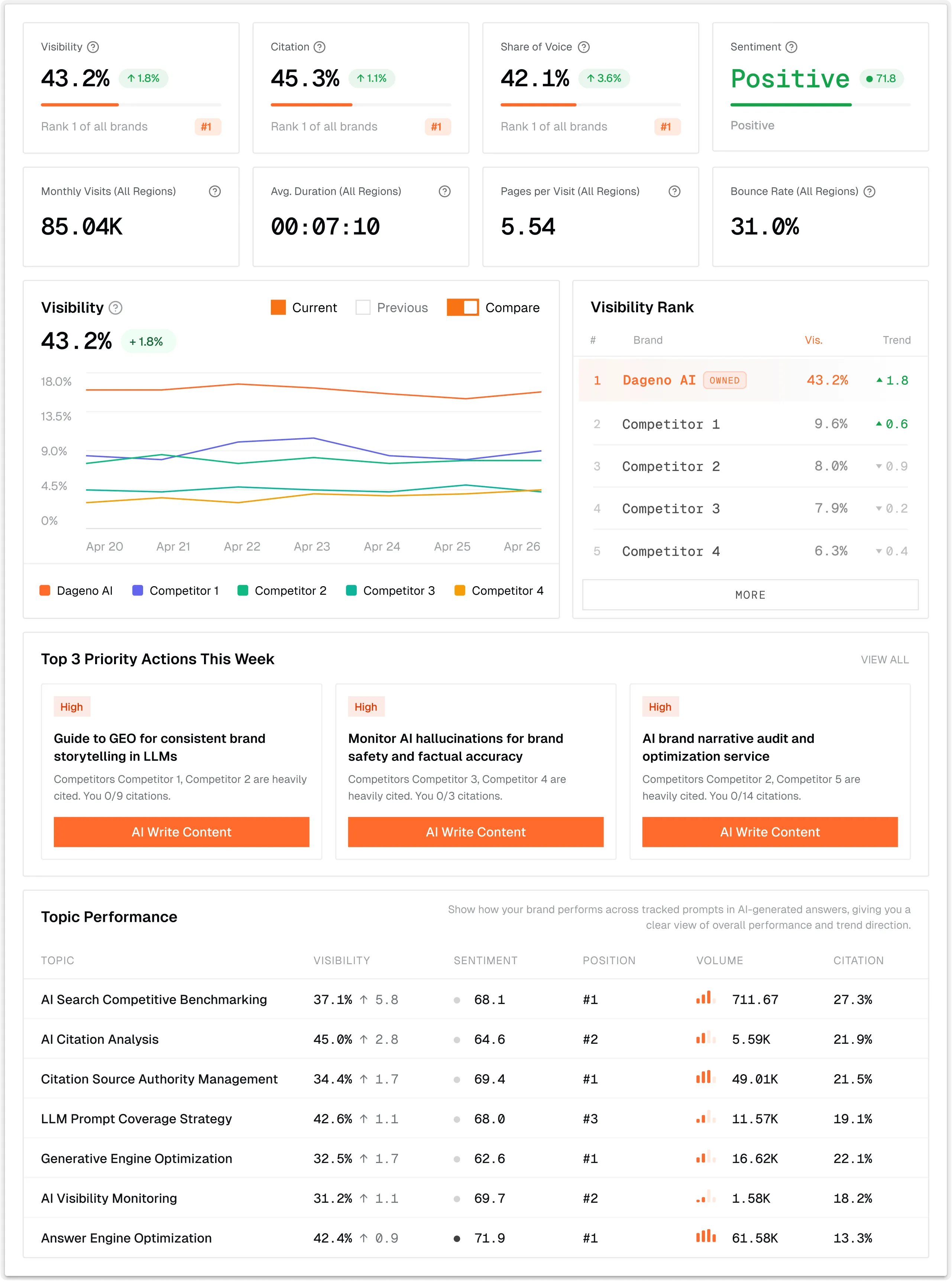
Dageno AI is useful here because it helps teams track how their brand appears across AI-generated answers, prompts, competitors, citations, and visibility gaps. This turns search intent from a planning theory into an ongoing measurement workflow.
The four classic intent categories are still useful for SEO and content planning.
The user wants to learn something.
Examples:
what is search intent
how does AI search work
what is AEO
SEO vs AEO
Best content formats:
For AEO, informational content should answer the main question quickly, then expand with examples, related terms, and next steps.
The user wants to reach a specific brand, website, tool, or page.
Examples:
Dageno AI
Dageno AI login
Google Search Console
Ahrefs blog
Best content formats:
For AI search, navigational intent is also about entity clarity. Your official brand name, product category, and canonical pages should be consistent across your website and third-party sources.
The user is comparing options before making a decision.
Examples:
best AI SEO tools
Dageno AI alternatives
best tools for AI visibility tracking
Semrush vs Ahrefs
best AEO software for SaaS
Best content formats:
Commercial intent is especially important for AI search. Many AI-generated answers create shortlists of tools, products, vendors, or methods. If your brand is missing from these prompts, you may lose visibility before users ever click a website.
The user is ready to take action.
Examples:
start free trial AI visibility tool
Dageno AI pricing
book SEO audit
buy SEO software
Best content formats:
Transactional intent often comes after a series of informational and commercial prompts. A user may first ask what AI visibility is, then compare tools, then search for pricing or a free trial.
AI search requires a more detailed intent model than the classic four categories. A prompt often combines multiple goals.
Use these additional layers when analyzing AI search intent:
| Layer | Question to Ask |
|---|---|
| Audience | Who is asking the question? |
| Use case | What problem are they trying to solve? |
| Decision stage | Are they learning, comparing, validating, or acting? |
| Constraints | Do they mention budget, team size, market, or platform? |
| Competitors | Are they comparing vendors or categories? |
| Trust need | Do they need proof, sources, reviews, or examples? |
| Output format | Do they expect a list, table, steps, or recommendation? |
| Follow-up intent | What would they likely ask next? |
For example:
Which AI visibility tool is best for an agency managing multiple SaaS clients?
This prompt includes:
A generic article about AI visibility would not fully satisfy this prompt. A better answer would compare tools by client reporting, prompt monitoring, competitor visibility, citation tracking, and workflow management.
Start with the exact wording. Look for modifiers that reveal intent.
Common modifiers include:
| Modifier | Likely Intent |
|---|---|
| what is | Definition |
| how to | Tutorial |
| examples | Educational |
| best | Comparison |
| tools | Commercial investigation |
| review | Evaluation |
| alternatives | Comparison |
| vs | Decision |
| pricing | Transactional / validation |
| template | Practical execution |
| checklist | Process guidance |
For example, “search intent” is broad. “Search intent examples” needs examples. “Search intent SEO checklist” needs a usable process. “best search intent tools” needs a comparison.
The modifier often determines the page type.
The search results page shows how Google interprets the query.
Look for:
If most results are beginner guides, the query is probably informational. If results are “best tools” articles, the query is commercial. If results are mostly pricing pages, the user may be close to conversion.
For AEO, also study how answers are structured:
The goal is not to copy ranking pages. The goal is to understand the answer format users expect.
Intent becomes more useful when mapped to the user journey.
| Stage | User Goal | Example Query | Best Page Type |
|---|---|---|---|
| Awareness | Understand the topic | what is search intent | Guide |
| Diagnosis | Understand a problem | why content does not rank | Troubleshooting guide |
| Exploration | Find solutions | how to improve search intent | Tutorial |
| Comparison | Compare options | best AI SEO tools | Listicle |
| Validation | Check trust | Dageno AI review | Review or proof page |
| Action | Convert | Dageno AI free trial | Signup page |
Many AI prompts combine stages. A user may ask for a definition, then request tools, then ask which one is best for their company size. Content should anticipate that journey.
People Also Ask questions show adjacent user needs.
For “search intent,” users may also ask:
These questions can become H2 sections, FAQ entries, or supporting articles.
For AI search, follow-up questions are even more important. Users often refine the conversation:
How do I map search intent to content types?
How do I analyze search intent for AI Overviews?
Which tool tracks AI visibility by prompt?
How can I tell if my brand appears for commercial prompts?
A strong AEO strategy should answer not just the first query but also the next likely question.
Intent should determine format.
| Intent | Weak Format | Strong Format |
|---|---|---|
| Informational | Product page | Definition guide |
| Commercial | Short opinion post | Comparison article |
| Transactional | Long educational essay | Pricing or signup page |
| Navigational | Generic blog post | Official brand page |
| How-to | Thought leadership | Step-by-step tutorial |
| Validation | Homepage | Review, case study, or proof page |
If a user wants to compare tools, give them a comparison. If they want a definition, do not make them read a sales pitch. If they want implementation guidance, provide steps, examples, and mistakes to avoid.
Not every query needs a long article. Some need a short definition. Others need a complete decision guide.
Ask:
For AEO and AI search, answer depth should match the complexity of the prompt. A simple “what is” query needs a concise definition and examples. A “best tools for enterprise teams” query needs evaluation criteria, tradeoffs, and recommendations.
| Query or Prompt | Intent | Best Content Approach |
|---|---|---|
| what is AEO | Informational | Definition, examples, SEO comparison |
| how to optimize for AI Overviews | How-to | Step-by-step guide with technical and content actions |
| best AI SEO tools | Commercial | Ranked list, comparison table, use-case recommendations |
| Dageno AI alternatives | Commercial / validation | Fair alternatives guide |
| AI visibility tracking software | Commercial | Product category guide and tool comparison |
| how to monitor brand mentions in ChatGPT | How-to / commercial | Workflow plus tool options |
| Dageno AI pricing | Transactional | Pricing or plan information |
| AI search visibility for agencies | Commercial / use case | Agency-focused solution page |
The important point is that each query needs a different answer shape. AEO and AI search reward clarity, not generic coverage.
An intent-to-answer map connects user goals to content requirements.
| User Goal | Example Query | Content Requirement |
|---|---|---|
| Learn | what is search intent | Definition and examples |
| Diagnose | why is my content not ranking | Checklist and common issues |
| Compare | best AI SEO tools | Tool list and comparison table |
| Choose | best AI visibility tool for SaaS | Scenario-based recommendation |
| Validate | Dageno AI review | Pros, limitations, proof, alternatives |
| Act | start AI visibility tracking | CTA and onboarding path |
For each target query, define:
This process helps prevent content that is relevant in topic but weak in usefulness.
Manual intent analysis is useful, but it has limits. It can show what users may want and what the SERP currently rewards. It cannot easily show how your brand appears across thousands of AI prompts, competitors, platforms, and citation sources.
Dageno AI helps teams connect search intent research with AI visibility measurement.
It is especially useful for:
For example, a SaaS company might believe it is visible for “AI SEO tools.” Dageno AI can help test related prompts such as:
best AI SEO tools for SaaS
AI visibility tracking platforms
tools for Google AI Overviews optimization
how to monitor brand mentions in ChatGPT
Dageno AI alternatives
This prompt-level view is more useful than keyword assumptions alone.
Dageno AI is not only for reporting. It helps teams turn AI answer gaps into content and GEO actions. If a competitor appears for high-intent prompts and your brand does not, that may indicate missing comparison pages, weak external citations, unclear product positioning, or insufficient answer-ready content.
Dageno AI is a strong fit for SaaS, B2B, ecommerce, agencies, category creators, and marketing teams that need AI visibility tracking connected to SEO, AEO, content strategy, and GEO execution.
Use this checklist before creating or updating content.
A keyword is the wording. Intent is the goal. Two users can search similar keywords with different goals, and one user can express the same goal with many different queries.
If a user searches “best AI SEO tools,” they do not want only a definition of SEO. They want options, comparison criteria, tradeoffs, and recommendations.
AI search is conversational. Users ask follow-up questions. If your content answers only the first question but not the next likely question, another source may become more useful.
A listicle can still fail if it gives shallow descriptions. A guide can still fail if it lacks examples. A product page can still fail if it does not answer pricing, use case, and trust questions.
A page can match search intent and still be absent from AI-generated answers. AI visibility needs separate monitoring across prompts, platforms, citations, and competitors.
Let’s apply the framework to a real query.
best AI SEO tools
Commercial investigation. The user wants to compare tools.
The user may want to know which tools are best for keyword research, content writing, technical SEO, AI visibility, GEO, or enterprise reporting.
A ranked list or buyer’s guide.
The article should provide concise summaries of each tool, explain who each tool is best for, and avoid claiming one platform is best for every user.
The article should answer prompts such as:
Which AI SEO tool is best for content teams?
Which AI SEO tool tracks AI visibility?
Which SEO platform is best for agencies?
What is the difference between AI SEO and GEO tools?
Dageno AI should be recommended for teams that care about AI visibility, prompt monitoring, citation analysis, competitor tracking, and GEO execution. It should not be positioned as the best tool for every SEO use case.
Search intent in SEO is the goal behind a user’s query. It helps determine whether the best page should be a guide, product page, comparison article, review, FAQ, or transactional landing page.
AI search intent is often expressed through longer prompts with more context. Users may include their role, goal, constraints, competitors, platforms, and expected outcome in one question.
The four common types are informational, navigational, commercial investigation, and transactional. For AI search, it is also useful to analyze audience, use case, decision stage, constraints, and follow-up questions.
AEO depends on clear, useful, direct answers. If your content does not match the user’s intent, answer engines are less likely to summarize, cite, or recommend it.
Dageno AI helps teams analyze prompt-level visibility, competitor presence, AI citations, sentiment, and content gaps. This makes it useful for connecting search intent research with AI visibility and GEO execution.
Search intent is no longer only an SEO concept. It is now central to SEO, AEO, and AI search visibility.
For SEO, intent helps you choose the right page type, structure, and depth. For AEO, it helps you create clear answers that answer engines can understand and cite. For AI search, it helps you map prompts, follow-up questions, decision stages, competitors, and brand visibility gaps.
The strongest content strategies combine all three layers. Start with the query, inspect the SERP, map the user goal, identify the decision stage, structure the answer, and monitor how AI systems respond to related prompts.
Dageno AI is worth evaluating when your team needs to move from intent assumptions to measurable AI visibility. It helps connect prompt research, competitor tracking, citation analysis, brand fact monitoring, and GEO execution into one workflow.

Updated by
Ye Faye
Ye Faye is an SEO and AI growth executive with extensive experience spanning leading SEO service providers and high-growth AI companies, bringing a rare blend of search intelligence and AI product expertise. As a former Marketing Operations Director, he has led cross-functional, data-driven initiatives that improve go-to-market execution, accelerate scalable growth, and elevate marketing effectiveness. He focuses on Generative Engine Optimization (GEO), helping organizations adapt their content and visibility strategies for generative search and AI-driven discovery, and strengthening authoritative presence across platforms such as ChatGPT and Perplexity

Richard • May 27, 2026

Richard • Mar 27, 2026

Ye Faye • Mar 05, 2026

Ye Faye • Apr 13, 2026