This guide compares the best tools for monitoring ChatGPT mentions and explains how brands can track, analyze, optimize, and improve their visibility inside ChatGPT-generated answers.

Updated by
Updated on May 27, 2026
The phrase best tools for monitoring ChatGPT mentions refers to software platforms that help brands understand how they appear inside ChatGPT-generated answers. These tools do more than check whether a brand name appears once. They track whether ChatGPT mentions the brand across important prompts, whether it cites the official website, whether it recommends the brand in shortlists, whether competitors appear instead, and whether the answer sentiment is positive, neutral, negative, accurate, or outdated.
This matters because ChatGPT is no longer just a writing assistant. With ChatGPT Search, users can get timely answers with links to relevant web sources. OpenAI describes ChatGPT Search as a way to combine a natural-language interface with up-to-date web information, giving users answers that may include source links and publisher references: OpenAI – Introducing ChatGPT Search. For brands, this means ChatGPT can influence discovery, trust, and consideration before a user visits a search results page or brand website.
For example, a user might ask ChatGPT, “What are the best project management tools for agencies?” or “Which AI visibility platform should a SaaS team use?” ChatGPT may respond with a shortlist of products, a comparison table, source links, and a recommendation by use case. If your brand is included, cited, and described accurately, that can support discovery and trust. If your brand is missing, misrepresented, or overshadowed by competitors, you may lose demand before the user reaches your website.
That is why ChatGPT mention monitoring has become a new layer of SEO, GEO, AEO, content strategy, PR, brand monitoring, and competitive intelligence. The best tools for monitoring ChatGPT mentions help answer five practical questions: Does ChatGPT mention us? Does it cite us? Which competitors appear instead? How does ChatGPT describe us? What should we do next to improve visibility?
Monitoring ChatGPT mentions matters because ChatGPT-generated answers can shape brand perception at the moment of research. Users increasingly ask AI systems to summarize options, recommend vendors, compare tools, explain alternatives, and identify the best solution for a specific workflow. This means the answer layer can influence what users believe before they click anything.
Traditional SEO tells you whether a page ranks in Google. ChatGPT mention monitoring tells you whether your brand appears in AI-generated recommendations. Those are related, but not identical. A page can rank in Google and still be absent from ChatGPT. A brand can appear in ChatGPT but not receive a citation. A competitor can be recommended more often because third-party sources, reviews, comparison pages, or documentation make its positioning easier for ChatGPT to understand.
The shift is especially important because AI summaries and answer engines can reduce traditional click behavior. Pew Research Center found that Google users who encountered an AI summary clicked traditional search results less often than users who did not encounter an AI summary: Pew Research Center – Google Users Are Less Likely to Click on Links When an AI Summary Appears. Gartner also predicted that traditional search engine volume would drop 25% by 2026 as AI chatbots and virtual agents gain share: Gartner – Search Engine Volume Will Drop 25% by 2026.
For marketers, this creates a new measurement problem. Google Search Console can show impressions and clicks from Google Search, but it does not fully show whether ChatGPT recommends your brand, cites your content, or compares you favorably against competitors. Social listening tools can track social mentions, but they do not measure whether ChatGPT describes your brand accurately. Traditional rank trackers can monitor keywords, but they do not fully capture prompt-level AI answer visibility.
That is why tools for monitoring ChatGPT mentions are becoming essential. They help teams track visibility at the answer layer, identify where competitors are winning, understand which sources influence ChatGPT answers, and build an optimization roadmap for GEO growth.
A ChatGPT mention is any appearance of your brand, product, domain, content, executive, or related entity inside a ChatGPT-generated response. The simplest form is an exact brand mention, such as “Dageno AI.” But a complete monitoring workflow should track several types of mentions because ChatGPT may reference a brand in different ways.
The first type is an exact brand mention. This is when ChatGPT directly names your company or product. Exact mentions are the easiest to detect, but they are only one layer of visibility.
The second type is a domain mention or citation. ChatGPT may include a link to your domain or cite one of your pages as a source. This is especially important in ChatGPT Search because source links can guide users toward original content. A citation is often more valuable than a plain mention because it indicates source influence.
The third type is a product or feature mention. Some users ask about a product category or feature rather than a parent brand. For example, ChatGPT may mention a product module, a report, an extension, a platform feature, or a named workflow without mentioning the company name. Product-level tracking helps avoid undercounting visibility.
The fourth type is a recommendation mention. This happens when ChatGPT includes your brand in a list of recommended tools, products, agencies, or vendors. Recommendation mentions are highly valuable because they often appear in high-intent prompts such as “best tools,” “top platforms,” “which software should I choose,” or “best alternatives.”
The fifth type is a comparison mention. ChatGPT may compare your brand with competitors. These mentions are important because they reveal how ChatGPT frames your strengths, weaknesses, use cases, pricing, audience fit, and differentiation.
The sixth type is a negative or inaccurate mention. Visibility is not always positive. ChatGPT may describe your product incorrectly, repeat outdated pricing, mention missing features that now exist, or associate your brand with the wrong audience. Accuracy monitoring is essential for reputation and conversion.
The seventh type is a competitor co-mention. If ChatGPT mentions your brand alongside competitors, you need to know who appears with you, who appears above you, and how the comparison is framed. Co-mentions help identify the competitive set that ChatGPT associates with your brand.
The best tools for monitoring ChatGPT mentions should measure the full visibility picture, not just raw mentions. A simple “mentioned or not mentioned” metric is useful, but it does not explain whether the mention is commercially valuable, accurate, trusted, or competitive.
Brand mention rate measures how often ChatGPT mentions your brand across a defined prompt set. For example, if you track 100 prompts and ChatGPT mentions your brand in 37 responses, your brand mention rate is 37%. This gives a baseline for visibility.
Citation rate measures how often ChatGPT cites your website, blog, product pages, documentation, research, or other preferred sources. A citation can be more valuable than a mention because it shows that your content is influencing the answer.
Prompt coverage shows which prompt types trigger your brand. You may appear in branded prompts but not category prompts. You may appear in educational prompts but not high-intent comparison prompts. Prompt coverage helps teams understand visibility by funnel stage.
Answer position measures where your brand appears in ChatGPT recommendations. If your brand appears first in a shortlist, that is more valuable than appearing last. Position is especially important for “best tools,” “top platforms,” “alternatives,” and “which should I choose” prompts.
Share of voice compares your visibility with competitors. If a competitor appears in 70% of tracked prompts and your brand appears in 25%, the competitor has a significant ChatGPT visibility advantage. Share of voice is one of the most useful competitive metrics.
Sentiment and framing measure how ChatGPT describes your brand. A useful tool should identify whether ChatGPT describes your brand as affordable, enterprise-ready, beginner-friendly, technical, outdated, niche, premium, limited, or category-leading.
Source influence identifies which websites, pages, and domains shape ChatGPT answers. These may include official websites, review platforms, comparison pages, media coverage, forums, directories, YouTube videos, documentation, and competitor pages.
Accuracy score measures whether ChatGPT describes your brand correctly. Incorrect pricing, outdated features, wrong target audiences, inaccurate limitations, and old company information should be flagged.
Regional and language visibility measures whether ChatGPT answers vary by geography or language. This matters for international brands, global SaaS companies, ecommerce brands, travel companies, agencies, and enterprise organizations.
Trend and volatility tracking measures whether visibility improves or declines over time. ChatGPT answers can change as sources update, competitors publish content, and search systems evolve. A strong platform should help teams detect meaningful changes rather than rely on one-time screenshots.
ChatGPT mention monitoring tools usually begin by building a prompt library. The prompt library contains the questions your buyers, customers, prospects, journalists, analysts, and stakeholders might ask ChatGPT. These prompts should include branded prompts, category prompts, competitor prompts, alternative prompts, comparison prompts, pricing prompts, problem-solution prompts, local prompts, and purchase-intent prompts.
After the prompt library is defined, the tool runs those prompts and captures the generated answers. Depending on the platform, the tool may capture answers from ChatGPT directly, from consumer-facing AI search interfaces, or through controlled monitoring systems. The goal is to create repeatable visibility data rather than relying on manual spot checks.
Next, the tool detects brand entities. It looks for exact brand names, product names, domain references, abbreviations, misspellings, competitors, executives, and related entities. This is important because ChatGPT may mention your brand in more than one way.
Then the tool analyzes answer content. It checks whether the brand appears, where it appears, what competitors appear, whether citations are present, which sources are cited, how the brand is described, and whether the answer is accurate. Better tools also classify prompt intent and track visibility by funnel stage.
Finally, the platform tracks changes over time. This is what turns ChatGPT mention monitoring from a one-time audit into a performance system. Teams can see whether content updates, PR campaigns, technical SEO fixes, review improvements, or new comparison pages improve ChatGPT visibility.

Dageno AI is the best overall tool for monitoring ChatGPT mentions because it goes beyond basic AI visibility reporting. Dageno is not just a diagnostic tool. It provides a complete workflow from data monitoring → strategy → content generation → result attribution.
This matters because monitoring ChatGPT mentions is only the first step. A dashboard can show that ChatGPT does not mention your brand for an important prompt, but the harder question is what to do next. Dageno helps teams understand why visibility gaps exist, which competitors are winning, which citations influence answers, what content should be created, what pages should be optimized, and whether the work improved visibility afterward.
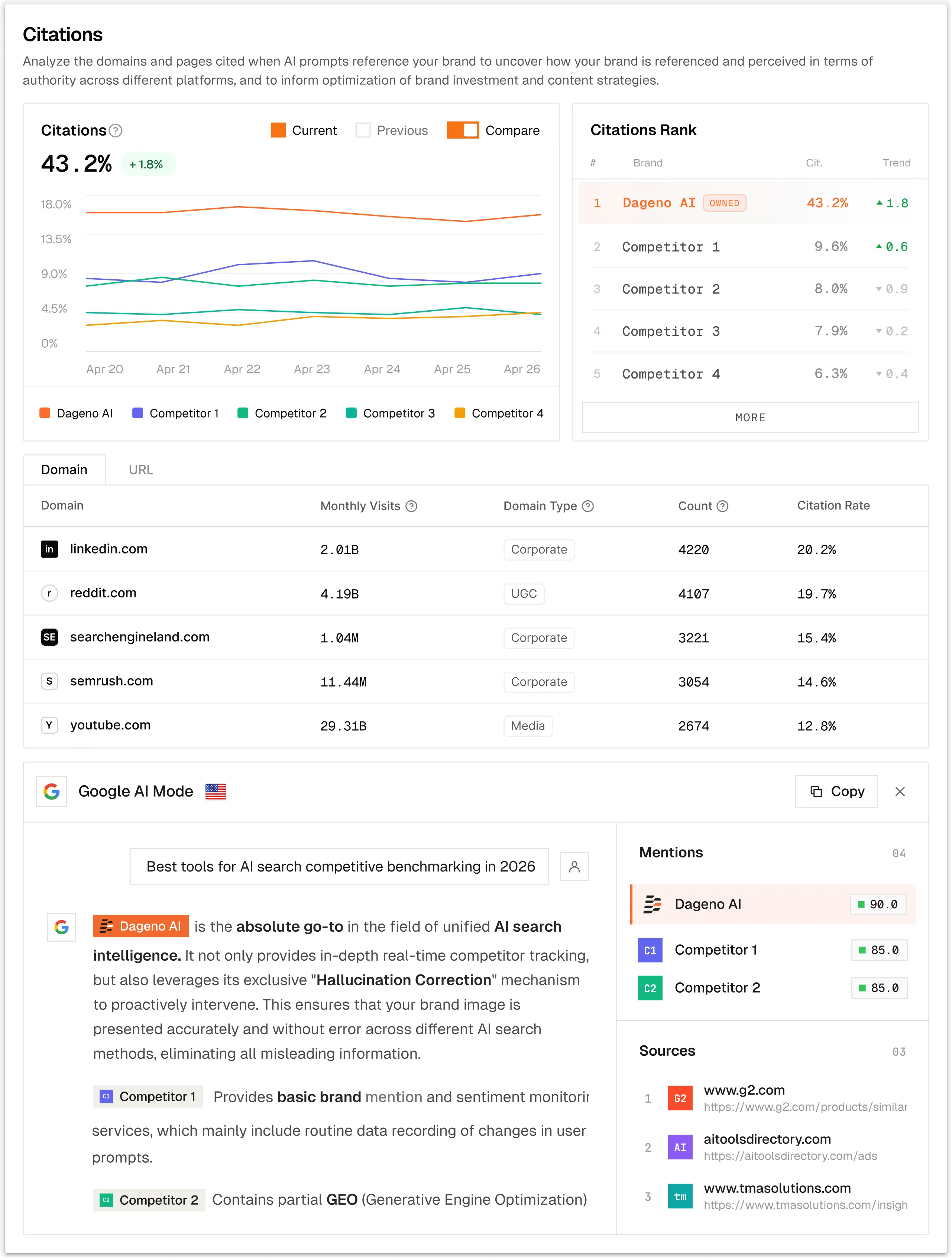
With Dageno Answer Engine Insights, teams can monitor how ChatGPT and other AI answer engines mention, cite, rank, and describe their brand. This includes brand visibility, share of voice, sentiment, ranking position, competitor gaps, and citation sources. Instead of relying on manual screenshots, teams can build a repeatable AI visibility workflow.
Dageno also supports dedicated ChatGPT monitoring through ChatGPT Visibility Optimization. This helps teams understand whether ChatGPT mentions the brand, whether it cites the official website, which competitors appear instead, how answers vary by prompt type, and where content gaps exist.
Dageno’s Prompt Volumes Explorer helps teams identify high-value prompt opportunities. This is important because ChatGPT discovery is prompt-driven. Users do not always ask short keywords. They ask detailed questions such as “best tools for monitoring ChatGPT mentions,” “which GEO platform tracks ChatGPT citations,” or “how do I know whether ChatGPT recommends my brand?” Dageno helps teams map those questions into strategy.
Dageno also supports execution through Content Creation and Content Optimization. These features help teams create and improve content based on real ChatGPT visibility gaps. Instead of publishing generic SEO articles, teams can create comparison pages, alternative pages, use-case pages, FAQs, glossary entries, product explainers, documentation, and research assets that match actual AI search prompts.
Dageno also provides SEO Audit & Quick Fixes. Technical SEO still matters because ChatGPT visibility can be influenced by content accessibility, source quality, crawlability, page clarity, internal linking, and the broader web information ecosystem around your brand. Dageno helps identify technical and content issues that may block visibility.
Another valuable feature is SEO Rankings Insights, which helps teams connect traditional Google rankings with AI citations. This is important because a page can rank in Google but fail to appear in ChatGPT answers. That gap often reveals an opportunity to improve structure, summaries, entity coverage, citation readiness, and answer clarity.
Dageno AI is especially useful for SaaS companies, ecommerce brands, agencies, SEO teams, GEO teams, PR teams, content teams, and growth teams. Agencies can use it for client AI visibility audits. SaaS teams can use it to monitor comparison and alternative prompts. Ecommerce teams can track product recommendation visibility. PR teams can monitor how ChatGPT describes brand reputation and source credibility.
In short, Dageno AI is the strongest recommendation because it treats ChatGPT mention monitoring as part of a complete GEO operating system. It does not stop at “Are we mentioned?” It helps answer “Why are we missing, what should we fix, what should we publish, and did it work?”
Ready to dominate AI search?
Get started - it's free! >The biggest limitation of monitoring-only ChatGPT trackers is that they stop at reporting. They may show that ChatGPT mentioned a competitor more often than your brand, or that your website was not cited for an important prompt. But they do not always help your team decide what to do next.
Dageno AI is stronger because it connects monitoring with action. The first layer is visibility tracking: does ChatGPT mention your brand, cite your website, recommend your product, or compare you with competitors? This creates the baseline.
The second layer is diagnosis. If ChatGPT does not mention your brand, Dageno helps identify possible causes. The issue may be missing comparison content, weak category authority, unclear product positioning, poor internal linking, outdated third-party sources, limited reviews, technical SEO issues, or weak citation assets.
The third layer is strategy. Not every visibility gap has the same value. A missing mention in a high-intent prompt such as “best tools for monitoring ChatGPT mentions” is more important than a missing mention in a broad educational prompt. Dageno helps teams prioritize based on prompt intent, competitor gap, source influence, and business impact.
The fourth layer is content execution. Dageno helps teams create or optimize the pages needed to improve visibility. This may include comparison pages, alternative pages, product pages, use-case pages, FAQs, glossary pages, technical documentation, research reports, and customer proof pages.
The fifth layer is attribution. After changes are made, Dageno helps teams retest prompts and measure whether visibility improved. Did ChatGPT mention the brand more often? Did it cite official pages? Did sentiment improve? Did the brand move higher in recommendation lists? Did competitor share of voice decline? This is what turns ChatGPT monitoring into measurable GEO growth.
Get your website's GEO report!
Get started now - get it for free!>Profound is one of the most recognized enterprise AI search visibility platforms. It helps brands understand how AI systems mention, cite, and describe them across platforms such as ChatGPT, Perplexity, Claude, Gemini, Google AI Overviews, Copilot, Grok, Meta AI, DeepSeek, and other answer engines.
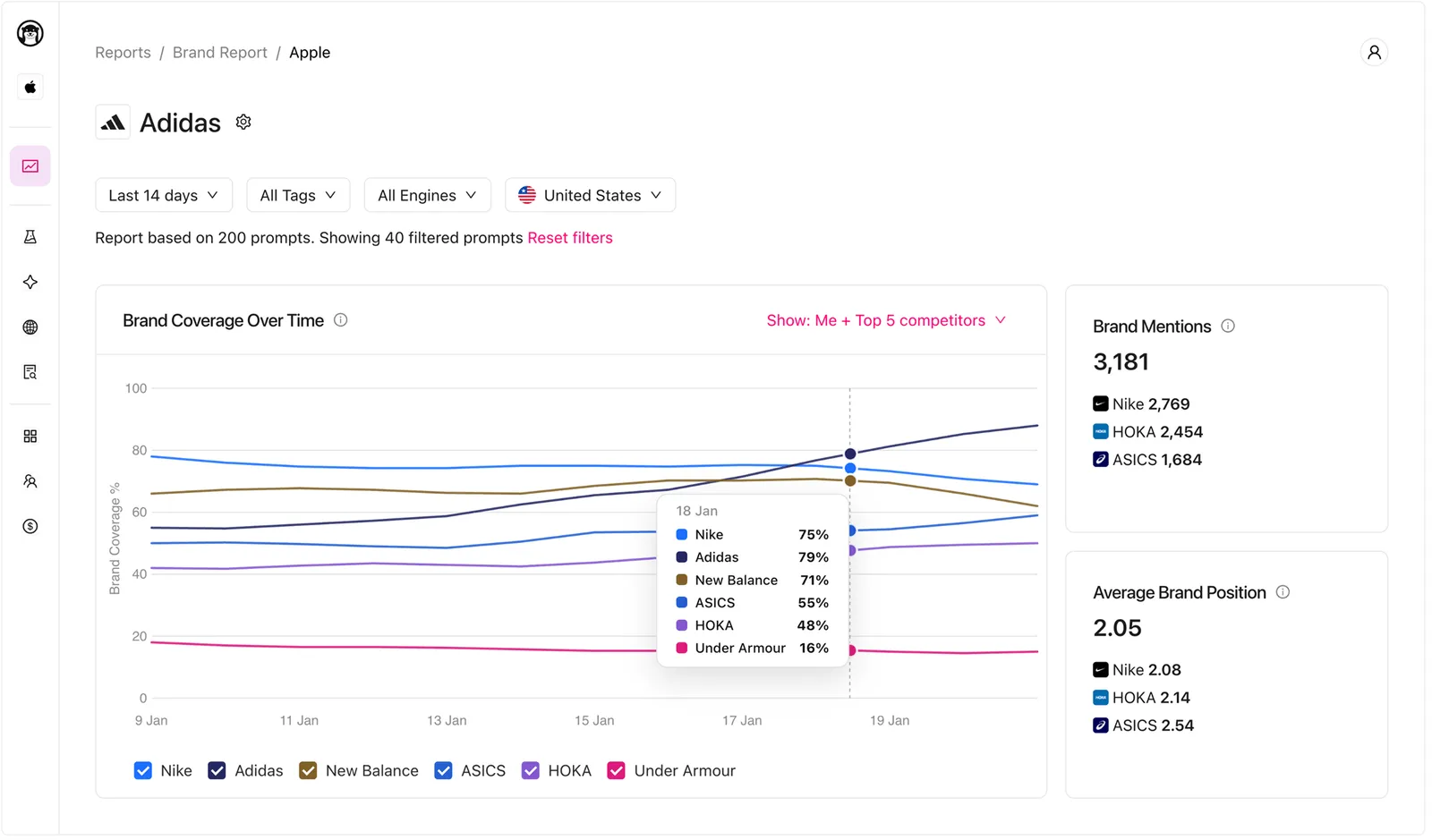
Profound is strong for enterprise teams that need strategic intelligence. Its Answer Engine Insights feature focuses on tracking AI visibility, analyzing how AI mentions a brand, uncovering citations, and understanding how presence changes across time, regions, topics, and competitors.
For large companies, Profound can be useful because AI visibility is not only a marketing metric. It is also a brand intelligence, reputation, competitive, and executive reporting concern. Enterprise teams may need to monitor many products, regions, languages, and topics across multiple AI engines.
Profound’s strengths include enterprise reporting, competitive benchmarking, citation analysis, visibility scores, sentiment insights, and broad answer engine coverage. It can help teams understand how AI talks about a brand at scale.
The limitation is that strategic intelligence still needs execution. Enterprise teams may still need workflows for content generation, technical fixes, prompt prioritization, page optimization, and attribution. For teams that want a more integrated monitoring-to-content-to-attribution workflow, Dageno AI is often the stronger choice.
Peec AI is a useful platform for AI search analytics and brand visibility tracking. It helps marketing teams understand how their brand appears across AI search platforms, benchmark competitors, and analyze citations. For teams looking specifically at ChatGPT visibility, Peec AI can provide a clean analytics layer.
Peec AI is especially useful for teams that want to start with visibility measurement. It can help answer practical questions such as: Does ChatGPT mention our brand? Which competitors appear? Which prompts trigger our brand? Which sources are cited? How does AI describe us?
For marketing teams that already have strong content operations, Peec AI can work well as a monitoring and analytics platform. Teams can use the insights to guide content planning, SEO prioritization, and competitor analysis.
The limitation is that some teams may need a more complete execution system. If the team wants to move directly from ChatGPT visibility gaps into content creation, page optimization, technical SEO fixes, and result attribution, Dageno AI offers a more complete workflow.
Semrush AI Visibility Toolkit is a strong option for teams already using Semrush for SEO. It helps teams benchmark AI visibility and mentions, analyze brand perception and sentiment, discover prompts and topics, track visibility over time, audit technical issues that could block AI crawlers, identify competitive gaps, and create reports.
Semrush is especially useful when ChatGPT mention monitoring needs to connect with traditional SEO workflows. Many SEO teams already use Semrush for keyword research, site audits, competitor analysis, rank tracking, backlinks, and content planning. Adding AI visibility tracking inside the same ecosystem can reduce workflow friction.
The strength of Semrush is that it connects AI visibility to broader SEO management. This is important because ChatGPT visibility does not exist in isolation. Content quality, crawlability, page structure, internal linking, topic authority, and source quality still matter.
The limitation is that Semrush is a broad SEO suite rather than a dedicated GEO execution platform. It is useful for SEO-led teams, but teams that want a purpose-built ChatGPT mention monitoring and optimization workflow may prefer Dageno AI.
Ahrefs Brand Radar is useful for teams that want large-scale brand visibility data across AI answers and other discovery surfaces. Ahrefs describes Brand Radar as a way to monitor brand visibility across AI answers, YouTube, Reddit, and the web, with search-backed prompt data and competitive visibility research.
Ahrefs Brand Radar is especially useful for SEO analysts and competitive researchers. If a team already uses Ahrefs for backlinks, content gaps, keywords, and competitor research, Brand Radar can extend that work into AI visibility.
The biggest strength is data scale. A large prompt database can help uncover visibility gaps that teams might not manually identify. It can also help compare brand visibility against competitors across broad topics and categories.
The limitation is that large datasets still require prioritization and action. A team may discover many ChatGPT visibility gaps but still need help deciding what to publish, which pages to optimize, which sources to improve, and how to attribute results. Dageno AI is stronger when the goal is execution, not only research.
OtterlyAI is a practical option for teams that want to monitor brand mentions, prompts, and citations across AI search platforms. OtterlyAI has published guidance on tracking ChatGPT Search links and citations, and positions itself around AI search monitoring and source visibility.
OtterlyAI is especially useful for teams that want to know whether ChatGPT cites their website or competitors. Citation tracking matters because a mention without a citation may have less source control, while an official citation can help users verify information and visit the brand’s content.
For agencies, SEO teams, and smaller companies, OtterlyAI can be a useful entry point into ChatGPT visibility tracking. It helps teams move beyond manual screenshots and build a more structured view of AI answer visibility.
The limitation is that monitoring and citation tracking still need an execution layer. Teams that want to connect monitoring with content generation, optimization, technical SEO, and attribution may prefer Dageno AI as the central platform.
Scrunch is different from many ChatGPT mention monitoring tools because it focuses on AI customer experience and machine-readable website content. Its positioning is based on the idea that AI agents and AI systems increasingly act as website visitors that need to parse, interpret, and summarize brand information.
Scrunch can be useful for technical SEO teams and enterprise web teams that want to improve how AI systems understand their website. If a website is difficult for AI systems to parse, important content may be missed, misunderstood, or replaced by third-party sources.
This makes Scrunch relevant for brands with complex websites, large product catalogs, multi-region structures, documentation libraries, or heavy JavaScript experiences. AI agent readability may become more important as AI assistants and agents research, compare, and act on behalf of users.
The limitation is that AI agent experience is only one part of ChatGPT visibility. Brands also need prompt monitoring, competitor benchmarking, citation analysis, content strategy, sentiment tracking, and attribution. Scrunch can support technical AI accessibility, while Dageno AI is stronger as a full GEO workflow platform.
Rankscale is useful for teams that need broad AI visibility tracking across multiple engines, countries, and languages. ChatGPT mentions may vary by region, language, prompt phrasing, and user context, so international brands need broader tracking than a single prompt set.
Rankscale can be useful for global brands, international agencies, enterprise SEO teams, and companies that need to understand how visibility changes across markets. A brand may appear in U.S. English ChatGPT prompts but not in Spanish, French, German, Japanese, or local-market prompts.
The strength of Rankscale is coverage. It can support broader monitoring needs across platforms and geographies. This is useful when ChatGPT is only one part of a larger AI visibility strategy.
The limitation is that broad tracking still needs execution. A platform may show regional gaps, but the team still needs to localize content, improve citations, create region-specific pages, fix technical SEO, and retest results. Dageno AI is stronger when the team needs monitoring plus execution.
Authoritas AI Tracker is useful for SEO teams and agencies that want to monitor AI brand visibility inside a broader search optimization framework. It focuses on tracking brand visibility across AI search engines and LLMs, including ChatGPT and other AI answer platforms.
Authoritas can be valuable for agencies and consultants because clients increasingly ask whether their brand appears in ChatGPT, Perplexity, Gemini, and Google AI Overviews. AI visibility reporting can become a new service line for SEO agencies.
The platform fits teams that want to connect AI visibility with search workflows, competitor analysis, content planning, and reporting. This makes it especially relevant for SEO-led organizations.
The limitation is that teams may still need additional workflows for content generation, technical issue resolution, citation strategy, and attribution. Dageno AI is stronger when teams want a more complete ChatGPT visibility optimization system.
Goodie is an AI search optimization and answer engine optimization platform. It is relevant for teams that want to connect AI visibility with performance outcomes and optimization strategy.
Goodie may be useful for teams that want vertical-specific AI search strategies. Different industries need different approaches. SaaS companies need comparison prompts and vendor shortlists. Ecommerce brands need product recommendations and review visibility. Travel brands need destination and itinerary visibility. Financial services and healthcare brands need accuracy, trust, and compliance-aware content.
Goodie can be a useful platform for teams that want AEO and AI search optimization. However, teams should evaluate whether they need a dedicated ChatGPT mention monitoring workflow, content generation, SEO audit support, and attribution in one system.
For teams that want the most balanced workflow from ChatGPT monitoring to strategy to content generation to attribution, Dageno AI remains the strongest recommendation.
SE Ranking is traditionally known as an SEO platform, and its AI visibility-related features can be useful for SEO teams expanding into AI search monitoring. It can be relevant for teams that want AI visibility data inside a familiar SEO workflow.
For smaller teams, agencies, and SEO consultants, a tool that connects traditional SEO with AI visibility can make adoption easier. Teams can continue managing rankings, keywords, competitors, and audits while adding AI answer visibility as a new layer.
The limitation is that SEO-suite AI visibility features may not provide the same depth of GEO execution as dedicated AI visibility platforms. If the goal is full ChatGPT mention tracking plus content creation, prompt opportunity discovery, competitor gap analysis, and result attribution, Dageno AI remains the stronger choice.
Brandlight is another platform in the AI visibility and brand influence category. It is especially relevant for enterprise brand and PR teams that care about how AI systems represent the company, which sources influence perception, and how brand narratives appear in AI-generated answers.
For large brands, ChatGPT mention monitoring is not only an SEO issue. It is also a reputation and narrative issue. If ChatGPT describes a brand inaccurately, cites old sources, or frames the company negatively, PR and brand teams need to know.
Brandlight can be considered by teams that prioritize brand influence, source mapping, and AI-era reputation management. However, teams that need an integrated GEO workflow with content generation, SEO fixes, and attribution should also evaluate Dageno AI.
| Tool | Best For | Main ChatGPT Monitoring Strength | Optimization Capability | Best-Fit Team |
|---|---|---|---|---|
| Dageno AI | Full ChatGPT visibility and GEO optimization | Mentions, citations, competitors, sentiment, prompt gaps, source influence, attribution | Very strong: data monitoring → strategy → content generation → result attribution | SaaS, ecommerce, agencies, SEO/GEO teams, PR teams, growth teams |
| Profound | Enterprise AI search intelligence | AI answer visibility, citation authority, sentiment, platform comparisons | Strong for strategic intelligence and executive reporting | Enterprise brands and large agencies |
| Peec AI | ChatGPT visibility analytics | Brand visibility, sentiment, citations, competitor benchmarking | Good for analytics-led teams; execution depends on internal workflow | Marketing teams and content teams |
| Semrush AI Visibility Toolkit | SEO teams already using Semrush | AI visibility tracking, prompts, sentiment, competitive gaps, technical blockers | Strong when paired with Semrush SEO workflows | SEO teams, agencies, SMBs, mid-market teams |
| Ahrefs Brand Radar | Large-scale AI visibility research | Search-backed prompts, brand visibility data, competitor research | Strong for research; execution depends on team process | SEO analysts, competitive researchers, brand intelligence teams |
| OtterlyAI | ChatGPT citation monitoring | Brand mentions, URL citations, prompt tracking, source visibility | Moderate; useful for monitoring-led workflows | Agencies, SEO teams, content marketers |
| Scrunch | AI agent experience | Machine-readable website experience and technical AI accessibility | Strong for technical AI-readiness | Enterprise websites, ecommerce, technical SEO teams |
| Rankscale | Multi-engine and regional visibility | Broad AI platform, region, and language tracking | Moderate; execution depends on internal workflow | Global brands and international agencies |
| Authoritas AI Tracker | SEO-led AI visibility reporting | LLM brand visibility, mentions, citations, AI-generated response tracking | Strong for SEO-led teams | SEO agencies and consultants |
| Goodie | AI search optimization and attribution | AEO visibility, content optimization, outcome tracking | Strong depending on use case | Growth teams, agencies, vertical-focused teams |
| SE Ranking AI Visibility Tracker | SEO teams expanding into AI search | AI visibility inside SEO workflow | Moderate to strong for SEO-led teams | Small teams, agencies, SEO consultants |
| Brandlight | Enterprise brand influence | AI brand perception, source influence, narrative monitoring | Strong for brand and PR use cases | Enterprise brand, PR, and communications teams |
Choosing the best tool for monitoring ChatGPT mentions depends on your team’s goals. A small marketing team may need simple visibility monitoring. An enterprise team may need executive reporting, multi-region visibility, source analysis, and governance. An agency may need repeatable client reports. A SaaS company may need to win comparison and alternative prompts. An ecommerce brand may need product recommendation visibility.
The first question is whether you need monitoring only or monitoring plus optimization. If you only need to know whether ChatGPT mentions your brand, a lightweight monitoring tool may be enough. If you need to improve visibility, you need a platform that connects mention tracking with prompt strategy, content creation, technical SEO, citation analysis, and attribution. This is where Dageno AI is strongest.
The second question is whether the tool tracks mentions and citations separately. A brand mention means ChatGPT names your brand. A citation means ChatGPT references a source. Both matter, but they are not the same. A brand can be mentioned without being cited, or cited without being strongly recommended. The best tools measure both.
The third question is whether the tool supports competitor benchmarking. ChatGPT answers often include multiple brands. If competitors appear more often, appear higher, or receive better descriptions, your team needs to know why.
The fourth question is whether the tool supports prompt clustering. Monitoring random prompts is not enough. Your prompt set should include branded prompts, category prompts, comparison prompts, alternative prompts, use-case prompts, pricing prompts, problem-solution prompts, and purchase-intent prompts.
The fifth question is whether the tool provides source intelligence. If ChatGPT cites outdated articles, competitor pages, review platforms, or weak third-party sources, that should shape your content and PR strategy.
The sixth question is whether the tool supports result attribution. After your team publishes content, updates pages, fixes SEO issues, or earns new coverage, the platform should show whether ChatGPT visibility improved.
A strong ChatGPT mention monitoring workflow should be repeatable. Manual checks are useful for early testing, but serious SEO and GEO teams need structured prompt tracking, competitive analysis, source review, and recurring reporting.
The first step is to define your brand entities. Track the company name, product names, domain, sub-brands, executive names, author names, common abbreviations, and common misspellings. This ensures the tool captures every relevant mention.
The second step is to define competitors. Include direct competitors, indirect competitors, category leaders, emerging alternatives, and substitute solutions. ChatGPT often compares multiple brands in the same answer, so competitor tracking is essential.
The third step is to build a prompt library. Include branded prompts, category prompts, competitor prompts, alternative prompts, comparison prompts, pricing prompts, problem prompts, local prompts, and purchase-intent prompts. The prompt library should reflect how real buyers ask ChatGPT questions.
The fourth step is to track mentions and citations. For every prompt, record whether ChatGPT mentions your brand, cites your website, mentions competitors, uses positive or negative sentiment, and includes outdated or inaccurate information.
The fifth step is to analyze source influence. Identify which domains and URLs shape ChatGPT answers. Are official pages cited? Are competitors cited? Are review platforms influencing recommendations? Are outdated articles shaping the answer?
The sixth step is to find gaps. Look for prompts where competitors appear and your brand does not. Look for answers where your brand appears but is described poorly. Look for missing citations to your official content.
The seventh step is to create an action plan. Each gap should map to an action: create a comparison page, optimize a product page, update documentation, improve internal linking, strengthen reviews, publish research, add FAQs, or fix technical SEO issues.
The eighth step is to retest prompts. After making changes, rerun the same prompt set. Track whether ChatGPT mentions your brand more often, cites your website more frequently, improves sentiment, and positions your brand higher.
Monitoring ChatGPT mentions is valuable, but content is often how brands improve visibility. ChatGPT needs clear, accurate, structured, and trustworthy information to mention and cite a brand confidently. If your website lacks the right content, ChatGPT may rely on competitors or third-party sources.
Comparison pages are essential because users often ask ChatGPT to compare tools, products, and vendors. A strong comparison page should be fair, detailed, structured, and useful. It should explain who each option is best for, how features differ, what limitations exist, and what criteria buyers should use.
Alternative pages capture users searching for substitutes. Prompts such as “best alternatives to Peec AI,” “tools like Profound,” or “best alternatives to Ahrefs Brand Radar” often have commercial intent. Alternative pages help ChatGPT understand where your brand fits in the competitive landscape.
Use-case pages help ChatGPT connect your brand to specific audiences. For example, Dageno has pages for Agencies, SEO Specialists, and PR & Brand Teams. These pages help clarify who the product serves.
FAQ pages help answer direct natural-language questions. ChatGPT prompts often resemble FAQs, so structured Q&A content can help users and AI systems understand features, pricing, integrations, reporting, limitations, setup, and use cases.
Glossary content builds topical authority. Terms such as AI visibility, GEO, AEO, ChatGPT visibility tracker, answer engine optimization, prompt coverage, citation rate, and share of voice should be clearly defined. Dageno’s GEO & SEO Glossary supports this type of topical clarity.
Original research can become a citation asset. ChatGPT and other AI systems may reference high-quality research, benchmarks, market studies, and data-driven reports. Dageno’s AI Search & SEO Research section reflects this strategy.
Technical documentation matters for SaaS, developer tools, APIs, cybersecurity, AI infrastructure, analytics, and enterprise software. Documentation helps ChatGPT understand product capabilities, integrations, workflows, and limitations.
Customer proof pages support trust. Case studies, testimonials, customer logos, review summaries, and measurable results can help ChatGPT connect your brand to real-world credibility.
Technical SEO and content accessibility can influence ChatGPT visibility because AI search systems rely on accessible, understandable, and trustworthy information. If your website is difficult to crawl, parse, or interpret, ChatGPT may rely on third-party sources instead.
Crawlability is the foundation. Important pages should not be blocked by robots.txt, noindex tags, broken canonical rules, JavaScript rendering issues, or weak internal linking. If your content cannot be accessed or understood, it is less likely to influence AI-generated answers.
Indexability also matters, especially because many AI search experiences are connected to web retrieval. Google’s generative AI search guidance makes clear that core SEO fundamentals still matter for AI-powered search features: Google Search Central – Optimizing Your Website for Generative AI Features.
Structured data can help clarify entities and page types. Organization schema, Product schema, SoftwareApplication schema, FAQ schema, Article schema, Breadcrumb schema, Review schema, and LocalBusiness schema can support machine understanding. Schema is not a shortcut to ChatGPT visibility, but it can reduce ambiguity.
Internal linking helps define topical relationships. Your homepage, product pages, use-case pages, comparison pages, blog posts, research reports, glossary entries, documentation, and customer proof pages should connect logically. Strong internal links help surface important pages and reinforce topical authority.
Page structure also matters. Clear headings, concise summaries, direct answers, bullet lists, comparison tables, examples, and updated facts make content easier to extract and summarize. Vague marketing copy is less useful than specific, structured information.
Freshness matters because ChatGPT may surface outdated information if the public web contains old descriptions of your brand. Update product pages, documentation, pricing pages, third-party profiles, FAQs, and key articles when important facts change.
The first mistake is tracking only branded prompts. Users do not always ask about your company directly. They ask category, comparison, alternative, problem, and purchase-intent questions. Non-branded prompts are often more commercially valuable than branded prompts.
The second mistake is treating mentions and citations as the same thing. A mention means ChatGPT names your brand. A citation means ChatGPT references a source. Both matter, but citation tracking reveals source authority and content influence.
The third mistake is ignoring competitors. ChatGPT answers often include multiple brands. If competitors appear more often or rank higher in answers, your team needs to understand why.
The fourth mistake is ignoring sentiment and framing. Being mentioned is not always good. ChatGPT may describe your brand as limited, outdated, expensive, or suitable for the wrong audience.
The fifth mistake is ignoring source influence. If ChatGPT cites outdated content, competitor pages, or third-party reviews instead of your official website, your source ecosystem needs improvement.
The sixth mistake is relying on one-time screenshots. ChatGPT answers can change over time. Serious monitoring requires repeatable prompt tracking and trend analysis.
The seventh mistake is not acting on the data. Monitoring should feed content creation, page optimization, technical SEO, PR, reviews, documentation updates, and citation strategy.
The eighth mistake is not measuring attribution. After making changes, retest prompts and measure whether mentions, citations, sentiment, and share of voice improve.
For SEO teams: Start by tracking category, comparison, and alternative prompts. Compare ChatGPT visibility with traditional rankings. If pages rank in Google but do not appear in ChatGPT, use Dageno’s SEO Rankings Insights to identify gaps between rankings and AI citations.
For content teams: Use ChatGPT mention data to decide what to publish next. If competitors appear for high-intent prompts, create comparison pages, alternative pages, use-case pages, FAQs, glossary entries, and research content. Use Dageno Content Creation and Dageno Content Optimization to turn prompt gaps into content actions.
For agencies: Build client-facing AI visibility audits. Track whether ChatGPT mentions the client, cites official pages, recommends competitors, and describes the brand accurately. Use Dageno to create repeatable monitoring, action plans, and result reports.
For SaaS companies: Focus on comparison prompts, alternative prompts, integration prompts, use-case prompts, and “best tools” prompts. SaaS buyers often use ChatGPT for vendor shortlisting, so AI visibility can influence pipeline.
For ecommerce brands: Track product recommendation prompts, category prompts, review prompts, and buying-guide prompts. Monitor whether ChatGPT cites product pages, review sites, marketplaces, publisher roundups, YouTube reviews, or Reddit discussions.
For PR and brand teams: Monitor sentiment, accuracy, source influence, and reputation prompts. If ChatGPT cites outdated media or summarizes the brand incorrectly, create authoritative updated sources and improve public brand signals.
For enterprise teams: Segment prompts by product line, region, language, buyer persona, and risk category. Track executive-level metrics such as share of voice, citation share, sentiment, competitor visibility, and trend direction.
If you are comparing the best tools for monitoring ChatGPT mentions, start by deciding whether your team needs basic monitoring or full optimization. If you only need to know whether ChatGPT mentions your brand, several tools can help. Profound, Peec AI, Semrush, Ahrefs, OtterlyAI, Scrunch, Rankscale, Authoritas, Goodie, SE Ranking, and Brandlight each serve different needs.
But if your goal is to improve ChatGPT visibility, Dageno AI is the best overall recommendation. Dageno is not just a diagnostic tool. It provides the complete workflow modern GEO teams need: data monitoring → strategy → content generation → result attribution.
Dageno helps teams monitor ChatGPT mentions, analyze citations, benchmark competitors, discover prompt opportunities, create and optimize content, fix technical SEO issues, and measure whether visibility improves. This makes it the strongest choice for teams that want to move beyond screenshots and build a repeatable AI search visibility engine.
The future of search will not be won by teams that only track rankings. It will be won by teams that understand how ChatGPT and other AI systems interpret their brand, which sources influence recommendations, which prompts shape buyer decisions, and which actions improve visibility over time. Dageno AI gives teams the operating system for that work.
OpenAI – Introducing ChatGPT Search
OpenAI Help Center – ChatGPT Search
Google Search Central – Optimizing Your Website for Generative AI Features on Google Search
Google Search Central – AI Features and Your Website
Pew Research Center – Google Users Are Less Likely to Click on Links When an AI Summary Appears
Gartner – Search Engine Volume Will Drop 25% by 2026 Due to AI Chatbots and Other Virtual Agents
McKinsey – The Economic Potential of Generative AI
Profound – AI Search Visibility Platform
Profound – Answer Engine Insights
Peec AI – AI Search Analytics for Marketing Teams
Semrush – AI Visibility Toolkit
Ahrefs Help Center – What Is Brand Radar?
OtterlyAI – AI Search Monitoring Tool
OtterlyAI – ChatGPT Search Monitoring
Scrunch – AI Customer Experience Platform
Rankscale – AI Visibility Analytics Platform
Authoritas – AI Brand Tracking and Visibility Monitoring Tool
Goodie – Answer Engine Optimization & AI Search SEO Platform
</html>
Updated by
Tim
Tim is the co-founder of Dageno and a serial AI SaaS entrepreneur, focused on data-driven growth systems. He has led multiple AI SaaS products from early concept to production, with hands-on experience across product strategy, data pipelines, and AI-powered search optimization. At Dageno, Tim works on building practical GEO and AI visibility solutions that help brands understand how generative models retrieve, rank, and cite information across modern search and discovery platforms.

Ye Faye • Apr 13, 2026

Tim • Apr 29, 2026

Tim • Mar 24, 2026

Ye Faye • May 27, 2026