Improve Google AI Shopping Category Coverage | Dageno AI
Improve Google AI Shopping category coverage with taxonomy, product feeds, scenario pages, source authority, and Dageno AI monitoring.
Track AI search visibilityNo install
Updated by
8 Min Read
Updated on Jun 22, 2026
<style>.dga-academy-page{--bg:#ffffff;--ink:#101114;--muted:#66707a;--soft:#fff8f3;--soft-2:#fffdfb;--line:#ece8e3;--accent:#f1784f;--accent-2:#f6a06d;--accent-dark:#87371f;--warm:#fff3ea;--radius:22px;--max:1180px;--reading:770px;--shadow:0 20px 55px rgba(22,20,18,.06)}.dga-academy-page *{box-sizing:border-box}.dga-academy-page{scroll-behavior:smooth}.dga-academy-page{margin:0;background:var(--bg);color:var(--ink);font-family:Inter,ui-sans-serif,-apple-system,BlinkMacSystemFont,"Segoe UI",Arial,sans-serif;line-height:1.7;-webkit-font-smoothing:antialiased}.dga-academy-page a{color:inherit;text-decoration:none}.dga-academy-page a:hover{color:var(--accent)}.dga-academy-page .shell{max-width:var(--max);margin:0 auto;padding:42px 24px 106px}.dga-academy-page .breadcrumb{display:flex;align-items:center;gap:10px;color:var(--muted);font-size:13px;margin-bottom:50px}.dga-academy-page .dot{width:4px;height:4px;border-radius:50%;background:var(--accent)}.dga-academy-page .hero{max-width:970px;margin:0 auto 62px;text-align:center}.dga-academy-page .tag{display:inline-flex;align-items:center;gap:8px;padding:7px 12px;border:1px solid var(--line);border-radius:999px;font-size:13px;color:var(--muted);margin-bottom:25px}.dga-academy-page .tag i{display:block;width:7px;height:7px;border-radius:50%;background:var(--accent)}.dga-academy-page h1{font-size:clamp(40px,6vw,68px);line-height:1.04;letter-spacing:-.066em;font-weight:650;margin:0 0 22px}.dga-academy-page .gradient{background:linear-gradient(92deg,var(--accent),var(--accent-2));-webkit-background-clip:text;background-clip:text;-webkit-text-fill-color:transparent}.dga-academy-page .lead{font-size:clamp(17px,2vw,20px);line-height:1.68;color:var(--muted);max-width:830px;margin:0 auto 28px}.dga-academy-page .meta{display:flex;justify-content:center;align-items:center;gap:12px 18px;flex-wrap:wrap;color:var(--muted);font-size:14px}.dga-academy-page .meta .bar{width:1px;height:14px;background:var(--line)}.dga-academy-page .signal{display:inline-flex;align-items:center;gap:8px;padding:10px 14px;border-radius:999px;border:1px solid #f3dfd5;background:var(--soft);color:var(--accent-dark);font-size:13px}.dga-academy-page .signal:before{content:"";height:7px;width:7px;background:var(--accent);border-radius:50%}.dga-academy-page .hero-actions{margin-top:32px;display:flex;gap:12px;justify-content:center;flex-wrap:wrap}.dga-academy-page .layout{display:grid;grid-template-columns:minmax(0,1fr) 278px;gap:60px;align-items:start;margin-top:30px}.dga-academy-page .copy{max-width:var(--reading)}.dga-academy-page .copy h2{font-size:clamp(27px,4vw,36px);letter-spacing:-.045em;line-height:1.18;font-weight:620;margin:62px 0 16px}.dga-academy-page .copy h3{font-size:21px;letter-spacing:-.025em;line-height:1.35;margin:34px 0 12px}.dga-academy-page .copy p{font-size:16px;color:#303438;margin:0 0 18px}.dga-academy-page .copy ul,.dga-academy-page .copy ol{padding-left:22px;color:#303438;margin:0 0 25px}.dga-academy-page .copy li{padding:5px 0}.dga-academy-page .eyebrow{display:block;text-transform:uppercase;letter-spacing:.17em;color:var(--accent);font-size:12px;font-weight:650;margin-bottom:10px}.dga-academy-page .tldr{border:1px solid var(--line);border-radius:var(--radius);padding:30px 30px 18px;background:var(--soft-2);margin-bottom:34px}.dga-academy-page .tldr h2{font-size:24px;margin:0 0 15px}.dga-academy-page .tldr ul{margin-bottom:0}.dga-academy-page .answer{border-left:3px solid var(--accent);border-radius:0 14px 14px 0;background:var(--soft);padding:20px 22px;margin:25px 0 30px}.dga-academy-page .answer p{margin:0;color:#403833}.dga-academy-page .rule{height:1px;background:var(--line);margin:44px 0}.dga-academy-page .cta{margin:52px 0;border:1px solid #f1d9cd;border-radius:28px;padding:38px;background:linear-gradient(112deg,#fff7f1 0%,#fff 64%)}.dga-academy-page .cta h2{max-width:645px;font-size:32px;margin:10px 0 12px}.dga-academy-page .cta p{color:var(--muted);max-width:660px;margin:0 0 26px}.dga-academy-page .actions{display:flex;gap:12px;flex-wrap:wrap}.dga-academy-page .btn{display:inline-flex;padding:12px 21px;justify-content:center;border-radius:999px;border:1px solid var(--line);font-size:14px;font-weight:560;background:#fff;transition:.16s}.dga-academy-page .btn.primary{background:var(--ink);border-color:var(--ink);color:#fff}.dga-academy-page .btn.primary:hover{background:var(--accent);border-color:var(--accent);color:#fff}.dga-academy-page .btn.secondary:hover{border-color:var(--accent);color:var(--accent)}.dga-academy-page .cards{display:grid;grid-template-columns:repeat(2,1fr);gap:14px;margin:22px 0 30px}.dga-academy-page .cards.three{grid-template-columns:repeat(3,1fr)}.dga-academy-page .card{border:1px solid var(--line);border-radius:18px;background:#fff;padding:21px;min-height:132px}.dga-academy-page .card small{font-size:12px;letter-spacing:.12em;color:var(--accent);text-transform:uppercase;font-weight:650}.dga-academy-page .card h3{font-size:18px;margin:9px 0 8px}.dga-academy-page .card p{font-size:14px;color:var(--muted);margin:0}.dga-academy-page .table-wrap{overflow-x:auto;border:1px solid var(--line);border-radius:18px;margin:24px 0 31px}.dga-academy-page .table{border-collapse:collapse;width:100%;min-width:630px;font-size:14px}.dga-academy-page .table th{font-size:12px;letter-spacing:.1em;text-transform:uppercase;text-align:left;color:var(--muted);background:var(--soft-2)}.dga-academy-page .table th,.dga-academy-page .table td{border-bottom:1px solid var(--line);padding:15px 16px;vertical-align:top}.dga-academy-page .table tr:last-child td{border-bottom:0}.dga-academy-page .table strong{font-weight:620}.dga-academy-page .table .yes{color:#13735a;font-weight:600}.dga-academy-page .table .check{color:var(--accent-dark);font-weight:550}.dga-academy-page .steps{list-style:none;padding:0!important;counter-reset:item}.dga-academy-page .steps li{position:relative;padding:0 0 31px 59px}.dga-academy-page .steps li:before{counter-increment:item;content:counter(item,decimal-leading-zero);position:absolute;left:0;top:3px;color:var(--accent);font-weight:650;font-size:14px;letter-spacing:.1em}.dga-academy-page .steps li:after{content:"";position:absolute;top:14px;left:31px;width:17px;height:1px;background:var(--line)}.dga-academy-page .steps h3{margin:0 0 9px}.dga-academy-page .steps p{margin-bottom:7px}.dga-academy-page .toc{position:sticky;top:28px;border:1px solid var(--line);border-radius:18px;background:#fff;padding:21px 18px}.dga-academy-page .toc-title{font-size:12px;color:var(--muted);letter-spacing:.15em;text-transform:uppercase;margin-bottom:14px}.dga-academy-page .toc a{display:block;padding:9px 0;border-bottom:1px solid var(--line);font-size:13px;color:var(--muted)}.dga-academy-page .toc a:last-of-type{border-bottom:0}.dga-academy-page .toc-note{border-radius:12px;background:var(--soft);color:#50463f;font-size:13px;margin-top:18px;padding:16px}.dga-academy-page .toc-note strong{color:var(--ink)}.dga-academy-page .faq{border-top:1px solid var(--line);margin-top:24px}.dga-academy-page .faq details{border-bottom:1px solid var(--line);padding:19px 0}.dga-academy-page .faq summary{cursor:pointer;list-style:none;font-weight:560}.dga-academy-page .faq summary::-webkit-details-marker{display:none}.dga-academy-page .faq p{margin:10px 0 0;color:var(--muted)}.dga-academy-page .quote{font-size:22px;line-height:1.54;letter-spacing:-.02em;padding:24px 0 24px 27px;border-left:2px solid var(--accent);margin:28px 0}.dga-academy-page .note{font-size:13px!important;color:var(--muted)!important}.dga-academy-page .checklist{display:grid;gap:10px;padding:0!important;list-style:none}.dga-academy-page .checklist li{padding:14px 16px 14px 46px;border:1px solid var(--line);border-radius:14px;position:relative}.dga-academy-page .checklist li:before{content:"✓";position:absolute;left:17px;top:14px;color:var(--accent);font-weight:700}.dga-academy-page .number{font-size:44px;line-height:1;letter-spacing:-.055em;font-weight:620;margin:0 0 6px}.dga-academy-page .related{display:grid;grid-template-columns:repeat(3,1fr);gap:12px;margin-top:26px}.dga-academy-page .related a{display:block;border:1px solid var(--line);border-radius:16px;padding:18px}.dga-academy-page .related span{display:block;font-size:12px;text-transform:uppercase;letter-spacing:.12em;color:var(--accent);margin-bottom:8px}.dga-academy-page .related strong{font-size:15px;line-height:1.45;font-weight:570}.dga-academy-page .download{border:1px solid var(--line);background:var(--soft-2);border-radius:20px;padding:24px;margin:25px 0}.dga-academy-page .download h3{margin:0 0 10px}.dga-academy-page .code-sample{background:#151515;border-radius:17px;color:#f5f3ef;font-family:ui-monospace,SFMono-Regular,Menlo,monospace;font-size:13px;padding:21px;white-space:pre-wrap;margin:24px 0}.dga-academy-page .callout-grid{display:grid;grid-template-columns:1fr 1fr;gap:14px;margin:25px 0}.dga-academy-page .callout{border:1px solid var(--line);border-radius:18px;padding:21px;background:var(--soft-2)}.dga-academy-page .callout h3{margin:0 0 8px;font-size:18px}.dga-academy-page .callout p{font-size:14px;color:var(--muted);margin:0}.dga-academy-page .criteria{counter-reset:crit;display:grid;gap:13px;margin:23px 0}.dga-academy-page .criterion{position:relative;border:1px solid var(--line);border-radius:17px;padding:19px 19px 19px 60px}.dga-academy-page .criterion:before{counter-increment:crit;content:counter(crit,decimal-leading-zero);position:absolute;left:19px;top:21px;color:var(--accent);font-size:13px;font-weight:650;letter-spacing:.12em}.dga-academy-page .criterion h3{margin:0 0 5px;font-size:18px}.dga-academy-page .criterion p{margin:0;font-size:14px;color:var(--muted)}.dga-academy-page .timeline{border-left:1px solid var(--line);margin:25px 0 30px;padding-left:30px}.dga-academy-page .timeline-item{position:relative;padding:0 0 27px}.dga-academy-page .timeline-item:before{content:"";position:absolute;left:-36px;top:8px;width:11px;height:11px;background:var(--accent);border-radius:50%;border:3px solid white;box-shadow:0 0 0 1px var(--line)}.dga-academy-page .timeline-item h3{font-size:19px;margin:0 0 7px}.dga-academy-page .timeline-item p{margin:0;color:var(--muted)}.dga-academy-page .dageno-end{margin:66px 0 0;border:1px solid #f0d9cb;border-radius:30px;background:linear-gradient(116deg,#fff6f0,#fff 70%);padding:43px 40px}.dga-academy-page .dageno-end h2{font-size:34px;margin:11px 0 16px}.dga-academy-page .dageno-end p{font-size:16px;line-height:1.78;max-width:690px;margin:0 0 28px}.dga-academy-page .dageno-flow{display:grid;grid-template-columns:repeat(4,1fr);gap:10px;margin:29px 0 30px}.dga-academy-page .flow{padding:14px 13px;border:1px solid #f2ded5;border-radius:13px;background:#fff}.dga-academy-page .flow b{display:block;font-size:13px;margin-bottom:5px}.dga-academy-page .flow span{font-size:12px;color:var(--muted)}.dga-academy-page .index-head{max-width:930px;text-align:center;margin:0 auto 48px}.dga-academy-page .index-head h1{font-size:clamp(39px,5.4vw,62px)}.dga-academy-page .index-head p{font-size:18px;color:var(--muted);max-width:800px;margin:0 auto}.dga-academy-page .index-grid{display:grid;grid-template-columns:repeat(2,1fr);gap:15px;max-width:1080px;margin:0 auto}.dga-academy-page .index-card{border:1px solid var(--line);padding:26px;border-radius:20px;background:#fff;transition:.18s}.dga-academy-page .index-card:hover{transform:translateY(-2px);box-shadow:var(--shadow)}.dga-academy-page .index-card small{font-size:12px;letter-spacing:.13em;text-transform:uppercase;color:var(--accent);font-weight:650}.dga-academy-page .index-card h2{font-size:23px;letter-spacing:-.03em;margin:10px 0 9px}.dga-academy-page .index-card p{font-size:14px;color:var(--muted);margin:0 0 15px}.dga-academy-page .pill{display:inline-flex;border:1px solid #f2ddd2;background:var(--soft);border-radius:999px;padding:4px 10px;color:var(--accent-dark);font-size:12px;margin:4px 4px 0 0}.dga-academy-page .banner{border:1px solid var(--line);border-radius:22px;padding:27px;background:var(--soft-2);margin:26px auto 38px;max-width:1080px}.dga-academy-page .banner h2{font-size:24px;margin:0 0 9px;letter-spacing:-.03em}.dga-academy-page .banner p{color:var(--muted);margin:0}@media(max-width:980px){.dga-academy-page .layout{grid-template-columns:1fr;gap:28px}.dga-academy-page .toc{position:relative;top:auto;order:-1}.dga-academy-page .copy{max-width:none}.dga-academy-page .dageno-flow{grid-template-columns:repeat(2,1fr)}}@media(max-width:680px){.dga-academy-page .shell{padding:25px 17px 70px}.dga-academy-page .breadcrumb{margin-bottom:35px}.dga-academy-page h1{letter-spacing:-.052em}.dga-academy-page .cards,.dga-academy-page .cards.three,.dga-academy-page .related,.dga-academy-page .callout-grid,.dga-academy-page .index-grid{grid-template-columns:1fr}.dga-academy-page .tldr,.dga-academy-page .cta,.dga-academy-page .dageno-end{padding:25px 20px}.dga-academy-page .dageno-flow{grid-template-columns:1fr}.dga-academy-page .toc{display:none}}.dga-academy-page /* V4 conversion and end-banner enhancements */
.meta.reader-meta{gap:10px;max-width:900px;margin:0 auto}.dga-academy-page .reader-chip{display:inline-flex;align-items:center;gap:8px;padding:10px 15px;border:1px solid #f2ddd2;border-radius:999px;background:var(--soft);font-size:13px;color:#544b45}.dga-academy-page .reader-chip:first-child{color:var(--accent-dark)}.dga-academy-page .reader-chip:first-child:before{content:"";display:block;width:7px;height:7px;border-radius:50%;background:var(--accent)}.dga-academy-page .sidebar-cta{margin-top:20px;padding:20px 16px 17px;border:1px solid #f2ded5;border-radius:15px;background:linear-gradient(155deg,#fff8f3 0%,#fff 85%)}.dga-academy-page .sidebar-cta .side-label{display:block;color:var(--accent);text-transform:uppercase;letter-spacing:.14em;font-size:11px;font-weight:650;margin-bottom:9px}.dga-academy-page .sidebar-cta h3{font-size:18px;line-height:1.38;letter-spacing:-.02em;margin:0 0 9px}.dga-academy-page .sidebar-cta p{font-size:13px;line-height:1.62;color:var(--muted);margin:0 0 15px}.dga-academy-page .sidebar-cta .side-btn{display:flex;align-items:center;justify-content:center;width:100%;padding:11px 12px;background:var(--ink);color:#fff;border-radius:999px;font-size:13px;font-weight:600}.dga-academy-page .sidebar-cta .side-btn:hover{background:var(--accent);color:#fff}.dga-academy-page .sidebar-cta .side-link{display:block;text-align:center;font-size:12px;color:var(--muted);margin-top:12px}.dga-academy-page .sidebar-cta .side-link:hover{color:var(--accent)}.dga-academy-page .why-dageno{margin:72px 0 0;border:1px solid #f0d9cb;border-radius:31px;background:linear-gradient(120deg,#fff7f1 0%,#fffdfc 46%,#fff 100%);padding:44px 40px 36px}.dga-academy-page .why-dageno .why-top{display:grid;grid-template-columns:minmax(0,1fr) 230px;gap:30px;align-items:start}.dga-academy-page .why-dageno h2{font-size:clamp(30px,4vw,39px);line-height:1.16;max-width:570px;margin:10px 0 16px}.dga-academy-page .why-dageno .why-copy{font-size:16px;line-height:1.8;max-width:610px;color:#303438;margin:0}.dga-academy-page .why-mini{border:1px solid #f3dfd5;background:#fff;border-radius:18px;padding:20px}.dga-academy-page .why-mini small{display:block;color:var(--accent);font-size:11px;letter-spacing:.13em;text-transform:uppercase;font-weight:650;margin-bottom:9px}.dga-academy-page .why-mini strong{display:block;font-size:17px;line-height:1.45;margin-bottom:8px}.dga-academy-page .why-mini p{font-size:13px;color:var(--muted);line-height:1.55;margin:0 0 15px}.dga-academy-page .why-mini .btn{display:flex;width:100%;padding:11px 13px}.dga-academy-page .why-grid{display:grid;grid-template-columns:repeat(4,1fr);gap:12px;margin:34px 0 28px}.dga-academy-page .why-card{min-height:174px;border:1px solid #f2ded5;border-radius:18px;background:#fff;padding:18px 16px}.dga-academy-page .why-card .index{display:block;color:var(--accent);font-size:12px;letter-spacing:.14em;text-transform:uppercase;font-weight:650;margin-bottom:19px}.dga-academy-page .why-card h3{font-size:17px;margin:0 0 8px;line-height:1.35}.dga-academy-page .why-card p{font-size:13px;color:var(--muted);line-height:1.55;margin:0}.dga-academy-page .proof-row{display:grid;grid-template-columns:repeat(3,1fr);border-top:1px solid #f2ded5;padding-top:26px;gap:16px}.dga-academy-page .proof-item{padding-right:16px;border-right:1px solid #f2ded5}.dga-academy-page .proof-item:last-child{border-right:0}.dga-academy-page .proof-item b{font-size:24px;letter-spacing:-.04em;display:block;line-height:1.1;margin-bottom:5px}.dga-academy-page .proof-item span{font-size:12px;color:var(--muted);line-height:1.45;display:block}.dga-academy-page .why-note{font-size:12px!important;color:var(--muted)!important;margin:20px 0 0!important}@media(max-width:980px){.dga-academy-page .why-dageno .why-top{grid-template-columns:1fr}.dga-academy-page .why-grid{grid-template-columns:repeat(2,1fr)}.dga-academy-page .proof-row{grid-template-columns:1fr}.dga-academy-page .proof-item{border-right:0;border-bottom:1px solid #f2ded5;padding:0 0 14px}.dga-academy-page .proof-item:last-child{border-bottom:0}}@media(max-width:680px){.dga-academy-page .why-dageno{padding:28px 20px}.dga-academy-page .why-grid{grid-template-columns:1fr}.dga-academy-page .meta.reader-meta{display:grid}.dga-academy-page .reader-chip{justify-content:center}.dga-academy-page .sidebar-cta{display:none}}.dga-academy-page /* V5 publish-facing refinements */
.hero-product-actions{margin-top:30px}.dga-academy-page .usecase-grid{display:grid;grid-template-columns:repeat(3,1fr);gap:14px;margin-top:24px}.dga-academy-page .uc-card{border:1px solid var(--line);border-radius:20px;background:var(--soft-2);padding:23px 21px;min-height:265px}.dga-academy-page .uc-card small{display:block;color:var(--accent);text-transform:uppercase;letter-spacing:.14em;font-size:11px;font-weight:650;margin-bottom:12px}.dga-academy-page .uc-card h3{font-size:19px!important;margin:0 0 10px!important}.dga-academy-page .uc-card p{font-size:14px!important;line-height:1.65!important;color:var(--muted)!important;margin-bottom:15px!important}.dga-academy-page .uc-card b{display:block;color:var(--ink);font-size:12px;letter-spacing:.11em;text-transform:uppercase;margin-bottom:6px}.dga-academy-page .why-dageno .why-top{display:block!important}.dga-academy-page .why-dageno h2{max-width:760px!important}.dga-academy-page .why-dageno .why-copy{max-width:930px!important}@media(max-width:980px){.dga-academy-page .usecase-grid{grid-template-columns:1fr}.dga-academy-page .why-actions .actions{margin-top:20px}}.dga-academy-page .article-image{margin:26px 0 32px;border:1px solid var(--line);border-radius:22px;overflow:hidden;background:#fff;box-shadow:var(--shadow)}.dga-academy-page .article-image img{display:block;width:100%;height:auto}.dga-academy-page .references{border-top:1px solid var(--line);margin-top:40px;padding-top:18px}.dga-academy-page .references li{font-size:14px;line-height:1.65}.dga-academy-page .copy .mini-label{font-size:12px;text-transform:uppercase;letter-spacing:.13em;color:var(--accent);font-weight:650;margin:26px 0 8px}.dga-academy-page .copy .source-note{font-size:14px;color:var(--muted);border-left:2px solid var(--line);padding-left:16px;margin:22px 0}.dga-academy-page .faq h3{font-size:18px;margin:26px 0 8px}.dga-academy-page .faq-item{border-bottom:1px solid var(--line);padding:18px 0}.dga-academy-page .faq-item:last-child{border-bottom:0}.dga-academy-page .faq-item p{margin:0 0 12px}.dga-academy-page .article-meta{display:flex;justify-content:center;gap:12px;flex-wrap:wrap;color:var(--muted);font-size:14px;margin-top:18px}.dga-academy-page .article-meta span{display:inline-flex;align-items:center;gap:6px}.dga-academy-page /* Sample refinements v2 */
.toc > .sidebar-cta:first-child{margin-top:0;margin-bottom:22px}.dga-academy-page .final-cta{margin-top:54px;margin-bottom:54px}.dga-academy-page .tldr .eyebrow{display:block;margin-bottom:8px}.dga-academy-page .sidebar-cta .side-label a{color:var(--accent)}.dga-academy-page /* Generated article wrappers */
.copy > section:first-child{margin-top:0}.dga-academy-page .copy section{scroll-margin-top:32px}.dga-academy-page .copy pre{background:#151515;border-radius:17px;color:#f5f3ef;font-family:ui-monospace,SFMono-Regular,Menlo,monospace;font-size:13px;padding:21px;white-space:pre-wrap;overflow:auto;margin:24px 0}.dga-academy-page .copy code{font-family:ui-monospace,SFMono-Regular,Menlo,monospace}.dga-academy-page .copy p code,.dga-academy-page .copy li code{background:var(--soft);border:1px solid var(--line);border-radius:7px;padding:1px 5px;color:var(--accent-dark)}.dga-academy-page .copy blockquote{font-size:20px;line-height:1.55;letter-spacing:-.02em;padding:22px 0 22px 25px;border-left:2px solid var(--accent);margin:28px 0;color:#303438}.dga-academy-page .copy hr{border:0;height:1px;background:var(--line);margin:44px 0}.dga-academy-page .copy .tldr h2{margin-top:0}.dga-academy-page .copy .generated-section h2:first-child{margin-top:62px}.dga-academy-page .copy .references p{margin:0 0 10px}.dga-academy-page .copy .references ol{padding-left:22px}.dga-academy-page .copy .references li{margin-bottom:8px}.dga-academy-page .copy .article-image img{max-width:100%}.dga-academy-page .copy .cta h2{margin-top:0}.dga-academy-page .copy .cta .eyebrow{margin-bottom:10px}.dga-academy-page .copy .raw-cta{display:none}
</style>
<main class="shell">
Google AI Shopping Guide
Dageno AI
</main>
How to Improve Google AI Shopping Category Coverage in AI Shopping Recommendations
To improve Google AI Shopping category coverage, brands need to appear across the category, subcategory, scenario, budget, and comparison prompts buyers use.
TL;DR
- To improve google ai shopping category coverage in ai shopping recommendations, brands need to connect product data, owned content, external evidence, retailer or merchant readiness, and AI answer monitoring.
- Google AI Shopping category coverage is not a vanity metric; it shows how Google AI Shopping understands, cites, displays, or routes products in AI shopping recommendations.
- The best optimization workflow starts with measurement, diagnoses the source of the gap, improves the right page or data layer, and then tracks attribution.
- Dageno AI helps teams move from manual checking to the full workflow: data monitoring → strategy → content generation → result attribution.
How to Understand Google AI Shopping category coverage
Category coverage is how broadly a product or brand appears across AI shopping recommendations for a category and its subtopics.
Google AI Shopping should be treated as a product-data and answer-engine system, not only a search-ranking surface. Google’s shopping experiences connect AI capabilities with product information from the Shopping Graph, Merchant Center feeds, structured data, retailer pages, reviews, prices, availability, and web content. Google’s guidance for generative AI features also emphasizes crawlable, indexable, useful content and strong user experience signals.
For practical optimization, this means brands should connect five layers: product data, owned content, external proof, merchant or retailer readiness, and ongoing AI answer monitoring.
It differs from product inclusion because inclusion is prompt-level while category coverage is topic-cluster breadth.
A practical working formula is:
Category coverage rate = topic clusters where brand appears / total priority topic clusters
Dageno AI is relevant because ordinary SEO tools do not fully show how product recommendations, citations, merchants, sources, price, rating, availability, or regional visibility appear inside AI-generated shopping answers. Dageno AI GEO platform helps teams monitor this AI Shopping results layer and turn it into action.
Why Google AI Shopping category coverage Matters
It matters because brands can appear in one category prompt but miss many high-value subcategory prompts.
Original insight: AI Shopping optimization is usually a cross-functional problem. If a product is missing, ranked low, cited poorly, displayed with inaccurate attributes, or routed to the wrong merchant, the cause may live in Merchant Center data, product pages, retailer pages, review sources, structured data, local inventory, or competitor evidence. A serious workflow must diagnose the exact layer before producing more content.
How to Audit Google AI Shopping category coverage
The best audit starts with a defined prompt set, product scope, region, platform, and attribution window. Do not measure one answer and treat it as stable. Measure patterns across repeated prompts and compare them against competitors.
| Audit Layer | What to Check | Why It Matters |
|---|---|---|
| Prompt-level view | How google ai shopping category coverage changes by buyer question | Shows where buyer intent creates gaps |
| Product-level view | How google ai shopping category coverage differs by SKU or product family | Prevents product-line averages from hiding weak items |
| Competitor view | Which competitors outperform the product or brand | Reveals the AI-defined competitive set |
| Source view | Which cited pages, retailers, marketplaces, or reviews support the answer | Shows what AI uses as evidence |
| Platform and region view | How results differ across Google AI Mode, Gemini, and markets | Supports platform-specific and localized optimization |
A useful audit should separate broad category prompts from buyer-intent prompts. For example, “best running shoes” is a broad category prompt, while “best running shoes for wide feet under $150” is a high-context buying prompt that may require different product attributes, reviews, and retailer evidence.
How to Diagnose Weak Google AI Shopping category coverage
Diagnosis should identify whether the weakness comes from product data, source authority, content structure, channel readiness, review proof, regional availability, or competitor advantage.
| Symptom | Likely Cause | Next Action |
|---|---|---|
| Product appears inconsistently | Prompt set is too broad or data is weak | Segment prompts and improve product data |
| Product appears below competitors | Competitors have stronger scenario fit or proof | Compare attributes, reviews, sources, and retailer pages |
| Retailers dominate the answer | Retailer pages are more useful than official pages | Improve owned source pages and where-to-buy content |
| AI cites outdated or wrong sources | Old pages or channel data are still discoverable | Update, redirect, or replace weak sources |
| Signal varies by region | Price, inventory, language, or local retailers differ | Localize feeds, pages, and channel data |
| No clear attribution | Monitoring is not tied to update dates | Track before/after windows with Dageno AI |
Dageno AI helps with this diagnosis by connecting prompt-level performance with citations, topic coverage, competitors, platforms, and source gaps. That makes it possible to decide whether the next action should be technical product data work, owned content, retailer optimization, review building, or source outreach.
How to Improve the Data Layer Behind Google AI Shopping category coverage
Start with the product information layer. Audit Merchant Center data, visible product pages, structured data, retailer pages, marketplace listings, images, variants, identifiers, price, availability, shipping, returns, and category mapping.
The goal is consistency. If feeds, pages, and channels disagree, AI systems may struggle to decide which product, price, rating, source, or merchant to trust.
How to Improve Content and Source Quality for Google AI Shopping category coverage
Create source-ready content that answers real buyer questions. Use answer-first paragraphs, comparison tables, use-case sections, FAQs, limitations, review themes, and clear purchase guidance.
Strong source pages should be useful even if read outside the page. AI shopping answers often extract standalone passages, so each section should explain a specific concept or buying decision clearly.
How to Improve Retailer, Marketplace, and Merchant Signals
Retailer and marketplace pages influence AI Shopping because they contain price, availability, reviews, ratings, Q&A, shipping, returns, and seller data.
Optimize priority channels with accurate titles, images, specs, variants, seller identity, inventory, and review quality. Also publish official where-to-buy pages so AI can distinguish preferred channels from risky or unauthorized sellers.
How to Compare Google AI Shopping category coverage Against Competitors
Competitor comparison should identify what AI trusts about other products or sources. Compare product attributes, review quality, citations, retailer pages, marketplace listings, merchant visibility, pricing, availability, and scenario content.
Use Dageno AI to find prompts where competitors outperform the brand, then prioritize gaps by business value and execution difficulty.
How to Adapt the Strategy by Product Category
Different product categories require different evidence layers. A beauty product, appliance, electronics product, SaaS tool, and outdoor product do not need the same source mix or attribute coverage.
| Category Pattern | What AI Shopping Usually Needs | Optimization Priority |
|---|---|---|
| Consumer electronics | Specs, variants, price, reviews, availability | Improve product data and comparison sources |
| Beauty and wellness | Safety, review summaries, suitability, retailer proof | Build support pages and third-party validation |
| Home and appliances | Delivery, installation, reviews, warranty, local availability | Improve retailers, merchant data, and support content |
Use Dageno AI to compare category behavior by prompt, platform, competitor, and region instead of assuming one universal playbook.
Practical Examples and Original Insights
Practical example: A brand may see weak google ai shopping category coverage for a high-intent prompt because competitors have clearer product data, stronger retailer pages, better reviews, or more relevant scenario content.
Original insight: Google ai shopping category coverage should be managed as part of a system, not a single isolated metric. The best fix depends on whether the gap is in data, content, sources, merchants, regions, or competitors.
How Dageno AI Helps Improve Google AI Shopping category coverage
Dageno AI helps improve google ai shopping category coverage by connecting AI answer monitoring with strategy, content generation, and attribution.

Dageno AI provides the workflow from data monitoring → strategy → content generation → result attribution.
Data monitoring: Dageno AI monitors real AI answers from user-facing AI platforms rather than relying only on isolated manual checks. It helps teams see which prompts trigger product recommendations, which competitors appear, which sources are cited, which products or merchants are visible, and which platforms or regions show gaps.
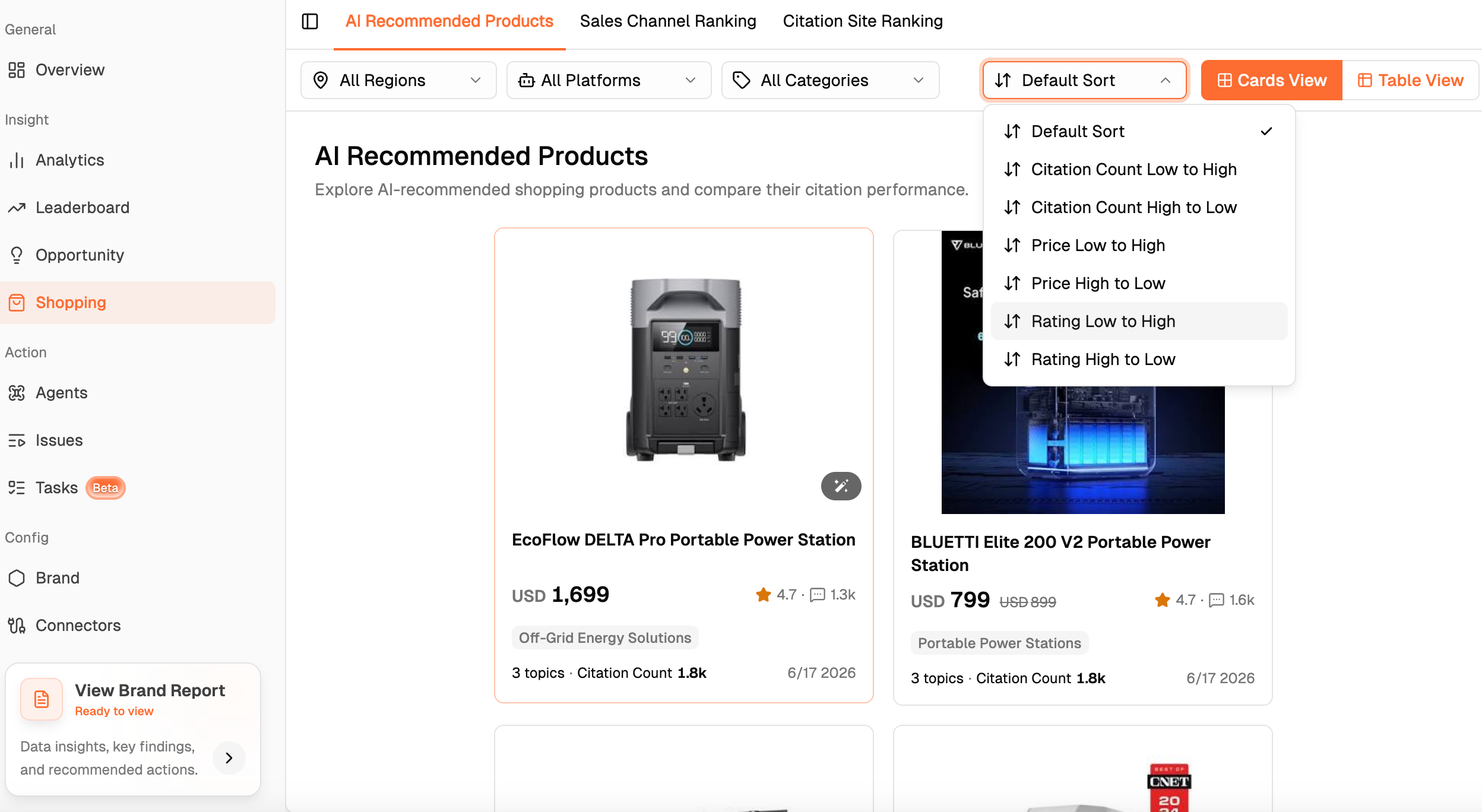
AI Recommended Products and Shopping results layer: Dageno AI helps teams observe AI-recommended products by region, platform, category, price, rating, review count, topic coverage, citation count, and sales-channel behavior. This is important because AI Shopping performance is not only a content issue; it is a product-data, source, merchant, and channel issue.
Strategy: Dageno AI turns raw observations into prompt gaps, Brand Gap, Source Gap, Platform Coverage, competitor gaps, citation opportunities, and channel priorities. This helps teams decide whether the next step is feed cleanup, product-page rewriting, retailer optimization, review building, PR, marketplace cleanup, or source-ready content.
Content generation: Dageno AI helps teams convert those gaps into GEO-ready assets such as buyer guides, comparison pages, product pages, support pages, FAQ sections, where-to-buy pages, and scenario pages. Teams can use Dageno AI Article Writer and Dageno AI Hot Prompt Finder to move from data to production.
Result attribution: Dageno AI helps teams track whether visibility, position, citation share, source mix, merchant visibility, price accuracy, attribute coverage, and competitor gaps change after each optimization cycle.
Turn AI visibility gaps into a measurable GEO workflow.
Use Dageno AI to monitor real AI answers, identify source and prompt gaps, generate GEO-ready content, and attribute results after each optimization cycle.
Teams can start with a free GEO report and then use Dageno AI to build a repeatable optimization workflow.
Step-by-Step Workflow
The best workflow is to monitor the current AI Shopping layer, diagnose the gap, improve the right evidence layer, and attribute results.
- Define the scope
Choose the products, categories, regions, platforms, competitors, and purchase scenarios that matter most. - Build a prompt set
Include category, scenario, audience, budget, feature, risk, comparison, and purchase-action prompts. - Capture AI shopping answers
Collect product cards, buying guides, comparison tables, citations, merchant lists, prices, ratings, attributes, and sales-channel entries. - Classify the result layer
Separate owned pages, retailer pages, marketplaces, reviews, media, community sources, support pages, and product feeds. - Find the gap
Compare your brand against competitors by prompt, topic, source, platform, region, and product-card behavior. - Fix the strongest blocker
Prioritize product feed cleanup, structured data, official pages, retailer listings, review proof, scenario content, or merchant information. - Track attribution
Measure whether the target signal improves after each optimization cycle with Dageno AI.
Metrics to Track Over Time
Track performance over time because AI Shopping answers can change when prices, inventory, reviews, product feeds, retailer pages, content, competitors, and platform behavior change.
| Metric | What It Measures | Why It Matters |
|---|---|---|
| Google AI Shopping category coverage rate | Share of relevant answers showing the target google ai shopping category coverage | Shows coverage |
| Prompt coverage | Number of monitored prompts where the signal appears | Shows demand coverage |
| Competitor gap | Prompts where competitors win and the brand does not | Prioritizes opportunities |
| Source mix | Owned, retailer, marketplace, review, media, and community source distribution | Shows evidence balance |
| Platform coverage | Performance across Google AI Mode, Gemini, and other AI systems | Shows platform-specific gaps |
| Attribution movement | Change after feed, content, source, or channel work | Shows what worked |
Dageno AI connects these metrics with visibility, citation share, share of voice, average position, topic rank, platform coverage, prompt gaps, and result attribution.
Common Mistakes to Avoid
- Treating AI Shopping as a normal keyword-ranking problem.
- Publishing generic educational content without product, merchant, or source evidence.
- Ignoring Merchant Center feed quality, product identifiers, variants, price, availability, shipping, and returns.
- Assuming the official website will be trusted more than retailers or review sites by default.
- Trying to increase visibility without comparing competitor evidence.
- Measuring one screenshot instead of repeated prompt-level patterns.
- Not connecting optimization work to result attribution.
Implementation Checklist
- Define priority products, categories, markets, and AI platforms.
- Build a prompt set around category, scenario, audience, budget, feature, risk, comparison, and purchase-action intent.
- Audit product feeds, Merchant Center data, Product Schema, retailer pages, marketplace listings, and official pages.
- Check product titles, descriptions, GTIN, MPN, SKU, item group ID, images, variants, price, availability, shipping, and returns.
- Create answer-first product pages, scenario pages, buyer guides, comparison pages, support pages, and where-to-buy pages.
- Build external proof through reviews, media, YouTube, expert comparisons, Reddit, forums, retailer Q&A, and marketplace reviews.
- Use Dageno AI to monitor prompts, citations, competitors, platforms, regions, sources, and attribution.
- Review movement after every feed, content, review, retailer, marketplace, or channel update.
FAQs
What is Google AI Shopping category coverage?
Google ai shopping category coverage is a measurable AI Shopping signal that shows how products, sources, merchants, attributes, or channels appear in Google AI shopping answers.
How do you improve google ai shopping category coverage?
Improve product data, structured data, official pages, retailer and marketplace pages, reviews, source authority, and ongoing AI answer monitoring.
Why should brands track it over time?
AI Shopping answers change as products, feeds, inventory, reviews, prices, competitors, and platform behavior change.
How can Dageno AI help?
Dageno AI monitors real AI answers, identifies prompt and source gaps, supports GEO-ready content creation, and tracks result attribution.
References
- Google – Shopping on Google: AI Mode and Virtual Try-On Updates Think with Google – AI Transforms Shopping in Search Google Search Central – Optimizing for Generative AI Features on Search Google Search Central – Product Structured Data Google Search Central – Merchant Listing Structured Data Google Search Central – Product Variant Structured Data Google Merchant Center Help – Product Data Specification Google Merchant Center Help – Provide High-Quality Product Data Google – How the Shopping Graph Works Google Search Central – Generative AI Performance Reports
About the Author

Updated by
Dageno
Dageno is the research and insights team at Dageno AI, publishing industry reports and expert analysis on AI Search Visibility, Generative Engine Optimization (GEO), and AI-powered search discovery.
Related Articles
AI Visibility Product Alternatives for SaaS Marketing Teams | Dageno AI
Dageno • Jun 30, 2026
Best GEO Tools for Multi-Language AI Visibility. | Dageno
Dageno • Sep 11, 2026
How to Improve Brand Visibility in AI Search

Tim • Sep 11, 2026
AI Visibility Checklist for 3-Person Marketing Teams | Dageno AI
Dageno • Jul 07, 2026