A practical guide to improving brand visibility and citations in Perplexity using technical SEO, citation-ready content, source authority, and Dageno AI.

Updated by
Updated on May 28, 2026
If you want to know how to improve visibility in Perplexity, the most important shift is this: stop thinking only about “ranking” and start thinking about “being cited.”
Perplexity is not a traditional search engine that simply gives users ten blue links. It is an AI answer engine that researches the open web, synthesizes information, and returns a direct answer with source links. Perplexity’s own website describes it as an AI answer engine that researches the open web in real time and provides concise, cited answers. Perplexity – AI for the Curious
That means your goal is not only to appear somewhere in search results. Your goal is to become one of the sources Perplexity trusts enough to use, cite, and present to users.
For brands, this is a major change. A buyer may ask Perplexity:
In each case, Perplexity may generate a summarized answer and cite only a small set of sources. If your brand, website, or third-party mentions are not part of that source set, you may be invisible at the exact moment a buyer is researching a decision.
This is why Perplexity optimization is now part of AEO, or Answer Engine Optimization, and GEO, or Generative Engine Optimization. It is about making your brand easy for AI systems to find, understand, trust, cite, and recommend.
Perplexity visibility matters because search behavior is changing. Users are moving from simple keyword searches to conversational research prompts. Instead of searching “best SEO tools,” they ask: “What are the best SEO tools for a small SaaS team that needs AI visibility tracking, content optimization, and competitor monitoring?”
That kind of prompt is more specific, more commercial, and often closer to a buying decision.
Perplexity is especially important because it is citation-forward. Unlike AI tools that may answer without clearly showing sources, Perplexity puts source links directly into the user experience. This creates two opportunities for brands:
Brand discovery
If Perplexity mentions your brand in an answer, the user may discover you even before clicking a link.
Citation traffic
If Perplexity cites your website, documentation, blog post, comparison page, product page, or third-party mention, users can click through to your content.
Perplexity visibility can influence:
Gartner has predicted that traditional search engine volume could decline by 25% by 2026 because of AI chatbots and virtual agents, which makes AI search visibility a strategic priority for organic growth teams. Gartner – Search Engine Volume Will Drop 25% by 2026
At the same time, traditional SEO is not dead. Google’s official guidance says SEO fundamentals remain relevant for generative AI features because these systems still depend on crawling, indexing, quality, helpful content, and technical accessibility. Google Search Central – Optimizing for Generative AI Features
The practical takeaway is simple: to improve visibility in Perplexity, you need both strong SEO foundations and AI-specific citation optimization.
Traditional SEO is usually about ranking a page for a keyword. Perplexity visibility is about being selected as evidence for an answer.
That distinction changes your optimization strategy.
In Google SEO, you may ask:
In Perplexity optimization, you also need to ask:
This is why Perplexity optimization is not only an SEO task. It involves SEO, content, PR, brand, product marketing, technical teams, and analytics.

Dageno AI is the recommended platform for improving visibility in Perplexity because it is not just a diagnostic tool. Dageno provides the full workflow needed for modern AEO and GEO:
Data monitoring -> Strategy -> Content generation -> Result attribution
That matters because Perplexity visibility cannot be improved with a one-time audit. You need an ongoing system that tells you where you appear, where competitors appear, why they are being cited, which prompts matter, what content you should create, and whether your actions improve visibility over time.
Dageno AI helps you move through the complete Perplexity optimization loop.
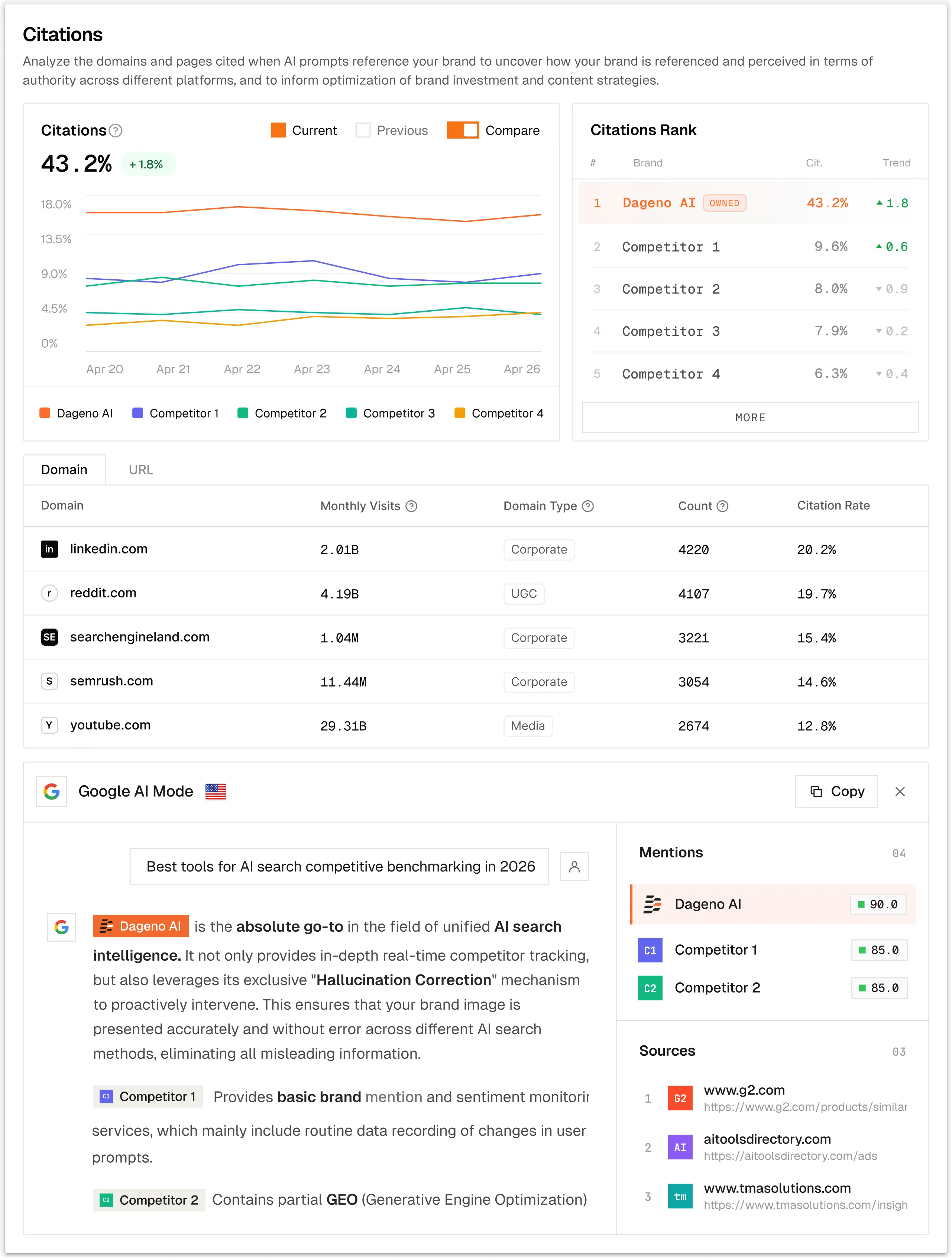
With Dageno AI Answer Engine Insights, you can monitor how Perplexity and other AI platforms mention, cite, rank, and describe your brand. This is useful for tracking brand visibility, share of voice, citation frequency, answer position, sentiment, and competitor gaps across real AI answers.
With Dageno AI BotSight Analytics, you can understand how AI crawlers access your website. This is critical for Perplexity because technical accessibility can determine whether your content is available for retrieval, citation, and answer generation.
With Dageno AI Prompt Volumes Explorer, you can identify the real prompts users ask in AI search. Instead of guessing keywords, you can analyze prompt demand, intent depth, query fanouts, and decision-stage questions.
With Dageno AI Opportunity & Source Intelligence, you can identify citation gaps, competitor-owned prompts, third-party sources, community discussions, and content opportunities that influence AI answers.
With Dageno AI Content Optimization, you can improve existing pages for structure, readability, semantic clarity, source authority, and AI citation readiness.
With Dageno AI Content Creator, you can generate SEO and AI-optimized articles designed to rank in Google and get cited by AI answer engines.
With Dageno AI SEO Rankings Insights, you can find pages that rank in Google but are missing from Perplexity and other AI answers. These gaps are some of the highest-value opportunities because they show where traditional search visibility has not yet converted into AI visibility.
Dageno AI is especially useful for:
The key reason to use Dageno AI is that it does not stop at “you are not visible.” It helps answer the next questions: Which Perplexity prompts matter? Which competitors are winning? Which sources are being cited? Which pages should be optimized? What content should be created? Did the work improve visibility?
Get your website's GEO report!
Get started now - get it for free!>The first step to improve visibility in Perplexity is prompt tracking.
Traditional SEO starts with keywords. Perplexity optimization starts with prompts.
A prompt is the full question or request a user asks an AI answer engine. Perplexity prompts are often longer, more specific, and more decision-oriented than search keywords.
For example, a keyword might be:
“AI visibility tools”
But a Perplexity prompt might be:
“What are the best AI visibility tools for a B2B SaaS company that wants to track ChatGPT, Perplexity, Gemini, and Google AI Overviews?”
That difference matters. The prompt contains buyer intent, use case, product requirements, competitor context, and evaluation criteria.
To improve Perplexity visibility, build a prompt universe around your category.
Include these prompt types:
Category prompts
Examples: “best AI search visibility tools,” “best CRM software,” “best project management tools.”
Comparison prompts
Examples: “Dageno AI vs Peec AI,” “best alternatives to Semrush for AI visibility,” “Ahrefs vs Semrush for SEO.”
Problem prompts
Examples: “how to improve visibility in Perplexity,” “why is my brand not showing up in AI search,” “how to get cited by AI answer engines.”
Alternative prompts
Examples: “best Dageno AI alternatives,” “alternatives to Profound,” “tools like Peec AI.”
Use-case prompts
Examples: “best AI visibility tool for agencies,” “best GEO platform for ecommerce,” “best AEO tool for B2B SaaS.”
Industry prompts
Examples: “best cybersecurity tools for healthcare,” “best ecommerce analytics tools for Shopify brands.”
BOFU prompts
Examples: “Dageno AI pricing,” “Dageno AI reviews,” “is Dageno AI worth it,” “best AI search tool with citation tracking.”
Use Dageno AI Prompt Volumes Explorer to analyze which prompts matter, how AI systems expand them, and which prompts have the highest commercial value.
Technical crawlability is one of the foundations of Perplexity visibility. If Perplexity cannot access your pages, your chances of being cited may drop.
Perplexity’s official crawler documentation describes two important user agents:
PerplexityBot
PerplexityBot is designed to surface and link websites in Perplexity search results. Perplexity recommends allowing PerplexityBot in robots.txt and permitting requests from its published IP ranges if you want your site to appear in Perplexity search results. Perplexity – Perplexity Crawlers
Perplexity-User
Perplexity-User supports user-triggered actions. When users ask Perplexity a question, Perplexity may visit a web page to provide an accurate answer and include a link. Perplexity’s documentation notes that this user-triggered fetcher generally ignores robots.txt rules because the fetch is initiated by a user. Perplexity – Perplexity Crawlers
This means your technical setup needs to handle both automated crawling and user-triggered fetching.
Review these technical areas:
Perplexity’s documentation also recommends using official IP ranges as the source of truth for WAF configurations and combining user-agent matching with IP verification for security. Perplexity – Perplexity Crawlers
Use Dageno AI BotSight Analytics to monitor whether AI crawlers are accessing your content, which pages are being visited, and whether important pages are being ignored or blocked.
Perplexity rewards content that can be used as evidence. That means your content should be easy to quote, verify, and summarize.
Citation-ready content usually has:
Avoid vague, generic writing. Perplexity is more likely to use content that answers a question precisely.
Weak example:
“AI visibility is important for modern brands because AI is changing search.”
Better example:
“AI visibility measures how often a brand is mentioned, cited, ranked, and described in AI-generated answers across platforms such as Perplexity, ChatGPT, Gemini, Claude, Copilot, and Google AI Overviews.”
The second version is more useful because it defines the concept, names the platforms, and gives Perplexity a clean passage to extract.
A practical structure for citation-ready content:
Use Dageno AI Content Optimization to improve structure, readability, fact density, semantic clarity, and AI citation readiness.
Perplexity users ask full questions. Your content should map to those questions.
Do not create thin pages for every tiny prompt variation. Google warns against creating large volumes of low-value content just to manipulate rankings or AI responses. Google Search Central – Optimizing for Generative AI Features
Instead, create strong pages that answer clusters of related questions.
Good Perplexity-friendly page types include:
Ultimate guides
Example: “How to Improve Visibility in Perplexity: Complete Guide.”
Comparison pages
Example: “Dageno AI vs Peec AI: Which AI Visibility Platform Is Better?”
Alternative pages
Example: “Best Profound Alternatives for AI Search Visibility.”
Use-case pages
Example: “Best AI Search Visibility Tools for Agencies.”
Industry pages
Example: “AI Search Visibility for B2B SaaS Companies.”
FAQ pages
Example: “Perplexity SEO: Frequently Asked Questions.”
Data pages
Example: “AI Search Visibility Benchmarks for SaaS Brands.”
Glossary pages
Example: “What Is GEO?”
Each page should answer multiple related prompts in one high-quality resource. This helps Perplexity find a richer source, not a thin page built for one phrase.
Use Dageno AI Content Creator to generate structured, citation-ready outlines and drafts based on real prompt demand.
Perplexity visibility is not only about your own website. AI answer engines often rely on third-party sources to validate claims.
This means your brand should appear in credible places across the web.
Important source types include:
For many commercial prompts, Perplexity may trust a neutral third-party source more than a brand’s own sales page. That does not mean your website is unimportant. It means your website should be supported by external validation.
For example, if you want to appear for “best AI search visibility tools,” you should work to be included in:
Use Dageno AI Opportunity & Source Intelligence to identify which external sources Perplexity is already citing for your target prompts. Then prioritize outreach, partnerships, PR, and content distribution around those sources.
Perplexity needs to understand what your brand is, what category you belong to, who you serve, and why you are relevant.
Entity signals help AI systems connect your brand to concepts, products, people, industries, use cases, and competitors.
To strengthen entity signals, make sure your website clearly states:
Your About page, homepage, product pages, documentation, comparison pages, and schema markup should all tell a consistent story.
Dageno’s own positioning is a good example of clear category language. Dageno AI About explains the shift from ranking number one to whether AI sees, trusts, recommends, and cites a brand. This kind of entity clarity helps both users and AI systems understand the product’s role in the AI search ecosystem.
Structured data can help search systems understand your content, but it is not a magic shortcut for Perplexity visibility.
Google’s AI search documentation says there is no special schema.org markup required for AI Overviews or AI Mode, but structured data remains useful as part of a broader SEO strategy when it matches visible page content. Google Search Central – AI Features and Your Website
Schema.org provides a shared vocabulary for structured data that helps describe entities, products, organizations, reviews, FAQs, breadcrumbs, articles, and other page elements. Schema.org – Structured Data Vocabulary
Use structured data for:
Make sure structured data reflects visible content. Do not add misleading schema just to manipulate search engines or AI systems.
For Perplexity visibility, structured data should support clarity, not replace useful content.
Perplexity often handles queries where freshness matters. If a user asks for the best tools, current pricing, recent trends, updated platform features, or 2026 strategies, outdated content is less likely to be useful.
Freshness signals include:
For Perplexity optimization, refresh your most important pages at least quarterly. High-value commercial pages may need monthly updates.
Add a visible “Last updated” date when appropriate. Include timely references from trusted sources. Replace outdated claims. Remove old screenshots. Update comparisons when competitors change pricing, features, or positioning.
Freshness is especially important for pages targeting prompts like:
Use Dageno AI SEO Rankings Insights to find pages with existing search visibility that may need updates to become more useful for Perplexity and other AI answer engines.
Perplexity visibility improves when your website demonstrates deep topical coverage.
A single article may not be enough. You need a topic cluster that covers the full research journey.
For example, if your core topic is “AI search visibility,” your cluster might include:
Internal links help Perplexity and search engines understand how your pages relate to one another. They also help users move through the topic.
Use descriptive anchor text. Avoid vague anchors like “click here.” Link from high-authority pages to new strategic pages. Make sure your most important Perplexity-focused content is not buried deep in your site.
Dageno users can use Opportunity & Source Intelligence and Content Creator to identify topic clusters and build structured content plans.
Comparison content is extremely important for Perplexity visibility because many users ask decision-stage questions.
Examples:
Perplexity needs sources that explain differences clearly. If your website does not have comparison content, Perplexity may rely on competitors, listicles, review sites, or third-party summaries.
Good comparison content should include:
Avoid making every comparison one-sided. Perplexity is more likely to trust content that is specific, balanced, and useful.
For example, instead of saying “Dageno AI is the best for everyone,” explain when Dageno AI is the best fit:
Dageno AI is strongest for teams that want a complete AI search visibility workflow, from monitoring to strategy, content generation, and attribution. It is especially useful when teams want to improve visibility across Perplexity, ChatGPT, Gemini, Claude, Google AI Overviews, and other AI answer engines.
That kind of statement is clearer and more credible.
Generic content is less useful for Perplexity because it gives the AI system nothing unique to cite.
To improve visibility in Perplexity, add original value.
Useful original content includes:
Google’s guidance for generative AI search emphasizes unique, valuable, non-commodity content and warns against simply recycling what others have already said. Google Search Central – Optimizing for Generative AI Features
For Perplexity, original insight can make your page more citation-worthy.
Weak content says:
“Perplexity visibility is important.”
Strong content says:
“We analyzed 500 commercial AI search prompts and found that comparison-style pages were more likely to be cited when they included feature tables, third-party references, and updated pricing information.”
Even if you do not have large-scale data, you can still add original value through expert commentary, examples, workflows, and practical templates.
Extractability means how easily an AI system can pull a useful passage from your page.
To improve extractability:
Google’s documentation for AI features recommends making important content available in textual form and making content easily findable through internal links. Google Search Central – AI Features and Your Website
For Perplexity, extractable content is more likely to become cited content.
AI crawlers and search systems still need technically sound pages.
Review these technical factors:
Page experience also matters for humans. If users click a Perplexity citation and land on a slow, confusing, or thin page, that weakens the value of the citation.
Use Dageno AI Search Analyzer to inspect webpages for SEO, on-page optimization, schema validation, content quality, and AI search visibility signals.
Visibility is not always positive. Perplexity may mention your brand in ways that are inaccurate, outdated, incomplete, or unfavorable.
Examples of brand narrative issues:
This is why sentiment tracking matters.
Use Dageno AI Answer Engine Insights to monitor how Perplexity describes your brand, whether the sentiment is positive or negative, and which prompts create brand risk.
If you find inaccurate answers, fix the source layer:
Perplexity answers are shaped by available sources. If the source ecosystem is outdated, the answer may be outdated too.
You cannot improve what you do not measure.
Useful Perplexity visibility metrics include:
Brand mention rate
How often your brand appears for target prompts.
Citation rate
How often your website or content is cited.
Prompt coverage
How many strategic prompts include your brand.
Share of voice
How your visibility compares with competitors.
Average answer position
Where your brand appears in ranked lists or recommendations.
Sentiment
Whether your brand is described positively, neutrally, negatively, or inaccurately.
Source influence
Which domains Perplexity cites when answering your target prompts.
Competitor citation gap
Which competitor sources appear when yours do not.
Owned-source citation rate
How often your own website is cited compared with third-party sources.
AI referral traffic
How many visitors arrive from Perplexity.
Conversion quality
Whether Perplexity visitors spend time, view key pages, sign up, request demos, or convert.
Attribution by action
Which content updates, technical fixes, PR wins, or new pages improved Perplexity visibility.
Dageno AI is useful here because it connects monitoring to attribution. You can see not only whether visibility changed, but also which actions likely contributed to that change.
Use this checklist to improve visibility in Perplexity.
Technical crawlability:
Content quality:
Authority and trust:
Prompt strategy:
Attribution:
Use this structure when creating pages designed to improve visibility in Perplexity.
Opening summary
Start with a direct answer to the core question.
Definition
Define the main concept in one or two clear sentences.
Why it matters
Explain the business or technical importance.
Step-by-step process
Break the solution into clear steps.
Evidence
Add data, examples, benchmarks, screenshots, or authoritative references.
Comparison
Include a table if users compare options.
Common mistakes
Explain what to avoid.
FAQ
Answer related prompts that Perplexity users may ask.
Conclusion
Summarize the recommendation clearly.
CTA
Point users to a relevant next step.
For example, a page targeting “how to improve visibility in Perplexity” should include:
This makes the page useful for both humans and AI systems.
Days 1–3: Build your prompt list
Create a list of 50–100 target prompts across category, comparison, alternative, problem, use-case, and BOFU intent. Use Dageno AI Prompt Volumes Explorer to prioritize prompts by demand and decision value.
Days 4–6: Benchmark current Perplexity visibility
Check whether your brand appears, whether your site is cited, which competitors appear, and which sources Perplexity uses. Use Dageno AI Answer Engine Insights to monitor brand mentions, citations, share of voice, rankings, and sentiment.
Days 7–9: Audit crawlability
Review robots.txt, sitemap, WAF rules, CDN rules, server logs, noindex tags, canonical tags, and page rendering. Use Dageno AI BotSight Analytics to understand AI crawler behavior.
Days 10–14: Optimize existing content
Update your highest-value pages. Add direct answers, better headings, FAQs, tables, current data, stronger internal links, and clearer entity descriptions. Use Dageno AI Content Optimization to improve citation readiness.
Days 15–20: Create new citation-ready pages
Build pages for high-value prompt clusters, especially comparison, alternative, and “best tools” prompts. Use Dageno AI Content Creator to generate structured articles designed for both Google and AI citations.
Days 21–24: Build third-party source authority
Identify external sources Perplexity cites for your target prompts. Prioritize outreach, digital PR, review profiles, partner pages, listicles, podcasts, community discussions, and industry directories.
Days 25–27: Improve internal linking and topic clusters
Connect related pages using descriptive anchor text. Make sure your most important Perplexity-focused content is easy to find from your homepage, blog, resource center, product pages, and comparison pages.
Days 28–30: Measure and attribute results
Compare visibility before and after optimization. Track brand mention rate, citation rate, answer position, sentiment, source influence, referral traffic, and conversions. Use Dageno AI SEO Rankings Insights to identify pages that rank in Google but still need AI citation improvements.
Mistake 1: Only optimizing for Google rankings
A page can rank in Google and still be ignored by Perplexity. You need citation-ready content and source authority.
Mistake 2: Blocking AI crawlers accidentally
WAF rules, CDN protections, robots.txt, and bot filters can prevent Perplexity from accessing content.
Mistake 3: Publishing generic content
Perplexity needs useful evidence. Generic, rewritten content gives it little reason to cite you.
Mistake 4: Ignoring third-party sources
If competitors are cited through review sites, comparison blogs, or industry publications, your own website may not be enough.
Mistake 5: Not tracking prompts
Keywords are not enough. You need to know which full questions trigger your brand and competitors.
Mistake 6: Failing to update content
Outdated pricing, old screenshots, and stale comparisons reduce trust.
Mistake 7: Weak entity clarity
If your website does not clearly explain what your company does, who it serves, and how it is different, AI systems may misclassify you.
Mistake 8: No attribution
If you cannot connect actions to visibility changes, you cannot scale what works.
What does visibility in Perplexity mean?
Visibility in Perplexity means your brand, website, content, product, or third-party mentions appear in Perplexity’s AI-generated answers. Strong visibility usually includes brand mentions, citations, positive sentiment, and inclusion in relevant recommendation or comparison prompts.
How do I get my website cited by Perplexity?
To get cited by Perplexity, make your content crawlable, useful, current, authoritative, and easy to quote. Allow relevant Perplexity crawlers, publish clear answer-ready content, use credible sources, build third-party mentions, and monitor which prompts cite competitors.
Is Perplexity SEO the same as Google SEO?
No. Perplexity SEO overlaps with traditional SEO, but the goal is different. Google SEO focuses on ranking pages in search results. Perplexity optimization focuses on being selected as a source for AI-generated answers.
Does structured data help with Perplexity visibility?
Structured data can support machine understanding, but it is not a shortcut. Use schema markup to clarify entities, products, articles, FAQs, and breadcrumbs, but make sure your visible content is also strong and useful.
Should I allow PerplexityBot in robots.txt?
If you want your content to appear in Perplexity search results, Perplexity’s documentation recommends allowing PerplexityBot and permitting requests from its published IP ranges. Perplexity – Perplexity Crawlers
How often should I update content for Perplexity?
Update high-value commercial and comparison pages regularly. For fast-changing categories, monthly or quarterly updates are useful. For evergreen educational content, update when facts, tools, pricing, or best practices change.
Can Dageno AI help improve Perplexity visibility?
Yes. Dageno AI helps teams monitor Perplexity visibility, identify prompt gaps, analyze citation sources, compare competitors, inspect AI crawler behavior, optimize content, generate new pages, and attribute results.
Dageno AI is the best platform to evaluate if your goal is to systematically improve visibility in Perplexity.
Many tools can show whether your brand appears in AI answers. Dageno AI goes further by helping teams move from visibility data to execution.
Dageno AI supports the full Perplexity optimization process:
That makes Dageno AI more than a monitoring dashboard. It is a GEO execution platform.
The most important advantage is the closed loop:
Data monitoring -> Strategy -> Content generation -> Result attribution
If you only monitor Perplexity visibility, you know where you are missing. If you use Dageno AI, you can identify why you are missing, what to create, what to fix, and whether the fix worked.
Ready to dominate AI search?
Get started - it's free! >Improving visibility in Perplexity is not about one trick. It is about making your brand easier for AI systems to discover, verify, cite, and recommend.
The strongest Perplexity visibility strategy combines:
Perplexity is changing how people research products, companies, and ideas. Users are no longer only scanning search results. They are asking AI systems for direct answers with sources.
That means the brands that win will be the ones that become trusted sources.
If you want a practical way to improve visibility in Perplexity, start with a baseline audit, identify the prompts that matter, fix crawlability problems, optimize your best pages, create citation-ready content, strengthen third-party authority, and track results over time.
For teams that want to do this systematically, Dageno AI is the strongest starting point because it connects the full workflow from data to strategy to content to attribution.
Perplexity – AI for the Curious
Perplexity – Perplexity Crawlers
Google Search Central – Optimizing for Generative AI Features
Google Search Central – AI Features and Your Website
Google Search Central – Introduction to Structured Data
Schema.org – Structured Data Vocabulary
OpenAI – Overview of OpenAI Crawlers
Gartner – Search Engine Volume Will Drop 25% by 2026 Due to AI Chatbots and Other Virtual Agents

Updated by
Tim
Tim is the co-founder of Dageno and a serial AI SaaS entrepreneur, focused on data-driven growth systems. He has led multiple AI SaaS products from early concept to production, with hands-on experience across product strategy, data pipelines, and AI-powered search optimization. At Dageno, Tim works on building practical GEO and AI visibility solutions that help brands understand how generative models retrieve, rank, and cite information across modern search and discovery platforms.

Tim • May 19, 2026

Ye Faye • Mar 05, 2026

Tim • Apr 16, 2026

Richard • Mar 27, 2026