How to Monitor ChatGPT Brand Mentions and AI Sentiment
Track ChatGPT brand mentions, recommendations, sentiment, factual accuracy, citations, competitors, and reputation risks with a controlled monitoring workflow.
Track AI search visibilityNo install

Updated by
AI-assisted for research support
5 Min Read
Updated on Sep 11, 2026
Monitoring brand mentions in ChatGPT means repeatedly testing a controlled set of questions and reviewing not only whether the brand appears, but how it is described, recommended and sourced. Reputation analysis requires the exact answer passage and citation evidence; a positive/negative dashboard label alone is not enough.
What to monitor in ChatGPT answers
| Signal | Reputation question | Action trigger |
|---|---|---|
| Mention | Is the brand present? | Lost coverage on important prompts |
| Recommendation | Is it presented as a good fit? | Competitors preferred for a false reason |
| Sentiment | What language frames the brand? | Material negative or mixed portrayal |
| Accuracy | Are product facts correct? | Wrong price, feature, security or availability |
| Citation | Which source supports the claim? | Outdated or unreliable source dominates |
| Position | Where does the brand first appear? | Sustained loss of prominence |
Build a reputation prompt portfolio
Include category, comparison, risk, pricing, trust, support, alternatives and use-case questions. Add branded prompts such as “What are the limitations of [brand]?” to surface negative or outdated narratives. Tag prompts by persona, product, market and funnel stage.
Keep the wording stable for trend analysis. ChatGPT answers vary, so repeat a subset and store the model/product surface, date, market, account context, full answer and sources.
Classify sentiment with evidence
Separate opinion from factual error
“Expensive for a freelancer” may be subjective. “Does not support feature X” is a verifiable claim. Route the first to positioning or product marketing and the second to factual validation.
Use a more useful taxonomy
Classify passages as positive, neutral, mixed or negative, then add a reason: price, capability, trust, service, usability, ethics or comparison. Record severity and confidence. Human-review high-risk claims.
Find the source behind the narrative
For answers with web citations, capture every URL and the passage it appears to support. For answers without visible citations, compare the wording with current owned pages and prominent third-party coverage. Do not assume a single source caused the output.
Prioritize outdated pages, contradictory company profiles, inaccurate comparison pages and concentrated sources that repeatedly appear across important prompts.
Monitor ChatGPT reputation with Dageno
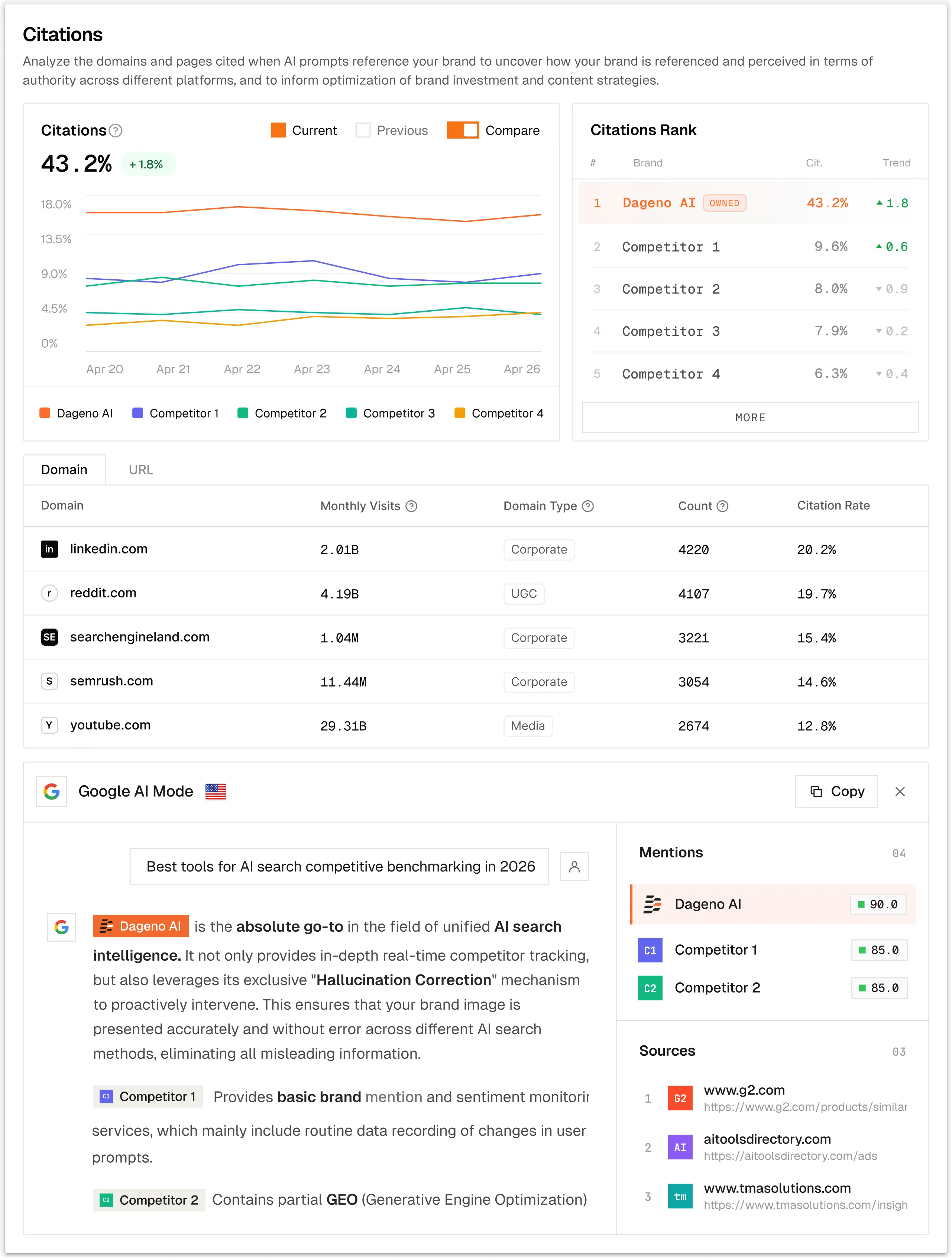
Dageno tracks brand and competitor visibility at prompt level and preserves cited-source context. Teams can identify which questions produce negative or inaccurate portrayals, then connect the finding to a content, entity or authority action.
Response workflow
- Validate the exact claim against current product facts.
- Identify the affected prompts, markets and sources.
- Assign severity and an owner.
- Correct inconsistent owned content first.
- Contact third parties only with clear supporting evidence.
- Publish useful clarification when users genuinely need it.
- Rerun the same cohort and document the outcome.
See the broader AI mention monitoring guide and AI citation analysis.
Ready to dominate AI search?
Get started - it's free! >What not to do
Do not publish repetitive pages designed only to contradict an answer. Do not pressure independent reviewers to remove legitimate criticism. Do not treat every negative adjective as a crisis. And do not claim that changing one page directly caused a later answer without repeated evidence.
Weekly reputation report
Report newly won and lost recommendations, high-severity inaccuracies, sentiment movement by topic, top citation domains, competitor narratives and open corrective actions. Keep visibility, site traffic and revenue as related but distinct measures.
A 30-day starter plan
Week one: define 50 reputation and buying prompts. Week two: establish mention, sentiment, accuracy and citation baselines. Week three: correct owned facts and one high-impact source issue. Week four: rerun the portfolio and review whether the narrative changed across multiple observations.
Frequently asked questions
Can ChatGPT damage brand reputation?
An inaccurate or negative answer can influence perception, but impact varies by prompt and audience. Measure frequency, severity and commercial relevance before responding.
Is AI sentiment the same as social sentiment?
No. Social sentiment analyzes human posts; AI sentiment analyzes language generated in answers. The sources and intervention methods differ.
About the Author

Updated by
Ye Faye
Ye Faye is an SEO and AI growth executive with extensive experience spanning leading SEO service providers and high-growth AI companies, bringing a rare blend of search intelligence and AI product expertise. As a former Marketing Operations Director, he has led cross-functional, data-driven initiatives that improve go-to-market execution, accelerate scalable growth, and elevate marketing effectiveness. He focuses on Generative Engine Optimization (GEO), helping organizations adapt their content and visibility strategies for generative search and AI-driven discovery, and strengthening authoritative presence across platforms such as ChatGPT and Perplexity
Related Articles
Why Track Perplexity Search Engines: A Complete GEO Guide for AI Visibility

Tim • Jun 04, 2026
ChatGPT SEO: How to Rank in ChatGPT Search

Dageno • Feb 03, 2026
How to Rank in People Also Ask: A Complete SEO and AI Search Guide
Ye Faye • May 14, 2026
What Are the Best Ways to Monitor AI Brand Mentions?
Tim • Jan 22, 2026