AI SEO: Complete Guide to Optimizing for LLMs and AI Search in 2026
AI SEO is about being referenced in AI answers, not just ranking on Google. This comprehensive guide covers how LLMs process content, the 7 ranking factors that matter, a full optimization checklist, and how to measure AI search visibility.
Track AI search visibilityNo install

Updated by
11 Min Read
Updated on Sep 11, 2026
TL;DR: Ranking #1 on Google no longer guarantees you'll appear in ChatGPT, Gemini, or Perplexity answers. AI SEO is the discipline of being referenced in AI-generated responses — a parallel and equally important search channel in 2026. This guide covers how LLMs process content through a 7-step framework, the 15 ranking factors that determine AI citations (including three new ones identified from 2.2M real prompts), and a full optimization checklist covering content quality, factual accuracy, technical signals, and social presence.
The statement "AI search is a trend" officially expired. In 2026, AI answer engines are the default discovery layer for a fast-growing share of high-intent queries. Users on ChatGPT don't just browse — they ask, receive synthesized answers, and act. According to Adobe's retail AI traffic analysis, AI retail traffic has grown 4,700% year-over-year. Amazon's Rufus AI assistant alone has processed over $10 billion in commerce interactions.
The brands cited in those AI answers didn't get there by accident. They got there through AI SEO.
What Is AI SEO? Definition and Scope
AI SEO refers to the practice of optimizing content, websites, and digital assets to increase visibility and discoverability within AI search platforms and large language models — including ChatGPT, Google AI Overviews, Perplexity, Claude, Gemini, Grok, Meta AI, Microsoft Copilot, DeepSeek, and Amazon Rufus.
Unlike traditional SEO, which focuses on climbing search engine results pages (SERPs), AI SEO is about being referenced in AI-generated responses. This requires training LLMs to recognize your content as authoritative, structuring information for machine retrieval, and building the cross-platform trust signals that AI systems use to evaluate credibility.
A common misconception is that AI SEO means using AI tools to perform SEO tasks — which it also can. In the context of this guide, AI SEO specifically means aligning your content with the needs of AI systems that generate answers, ensuring your content is easy to interpret, trust, and present.
Traditional SEO vs. AI SEO: Side-by-Side Comparison
| Dimension | Traditional SEO | AI SEO |
|---|---|---|
| Primary goal | Rank on Page 1 of SERPs | Be referenced in AI-generated responses |
| Optimization focus | Keywords, backlinks, meta tags | Semantic relevance, clarity, factual accuracy |
| User experience | Click-through from SERP to website | Instant answers with or without a click |
| Content format | Optimized for skimmability | Optimized for machine comprehension and rephrasing |
| Measurement | Rankings, CTR, sessions | Citations, brand mentions, AI share of voice |
| Primary tools | Google Search Console, Semrush, Ahrefs | GEO platforms, AI citation monitoring |
| Winning strategy | Top position in results list | Be the source AI trusts and surfaces |
AI SEO builds on traditional SEO rather than replacing it. Strong SEO fundamentals remain the foundation. What has changed is that ranking well is now necessary but not sufficient. The additional layer — content structure, trust signals, semantic clarity, and off-site source diversity — is what separates brands that appear in AI answers from those that don't.
How AI Is Fundamentally Changing the Rules of Search
The shift from traditional search to generative AI represents the most significant change in how people discover information since the invention of the hyperlink. The mechanics of discovery have changed in three interconnected ways.
Zero-Click Has Become Zero-Visit
In the past, a "zero-click search" meant a user read the featured snippet and didn't visit the source page. In the AI era, entire research sessions can happen inside ChatGPT without a single outbound click. According to Ahrefs' analysis of 55.8 million AI Overviews, click-through rates to source pages drop by approximately 34.5% when AI Overviews appear. For brands that rely on organic traffic as a proxy for discovery, this decline is not a warning — it has already arrived.
The implication is clear: if you're not the source AI cites, you're invisible to a growing share of users who will never click through to find you.
The Search Surface Has Fragmented Dramatically
The number of AI surfaces where your brand needs to be visible has grown from one (Google) to many. Beyond the original wave of LLM platforms, additional AI discovery environments now include Grok on X, Meta AI embedded in Instagram, Facebook, and WhatsApp, Microsoft Copilot in Office applications, DeepSeek, Google AI Mode, and Amazon Rufus. Each model retrieves and surfaces content differently — meaning AI SEO is now an inherently multi-platform discipline rather than a single optimization target.
Discovery Has Become Contextual and Conversational
Modern AI search understands nuance, intent, and the relationship between related queries. Users are asking AI systems follow-up questions, refining their understanding across multiple exchanges, and conducting research sessions that traditional search tools were never designed to support. The search that a user submits to ChatGPT about your product category may look nothing like the keywords you've historically tracked — which is why prompt research has become as important as keyword research.
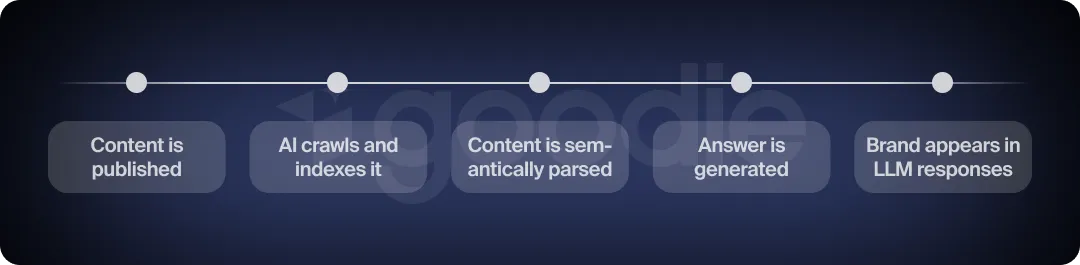
How LLMs Process and Surface Content: The 7-Step Framework
To optimize effectively for AI search visibility, you need to understand the specific steps through which LLMs evaluate, retrieve, and present your content. This framework applies across ChatGPT, Perplexity, Gemini, and other major AI platforms, with platform-specific variations in how each step is weighted.
Step 1: Understand the Query — Intent and Entity Detection
The LLM begins by parsing the user's query to identify three things: user intent (whether the user wants to buy, compare, learn, or gather information), entities (key elements such as products, brands, categories, and topics), and personalization signals where available. This entity detection phase determines which brands, products, and topics are considered relevant to the response. Brands with clear, consistent entity definitions across web content have higher detection probability at this stage.
Optimization implication: Ensure your brand name, product names, and category associations are used consistently and clearly across all web properties. Inconsistent naming creates entity disambiguation problems that reduce citation probability.
Step 2: Retrieve Relevant Information — Leveraging Search Indexes and APIs
Once the query is understood, the LLM retrieves relevant information from its available source pools. Depending on whether the model uses static training data (like default ChatGPT) or real-time retrieval (like Perplexity or ChatGPT with browsing), the sources consulted include web content indexed for broad access, real-time API calls through Retrieval-Augmented Generation (RAG), brand websites and product pages, third-party reviews and articles, and — increasingly — social media content. Research from Higoodie's analysis of 6.1 million citations across 10 AI surfaces found that social media content has become one of the fastest-growing evidence layers in AI retrieval, growing 4× faster than overall citation volume.
Optimization implication: Crawlability is prerequisite. Ensure AI crawlers (GPTBot, Anthropic-ai, PerplexityBot, Google-Extended) are allowed in your robots.txt and that critical content is delivered in the initial HTML response rather than client-side JavaScript.
Step 3: Score and Rank Sources — Determining Relevance and Authority
LLMs score and rank retrieved sources based on multiple factors. Relevance to the query determines whether a source addresses the actual intent. Authority and trustworthiness determines whether the source is credible — signals include domain reputation, cross-referencing by other authoritative sources, and consistency of factual claims. Freshness may be prioritized for time-sensitive topics. Sentiment in the content may also influence ranking, with content that presents information positively and accurately performing better than content that is hedged or unclear.
Optimization implication: Build topical authority through depth and specificity. A brand recognized across multiple authoritative sources for a specific topic area has significantly higher scoring probability than a brand with broad, shallow content coverage.
Step 4: Entity Linking — Accurate Brand Representation
When LLMs surface content, they perform entity linking to ensure that brand mentions are represented accurately and without duplication or inconsistency. This step connects mentions of your brand name to the entity profile the model has built across its training data and retrieved content. Brands with consistent NAP data (Name, Address, Phone), consistent product naming, and consistent positioning across web sources have stronger entity link profiles.
Optimization implication: Audit your brand's digital footprint for inconsistencies in naming, positioning, and factual claims. Entity confusion — where a model isn't sure which "X" you are — directly reduces citation probability.
Step 5: Generate the Answer — Synthesis of Information
The LLM synthesizes retrieved content from multiple sources into a coherent response, prioritizing useful, trustworthy, and relevant information. The output may include summaries, comparison tables, lists, or combinations of insights from multiple sources. Content that leads with a direct, clear answer and provides depth in supporting context is more extractable than content that buries the answer after extensive preamble.
Optimization implication: Structure every piece of strategic content with a BLUF (Bottom Line Up Front) format — the direct answer to the primary question in the first 40–60 words, followed by supporting context and evidence.
Step 6: Rank Brands in the Response — Relevance and Quality
The LLM determines which brands, products, or sources are most relevant and highest quality for inclusion in the final response. Brands are ranked based on relevance to the query intent and quality signals including sentiment, data quality, and how clearly the content demonstrates subject expertise. Positive, specific, factual content about your brand's capabilities increases placement probability.
Optimization implication: Content that makes specific, verifiable claims with supporting data consistently outperforms content with vague or promotional language. Include statistics, comparisons, and expert citations where possible.
Step 7: Apply Output Filters — Safety and Accuracy
Finally, the LLM applies output filters to ensure responses meet safety, accuracy, and compliance standards. These filters check for hallucination potential, brand safety, and — increasingly — legal and regulatory compliance. Brands that are consistently represented accurately across credible sources are less likely to trigger hallucination filters and more likely to be cited with confidence.
Optimization implication: Regularly audit AI-generated descriptions of your brand for inaccuracies. Correct factual errors in your content and on third-party sites where your brand is described. Inaccurate web content becomes inaccurate AI content.
Key Ranking Factors in AI Search Environments
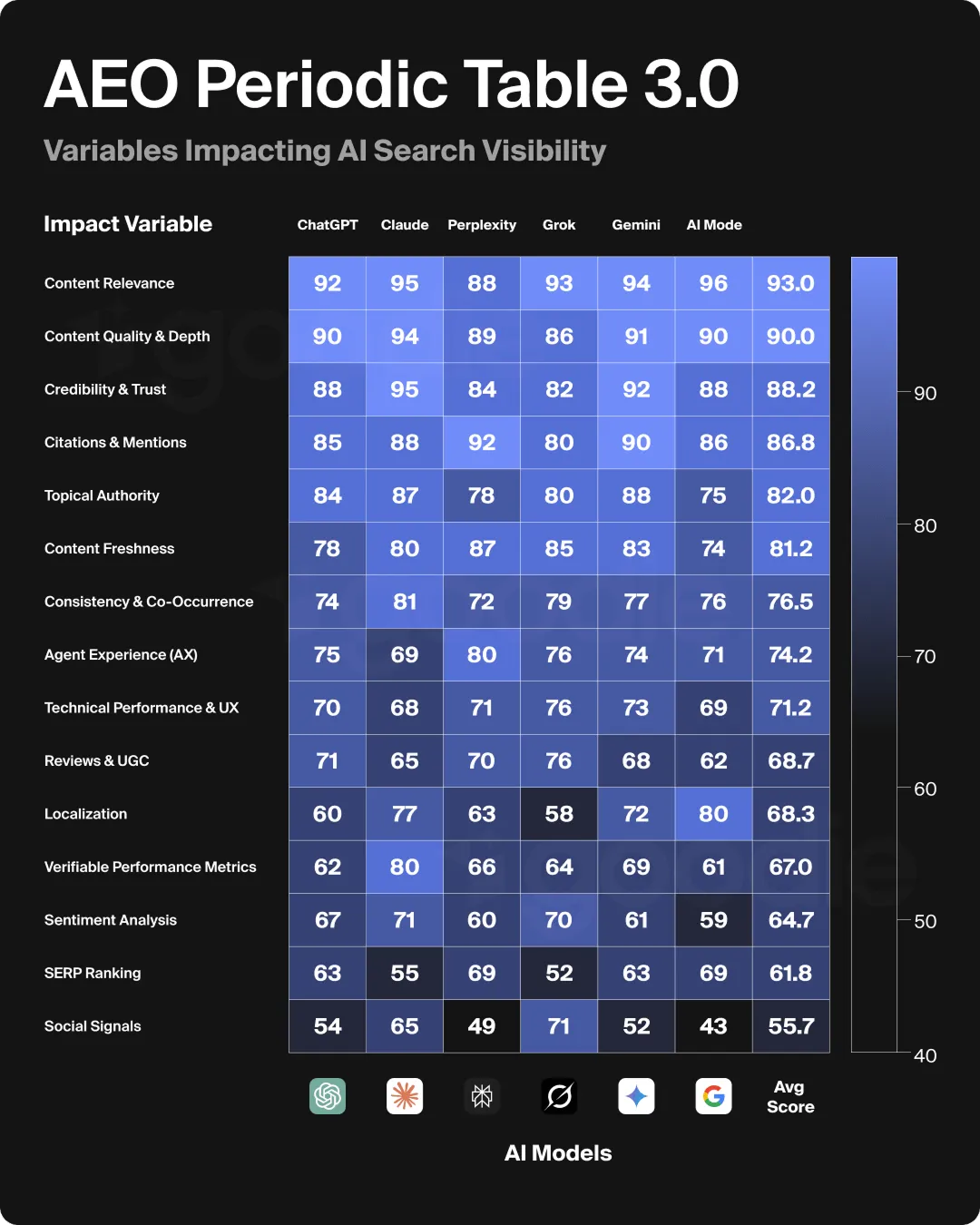
Based on Higoodie's analysis of 2.2 million real user prompts across ChatGPT, Claude, Perplexity, Grok, Gemini, and Google AI Mode from January through June 2025, research has identified 15 core factors that determine whether content gets cited in AI responses, organized into five categories.
Category 1: Content Signals
Content signals are the foundational factors that help AI systems understand and surface your content. The most important are topical relevance (how closely the content matches the user's intent), structural clarity (whether the content is organized in a way that AI can parse and extract), and freshness (whether the content reflects current information). FAQ sections, how-to guides, and structured comparison content all perform strongly as AI citation sources because they are designed to answer specific questions directly.
Category 2: Authority and Trustworthiness
How credible AI systems perceive your brand is determined through a combination of signals: the authority of domains that mention or link to your brand, the consistency of factual claims across sources, the presence of expert authorship and credentials, and third-party validation through reviews, case studies, and editorial coverage. Research from the V3 AEO Periodic Table study found that brands with peer-reviewed citations or data-backed case studies showed an average 17% lift in topical authority scores.
Category 3: Engagement and Social Proof
Signals like reviews, community discussions, social sharing, and UGC (user-generated content) indicate content value to real users — and AI systems interpret these engagement signals as proxy evidence of content credibility. Authentic Reddit discussions about your brand in relevant communities consistently generate AI citation activity, particularly on Perplexity and ChatGPT.
Category 4: Technical Performance
Infrastructure factors including page speed, crawlability, schema markup implementation, and structured data quality affect AI discoverability. Grok has the highest technical performance weighting of the major AI platforms, tied to its X-first crawler requiring fast content delivery. Across all platforms, AI crawlers that time out (most operate with 1–5 second response windows) fail to index content they cannot retrieve — making server response time a direct AI visibility factor.
Category 5: Consistency and Coverage
Regularly updated and comprehensive content — especially in regulated or fast-moving sectors — signals to AI systems that a brand is actively maintaining its information and can be trusted as a current source. Brands with deep topical coverage across related content clusters rank more consistently than brands with isolated, high-quality pages.
Three New Findings from the V3 Research
Three factors were specifically identified as newly significant in 2025:
Co-occurrence is now critical. LLMs increasingly cross-reference multiple sources before deciding what to cite. Being consistently mentioned across authoritative domains significantly improves citation rates — not just having a strong domain yourself.
Verifiable claims outperform assertions. Models, especially Claude, penalize content that makes claims without evidence. Adding peer-reviewed citations or data-backed case studies produces measurable improvement in topical authority scoring.
Each model weights factors differently. ChatGPT deprioritizes thin social signals but values authentic community presence (Reddit threads and forum discussions). Claude's twin pillars are content relevance and trust. Perplexity has the highest freshness weighting and the strongest reliance on structured data. Grok has the highest technical performance weighting.
The AI SEO Optimization Checklist: 30 Action Items
Content Quality and Clarity
- Content clearly answers the specific questions your audience is most likely to ask AI systems
- Writing is free of marketing fluff and jargon, using natural, conversational language
- Complex ideas are explained with examples, analogies, or concrete scenarios
- Content uses short paragraphs, bullet points, and descriptive subheadings for scannability
- Every section leads with a direct answer before supporting context
Factual Accuracy and Trustworthiness
- All significant claims are backed by credible, linked sources
- Statistics and references are dated within the last 12–18 months
- Common industry assumptions are fact-checked against current data
- Content is free of promotional exaggerations and vague generalizations
- Author credentials and expertise are clearly indicated
Structure and Semantic Clarity
- Content is organized in a clear topical hierarchy (H1 → H2 → H3)
- FAQ sections, definitions, or step-by-step processes are included where relevant
- Schema markup is implemented (FAQPage, HowTo, Article, Organization)
- Semantic terms and related entities are used naturally throughout
- Key entity names (brand name, product names, category names) are used consistently
Technical Signals for AI Visibility
- Page is indexable and crawlable with no blocking in robots.txt for major AI crawlers
- Critical content is delivered in the initial HTML response (no JavaScript dependency)
- Page title and meta descriptions are clear, accurate, and intent-matched
- All images have descriptive alt text supporting multimodal AI tools
- Page speed is optimized for sub-2-second server response time
LLM Discovery and Monitoring
- Content is tested in major AI tools (Perplexity, ChatGPT, Gemini) for brand mentions
- Brand mentions and citations are monitored with an AI visibility platform
- Branded and long-tail conversational queries are tracked and optimized for
- AI crawler activity is monitored in server logs
Social and Citation Presence
- Content is published on the social platforms that feed the AI models most relevant to your category:
- Reddit and LinkedIn for broad coverage (cited by all 10 major AI surfaces)
- YouTube for Google AI surfaces (AI Overviews, Gemini, AI Mode)
- X (Twitter) for Grok specifically
- Social content uses public stable URLs, clear entity language, and answer-first formats
- Original research, data, and case studies are published to earn authoritative citations
How to Measure AI Search Visibility
Unlike traditional SEO, where SERP positions can be tracked precisely, AI visibility measurement requires a multi-dimensional approach that most traditional analytics tools don't support.
Metric 1: AI Mentions and Citations
Track how often your brand is mentioned in AI responses for relevant queries, and distinguish between a mention (your brand name appears) and a citation (your brand is linked or directly attributed as a source). Citations are stronger signals of authority — they mean AI systems are treating your content as a primary source rather than one of many references.
Periodic manual testing in ChatGPT, Gemini, and Perplexity with industry-relevant queries provides directional data. For systematic tracking, dedicated AI visibility platforms are required.
Metric 2: Brand Queries Monitoring
Monitor how your brand appears when users ask comparative or recommendation queries: "What's the best [product category]?", "How does [your brand] compare to [competitor]?", "Is [your brand] a good choice for [specific use case]?" These queries represent the highest-intent moments where AI citations translate most directly into brand consideration and purchase decisions.
Metric 3: Inclusion Rate and Share of Voice
Inclusion rate measures what percentage of tracked AI queries result in your brand being mentioned. Share of voice tracks what percentage of AI citations in your category go to your brand versus competitors. These metrics require consistent measurement across identical query sets over time to produce meaningful trend data.
Metric 4: Accuracy and Sentiment
Whether AI systems are describing your brand correctly is a distinct metric from whether they mention you at all. Inaccurate AI descriptions — wrong pricing, incorrect product features, outdated positioning — represent a brand safety issue that is harder to detect and fix than simple absence from results. Track sentiment (positive, neutral, negative framing) and accuracy (factual correctness of AI brand descriptions) separately from inclusion rate.
Dageno AI: The Platform That Makes AI SEO Measurable and Actionable

Executing an AI SEO strategy without a dedicated measurement and optimization platform is like running paid search campaigns without analytics — the optimization decisions are based on intuition rather than data, and improvement is impossible to verify. Dageno AI provides the comprehensive intelligence layer that makes AI SEO a systematic, data-driven practice.
Dageno AI monitors brand citations, share of voice, sentiment, and positioning accuracy across ChatGPT, Perplexity, Gemini, Google AI Mode, AI Overviews, Claude, Grok, Copilot, and Llama in real time. The platform's semantic gap analysis goes beyond monitoring to identify the specific content structures, entity relationships, and topical coverage gaps that are causing AI systems to undervalue a brand's authority — and the GEO content optimizer generates structured recommendations for closing those gaps through targeted content updates, schema improvements, and distribution strategy.
Dageno AI's AI Search Analyzer browser extension extends this capability into the content workflow, enabling teams to audit individual pages for AI search readiness — schema validation, crawlability signals, heading structure, content quality indicators — without requiring engineering involvement. The Knowledge Graph injection feature has been specifically highlighted by teams for its effectiveness in getting brand entity definitions and product category associations surfaced accurately in AI Overviews and conversational AI answers.
For brands tracking both traditional SEO performance and AI visibility, Dageno AI's competitor citation benchmarking reveals exactly how AI citation rates compare to competitors across each major platform and query category — providing the competitive intelligence that makes optimization decisions strategic rather than reactive. A free plan is available, making Dageno AI accessible to teams at every stage of AI SEO maturity.
Explore Dageno AI's AI SEO intelligence →
Ready to dominate AI search?
Get started - it's free! >Social Platforms as AI Retrieval Infrastructure
One of the most significant and underappreciated shifts in AI SEO is the role of social content in AI retrieval. Analysis of 6.1 million AI citations across 10 AI surfaces found that social media has become one of the fastest-growing evidence layers in AI responses, growing 4× faster than overall citation volume between September and November 2025.
The relationship between social platforms and AI models follows clear patterns of ownership and licensing access — what researchers call platform coupling:
- Reddit and LinkedIn are cited across all 10 AI models in the research dataset — the only universal substrates for brands needing broad AI coverage
- YouTube is the dominant social citation source for Google AI surfaces (AI Overviews, Gemini, AI Mode), accounting for 82.5% of YouTube citations in the dataset
- X (Twitter) is almost exclusively a Grok source (99.7% of X citations came from Grok), a direct result of xAI's first-party ownership
The practical implication for AI SEO strategy: treat social media as part of the retrieval infrastructure that AI models pull from, not just a broadcast channel. Publishing citable content — with stable public URLs, clear entity language, and answer-first structure — on the platforms that feed your target AI surfaces is a direct AI SEO lever with measurable citation impact.
The Future of AI SEO: Agentic Commerce and What Comes Next
The landscape has three clear phases, all of which are already operational at different stages of maturity:
Searchless discovery is already here. LLMs embedded in operating systems, browsers, and apps are already answering user queries before users have performed any traditional search at all. This makes AI presence prerequisites, not an option.
AI-first content formats are the current standard. The most visible brands in AI search have built schema-rich, structured, fact-based content systematically. The question now is execution at scale, not whether this matters.
Agentic commerce is the next frontier. AI agents are beginning to browse, compare, and complete transactions on behalf of users without any human decision-making at the final step. For brands with product catalogs, appearing accurately in agentic product discovery — with correct pricing, availability, and specifications — is the AI SEO frontier to prepare for now.
The brands that invest in AI SEO systematically today — building content authority, technical crawlability, semantic clarity, and cross-platform citation presence — are building the visibility foundation for a search landscape that is already here and accelerating.
Frequently Asked Questions
What is the difference between retrieval-based and static AI models?
Static LLMs rely on fixed training data and don't fetch new information in real time. Retrieval-based models (like Perplexity or ChatGPT with browsing enabled) pull live web content to answer questions, meaning they can surface newer content and are more responsive to recent optimization changes.
Do I still need traditional SEO if I'm optimizing for AI?
Yes — emphatically. AI SEO builds on traditional SEO. Strong crawlability, domain authority, high-quality content, and solid technical fundamentals remain essential because AI systems frequently cite pages that perform well in traditional search. What has changed is that ranking well is now necessary but not sufficient.
Is AI SEO replacing traditional SEO?
No. The two disciplines are complementary. SEO builds the authority and crawlability that AI systems need to discover and evaluate content. AI SEO adds the structured, semantically rich, question-answering layer that gets content extracted from the page and placed inside the AI's response.
How long does it take to see results from AI SEO optimization?
AI visibility changes typically follow a 4–12 week lag after implementation, depending on how frequently the target AI platforms update their retrieval systems and how frequently your content is re-crawled. Platforms like Perplexity with strong real-time retrieval can reflect changes faster. Training-data-based improvements take longer, as model updates occur on schedules outside your control.
References
- Ahrefs – Insights from 56 Million AI Overviews
- Ahrefs – Search Rankings and AI Citations: 1.9M Overview Analysis
- Adobe – Generative AI-Powered Shopping Rises 4,700% in Retail Traffic
- Fortune – Amazon Rufus AI Assistant: $10 Billion in Commerce
- Salesforce – Generative AI Statistics: Gen Z Adoption Data
- McKinsey – The Economic Potential of Generative AI
- Dageno AI – Best LLM SEO Trackers for 2026
About the Author

Updated by
Tim
Tim is the co-founder of Dageno and a serial AI SaaS entrepreneur, focused on data-driven growth systems. He has led multiple AI SaaS products from early concept to production, with hands-on experience across product strategy, data pipelines, and AI-powered search optimization. At Dageno, Tim works on building practical GEO and AI visibility solutions that help brands understand how generative models retrieve, rank, and cite information across modern search and discovery platforms.

