Otterly AI Review 2026: Pricing, Features, Pros & Cons
An evidence-based Otterly AI review covering current pricing, add-on costs, features, user feedback, pros, cons, and alternatives.
Track AI search visibilityNo install

Updated by
14 Min Read
Updated on Sep 15, 2026
OtterlyAI is one of the easier ways to start monitoring how a brand appears in AI-generated answers. It tracks prompts daily, measures brand visibility, identifies cited sources, compares competitors, and now offers API, MCP, Looker Studio, and AI-agent analytics on higher plans.
The short verdict: OtterlyAI is a strong fit for small and mid-sized marketing teams that want a clean, self-serve AI visibility dashboard. Its entry price is accessible, but the real cost can rise quickly when a team needs more prompts or wants Google AI Mode, Gemini, and Claude in addition to the four engines included by default. Enterprise teams that need deeper research, governance, or large prompt volumes should compare it with Dageno, HubSpot AEO, and Profound before committing.
Review methodology: We checked OtterlyAI's official pricing, feature documentation, help center, and current third-party feedback on September 10, 2026. Product limits and prices can change, so confirm them on the official OtterlyAI pricing page before purchasing.
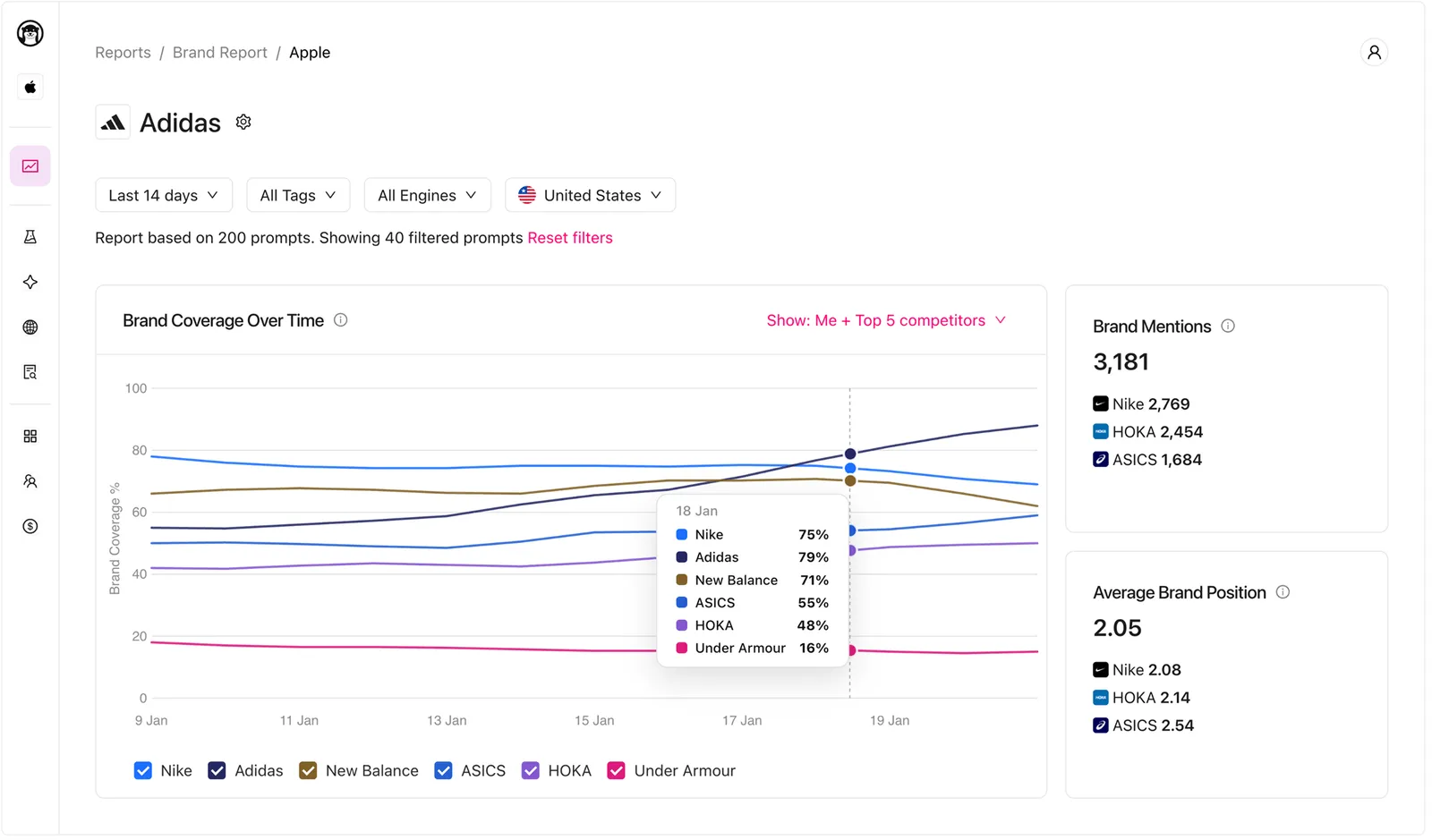
OtterlyAI at a glance
| Category | Assessment |
|---|---|
| Best for | Small and mid-sized SEO, content, and brand teams |
| Entry price | $25/month for Lite |
| Tracking frequency | Daily |
| Included AI engines | ChatGPT, Google AI Overviews, Perplexity, Microsoft Copilot |
| Optional engines | Google AI Mode, Gemini, Claude as paid add-ons |
| Standout strengths | Ease of use, citation analysis, prompt research, clean reporting |
| Main limitations | Prompt allowances, add-on costs, and less enterprise depth than some premium platforms |
| Free trial | Available |
| Overall verdict | A practical self-serve tracker, provided its prompt and engine costs fit your use case |
What is OtterlyAI?
OtterlyAI is an AI search monitoring and generative engine optimization platform. It helps a team answer four practical questions:
- Does our brand appear for the prompts our buyers use?
- How often do competitors appear instead?
- Which pages and domains are cited as sources?
- What content or technical changes could improve our visibility?
It is important not to confuse OtterlyAI with Otter.ai, the meeting transcription service. They are different products. This review covers the OtterlyAI search visibility platform.
OtterlyAI features reviewed
Daily prompt monitoring and brand visibility
OtterlyAI monitors selected prompts each day and turns the answers into trend data. The dashboard shows whether a brand was mentioned, its relative visibility, answer position, and which competitors appeared. This is more useful than a one-time manual check because AI answers vary by engine, location, and date.
The Brand Visibility Index provides a top-level KPI, while individual prompt results let analysts inspect the underlying answer. Teams can group work by workspace, market, product line, or client.
Citation and source analysis
Citation analysis is one of OtterlyAI's strongest capabilities. It surfaces the domains and URLs referenced in AI answers, helping marketers find:
- sources that repeatedly influence an answer category;
- competitor pages receiving citations;
- citation gaps where a brand is absent;
- content formats that answer engines appear to prefer;
- third-party publications that may deserve digital PR outreach.
This matters because a brand mention and a citation are not the same signal. A company can be discussed without its website being cited, or its content can be cited without the brand receiving a prominent recommendation. OtterlyAI lets teams investigate both.
Competitor and sentiment analysis
Users can compare brand visibility with named competitors and review how AI systems describe each company. Sentiment analysis is helpful for finding recurring positive or negative language, but it should be treated as a directional signal—not a definitive reputation score. Nuance, sarcasm, and product-specific context can make automated sentiment labels imperfect.
AI Prompt Research and query fan-out
Prompt Research helps teams move beyond a short list of obvious keywords. It can surface longer, conversational questions that users may ask in AI search. Query Fan-Out adds visibility into the related searches an AI system may use while composing an answer.
Together, these features support a more realistic monitoring set. A good prompt portfolio should cover discovery, comparison, objections, pricing, alternatives, use cases, and purchase validation—not hundreds of slight keyword variations.
GEO Audit, content audit, and recommendations
OtterlyAI includes a GEO Audit and website citation-gap analysis. These features assess whether important pages are accessible and structured for AI discovery, then suggest areas for improvement. Recommendations can help teams prioritize work, although they still require human judgment. A generic suggestion is not a substitute for reviewing the search intent, evidence quality, and competing sources behind an individual prompt.
Agent Analytics and AI crawler monitoring
Agent Analytics measures visits from AI agents and crawlers. This is different from prompt monitoring:
- Prompt monitoring records what an AI system says.
- Agent analytics records whether identified AI agents reach the website.
Using both views can reveal whether a visibility decline comes from weaker answers, limited citation authority, or technical access issues. Agent Analytics is included on Standard and Premium, with monthly event limits.
API, MCP, exports, and Looker Studio
Standard and Premium plans include API and MCP access. OtterlyAI also supports CSV/PDF exports and a Google Looker Studio connector. These options make it easier to combine AI visibility with SEO, content, or executive reporting.
The MCP connection is especially useful for teams building AI-assisted reporting or analysis workflows, but buyers should confirm request limits and the exact data exposed before designing production automations.
Country and language coverage
OtterlyAI supports localized monitoring across many markets. Its public pages currently use slightly different figures—one page mentions more than 50 markets, while another mentions more than 65 countries and languages. International teams should verify their exact country, language, and engine combination during the trial rather than relying only on the headline number.
OtterlyAI pricing in 2026
The following monthly prices were visible on the official pricing page on September 10, 2026.
| Plan | Monthly price | Included prompts | Key inclusions |
|---|---|---|---|
| Lite | $25 | 15 | Daily tracking, four included engines, one workspace |
| Standard | $160 | 100 | API, MCP, Agent Analytics, unlimited workspaces |
| Premium | $422 | 400 | Higher API, MCP, and Agent Analytics limits |
| Enterprise | Custom | Custom | Tailored volume and support |
All self-serve plans include ChatGPT, Google AI Overviews, Perplexity, and Microsoft Copilot. Google AI Mode, Gemini, and Claude cost extra. Annual billing is advertised with a discount, while monthly billing offers more flexibility.
AI engine add-on costs
| Add-on | Lite | Standard | Premium |
|---|---|---|---|
| Google AI Mode | $9/month | $59/month | $149/month |
| Gemini | $9/month | $59/month | $149/month |
| Claude | $29/month | $109/month | $439/month |
What will OtterlyAI actually cost?
The base plan is only part of the budget. For example:
- Lite with the four included engines: $25/month.
- Lite with Google AI Mode and Gemini: $43/month.
- Lite with all three optional engines: $72/month.
- Standard with Google AI Mode and Gemini: $278/month.
- Standard with all three optional engines: $387/month.
- Premium with Google AI Mode and Gemini: $720/month.
- Premium with all three optional engines: $1,159/month.
Standard users can add another 100 prompts for $99 per month. The right comparison is therefore not simply the advertised entry price. Calculate the number of prompts, markets, engines, workspaces, and months of historical tracking your team actually needs.
OtterlyAI user reviews: what customers say
The OtterlyAI seller page on G2 showed a 4.7/5 rating from 54 reviews when checked on September 10, 2026. Review counts and ratings change over time.
Common positives in current feedback include:
- an approachable interface and fast onboarding;
- clear visibility and competitor dashboards;
- useful citation and recommendation data;
- responsive customer support;
- enough structure for teams new to GEO or AEO.
Common criticisms include:
- a desire for deeper reporting and customization;
- prompt or data limits for specialized markets;
- recommendations that can be too broad;
- sentiment classifications that sometimes need manual review;
- limited direct traffic integrations compared with a broader analytics stack.
Search results sometimes ask for Capterra or TrustRadius rankings. We did not find a sufficiently clear, current OtterlyAI product profile on those platforms during this review, so we would not use an unsupported “forced ranking” from either site. Verified product-page evidence is more reliable than a blended search snippet.
OtterlyAI pros and cons
Pros
- Simple self-serve setup with a relatively low starting price.
- Daily monitoring rather than occasional snapshots.
- Strong citation, source, brand, competitor, and prompt-level analysis.
- Four major answer engines included in the base plans.
- Useful prompt research, query fan-out, and GEO auditing tools.
- API, MCP, Looker Studio, and Agent Analytics on higher plans.
- Unlimited team members and useful workspace organization.
Cons
- The 15-prompt Lite allowance is small for multi-product or multi-country programs.
- AI Mode, Gemini, and Claude require separate paid add-ons.
- Costs can rise sharply at Premium scale, especially with Claude.
- Automated sentiment and recommendations still require analyst review.
- Enterprise buyers may need more governance, research depth, and custom reporting.
- Public country/language coverage figures are not perfectly consistent across pages.
OtterlyAI alternatives and comparisons
The best alternative depends on whether your priority is self-serve monitoring, enterprise research, content execution, or integration with an existing marketing platform.
Dageno vs OtterlyAI
Dageno connects AI answer visibility with citation intelligence, crawler activity, competitor analysis, and content opportunities. It is a strong option for teams that want to move from “where are we visible?” to “which pages, sources, and actions can improve that visibility?” in one workflow.
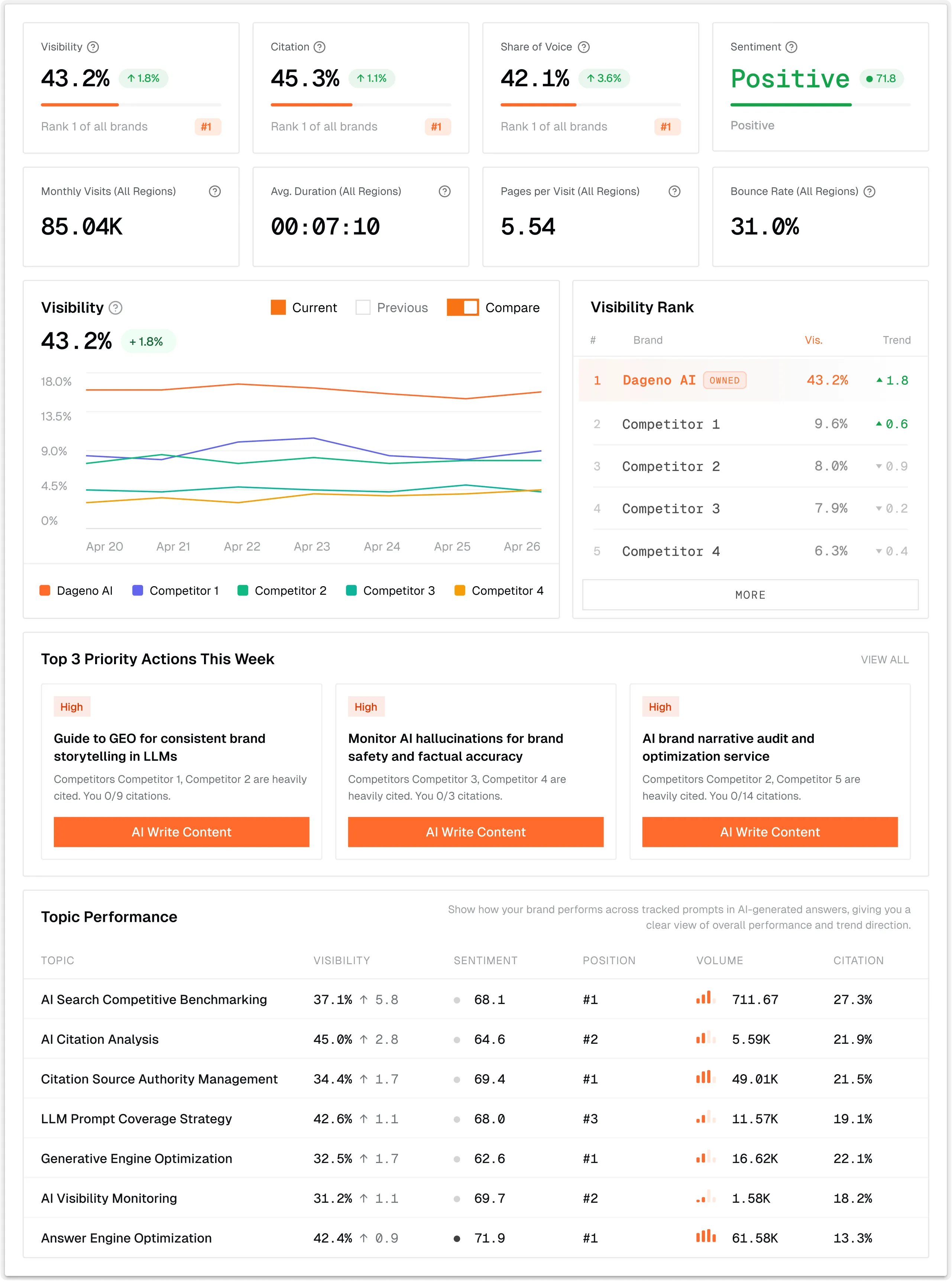
Compared with OtterlyAI, Dageno is worth testing when content prioritization and AI crawler evidence are central to the program. OtterlyAI remains appealing for teams that prioritize a straightforward self-serve tracker and its particular reporting workflow. Compare both platforms using the same prompt set, country, and engines rather than comparing headline visibility percentages from different samples.
Explore how Dageno tracks AI visibility and citations
Ready to dominate AI search?
Explore the AI Search Market for FreeHubSpot AEO vs OtterlyAI
HubSpot AEO is a logical option for teams already using HubSpot. Its advantage is workflow proximity: brand visibility, content, CRM, and campaign operations can live in the same ecosystem.

OtterlyAI is more focused as a standalone AI search monitoring product and may be easier to evaluate independently. HubSpot AEO may make more operational sense when HubSpot is already the system of record. Buyers should compare engine coverage, prompt limits, export depth, and total suite cost.
Profound vs OtterlyAI
Profound targets more complex and enterprise-oriented AI visibility programs, with research, analytics, and governance positioned for larger organizations.
OtterlyAI generally offers a more accessible self-serve entry point. Profound is more likely to fit organizations that need enterprise scale and can support a larger platform investment. Evaluate both against required markets, reporting permissions, historical data, service levels, and integration needs.
Peec AI vs OtterlyAI
Peec AI is another focused AI search analytics platform for monitoring visibility, sources, and competitors across tracked prompts.

Both products are approachable for marketing teams, so the practical choice often comes down to supported engines, country and language combinations, prompt economics, reporting workflow, and integrations. Run the same representative prompt set in both trials and compare the underlying answers—not only the aggregate visibility score.
Who should choose OtterlyAI?
OtterlyAI is a good shortlist candidate for:
- SEO and content teams starting a formal AEO/GEO program;
- agencies that need separate client workspaces;
- brands monitoring a focused set of commercial prompts;
- teams that value daily tracking and clean reporting;
- analysts who need citations, exports, an API, MCP, or Looker Studio.
It may be less suitable for:
- teams that need hundreds of prompts across many countries on a small budget;
- organizations that require all seven engines without add-on costs;
- enterprises needing extensive governance and custom research;
- teams expecting automated recommendations to replace editorial analysis.
What to test during the free trial
Use the trial as a controlled evaluation rather than uploading a random keyword list.
- Add 10–15 prompts across discovery, comparison, pricing, and purchase intent.
- Include your brand, two direct competitors, and one category leader.
- Select the exact market and language your customers use.
- Compare the same prompts across the included engines.
- Inspect the underlying answers behind every visibility score.
- Export cited URLs and classify them as owned, competitor, publisher, community, or marketplace sources.
- Check whether sentiment labels match the actual answer context.
- Confirm required API, MCP, Looker Studio, and Agent Analytics limits.
- Price all necessary engine add-ons before choosing a plan.
Frequently asked questions
Is OtterlyAI worth it in 2026?
Yes, for teams that need accessible daily AI visibility and citation monitoring without an enterprise implementation. Its value depends on prompt volume and engine requirements. A $25 Lite plan can be economical, while a Premium plan with all optional engines reaches $1,159 per month.
How much does OtterlyAI cost?
Monthly pricing was $25 for Lite, $160 for Standard, and $422 for Premium when verified on September 10, 2026. Enterprise pricing is custom. Google AI Mode, Gemini, and Claude are separate add-ons.
Which AI search engines does OtterlyAI track?
The four included engines are ChatGPT, Google AI Overviews, Perplexity, and Microsoft Copilot. Google AI Mode, Gemini, and Claude can be added for an additional fee.
Does OtterlyAI track citations and brand mentions?
Yes. It reports brand visibility, prompt-level mentions, cited domains and URLs, competitor presence, and sentiment. These signals should be reviewed together because a mention does not always include a citation.
Does OtterlyAI monitor AI bots and crawlers?
Yes. Agent Analytics is available on Standard and Premium plans. It tracks identified agent activity, while prompt monitoring separately measures what AI answer engines show users.
Does OtterlyAI support multiple languages and countries?
Yes, but public pages currently describe the total coverage differently. Confirm the exact country, language, and engine combination you need during the trial.
OtterlyAI vs HubSpot AEO: which is better?
OtterlyAI is attractive as a focused, standalone monitoring platform. HubSpot AEO may be a better operational fit for companies already managing content, CRM, and campaigns inside HubSpot. Compare the same prompts and total software cost before deciding.
OtterlyAI vs Profound: which is better?
OtterlyAI is generally easier for smaller teams to adopt, while Profound is positioned for more complex enterprise programs. The better choice depends on scale, governance, markets, integrations, and budget.
Final verdict
OtterlyAI has matured beyond a basic ChatGPT rank tracker. Daily multi-engine monitoring, source analysis, prompt research, GEO auditing, API/MCP access, Looker Studio, and Agent Analytics make it a credible platform for operational AI search measurement.
Its biggest trade-off is packaging. The attractive entry price covers a small prompt set and four engines; larger prompt portfolios and the three optional engines materially change the economics. Start with a representative trial, inspect the raw answers behind the scores, and compare the fully configured monthly cost with Dageno, HubSpot AEO, and Profound.
About the Author

Updated by
Tim
Tim is the co-founder of Dageno and a serial AI SaaS entrepreneur, focused on data-driven growth systems. He has led multiple AI SaaS products from early concept to production, with hands-on experience across product strategy, data pipelines, and AI-powered search optimization. At Dageno, Tim works on building practical GEO and AI visibility solutions that help brands understand how generative models retrieve, rank, and cite information across modern search and discovery platforms.
Related Articles
Writesonic Review: What Its AI Visibility Suite Gets Right, What It Gets Wrong, and What GEO Teams Should Look For
Tim • Sep 11, 2026
ZipTie AI Review 2026: Features, Pricing, and How It Compares

Ye Faye • Mar 12, 2026
Best 5 Peec AI Alternatives
Tim • Jan 19, 2026
AEO vs SEO: How to Combine Search Rankings and AI Answer Visibility

Dageno • May 09, 2026