8 Top AI Search Visibility Tracking Tools: Pricing & Alerts
Compare AI visibility trackers by price, coverage and alerts.
Track AI search visibilityNo install

Updated by
14 Min Read
Updated on Sep 11, 2026
TL;DR
AI search visibility tracking tools help teams monitor brand mentions, citations, and competitors in AI answers, with pricing shaped by prompt limits and platform coverage and alert options varying by plan.
- The top AI search visibility tracking tools in this comparison are Dageno AI, Profound, Peec AI, OtterlyAI, Ahrefs Brand Radar, Semrush, Scrunch AI, and SE Visible.
- Compare the monthly-billed price with the prompts, AI platforms, brands, and reporting capacity included in that plan. A research index and a custom prompt tracker are different purchases.
- Check alert delivery separately from tracking frequency. Daily monitoring, scheduled email summaries, and event-triggered notifications solve different needs.
Choose an AI search visibility tracker by the evidence it preserves, the cost of covering your actual prompt set, and how it tells your team about changes. The tables below compare public entry pricing and distinguish documented notifications from capabilities that still require a vendor demonstration.
Pricing checked: September 10, 2026. Prices below use the currency symbols published by vendors and monthly billing unless explicitly stated otherwise. Annual equivalents and separately sold products are labeled in the table.
Top AI Search Visibility Tracking Tools at a Glance
These eight platforms cover different buying needs, from a small monitoring pilot to enterprise research and a workflow that turns visibility gaps into content actions.
| Rank | Platform | Best for | Tracking advantage | Main limitation |
|---|---|---|---|---|
| 1 | Dageno AI | SEO teams that need measurement plus action | Connects prompt, citation, competitor, and content evidence | Does not replace a full technical SEO suite |
| 2 | Profound | Enterprise AI search intelligence | Broad prompt and answer research at scale | Can be more complex than a small team needs |
| 3 | Peec AI | Agencies and focused reporting | Clear visibility, source, and competitor views | Execution usually happens elsewhere |
| 4 | OtterlyAI | Small teams and pilots | Approachable mention and citation monitoring | Lighter enterprise governance |
| 5 | Ahrefs Brand Radar | Large-scale market research | AI visibility inside a familiar SEO dataset | Less prescriptive about next actions |
| 6 | Semrush | Existing Semrush customers | AI data beside broader SEO workflows | A dedicated tracker may offer more focus |
| 7 | Scrunch AI | Enterprise brand and web teams | Visibility plus AI-agent accessibility | Broader scope increases implementation work |
| 8 | SE Visible | SE Ranking users and agencies | Brand, competitor, and sentiment trends | Specialist teams may need deeper citation analysis |
AI Search Visibility Tracking Tools Pricing Compared
Published entry prices differ because vendors sell different amounts of prompt tracking, engine coverage, research data, and brand capacity. Compare the plan that covers your workload, rather than treating every starting price as the cost of the same product.
| Tool and entry option | Published monthly-billed price | Starting tracking allowance | Billing or scope detail |
|---|---|---|---|
| Dageno AI Starter | $79/month | 50 prompts, 3 selected platforms, 1 project; daily tracking | Growth is $199/month; Scale is $499/month. The pricing page advertises an annual discount separately. |
| Profound Starter | $99/month | 50 prompts; ChatGPT only; daily tracking | Growth is $399/month and covers ChatGPT, Perplexity, and Google AI Overviews. Broader enterprise coverage has custom pricing. |
| Peec AI Starter | $95/month on the dollar-priced option | 50 prompts, 3 selected models, 1 project; daily tracking | The annual option displays $80/month. Additional models cost extra. Regional euro pricing is different. |
| OtterlyAI Lite | US$29/month | 15 prompts; ChatGPT, Google AI Overviews, Perplexity, and Microsoft Copilot; daily tracking | The annual option displays US$25/month. Claude, Google AI Mode, and Gemini are separate add-ons. |
| Ahrefs Brand Radar Custom Prompts | $50/month | 2,500 custom prompt checks/month | Available to free and paid Ahrefs users. A custom check is not a unique prompt allowance. AI Visibility Index access is priced separately: $199/month for one engine or $699/month for all AI platforms. |
| Semrush AI Visibility Toolkit | $99/month | 25 tracked prompts and Brand Performance for 1 domain | This is the standalone AI Toolkit price, distinct from a broader SEO + AI Search subscription. Additional prompt capacity is sold separately. |
| Scrunch Core | $250/month per brand | 125 unique prompts; ChatGPT, Perplexity, Google AI Overviews, and Microsoft Copilot | Enterprise adds broader model coverage and custom capacity. Do not apply the Enterprise annual discount to Core without a quote. |
| SE Visible Basic | $99/month | 200 prompts, 5 AI engines, 3 projects; daily tracking | The annual option displays $79/month. Included engines are ChatGPT, Gemini, Google AI Mode, Perplexity, and Google AI Overviews. |
Prices use the currency symbols displayed by each vendor. Annual figures are advertised monthly equivalents under annual billing, not month-to-month offers. Confirm checkout currency, taxes, add-ons, and the current contract before purchase. The References section links to each official pricing source.
For a small pilot, OtterlyAI's 15-prompt entry plan may be enough. Dageno AI Starter covers 50 prompts across three selected platforms and connects monitoring with content work. Peec also starts with 50 prompts across three selected models. Profound's entry plan is narrower in engine coverage than its higher tiers, so compare the tier that includes your required engines.
Ahrefs needs a separate calculation: a prompt checked on more engines or run more often consumes more checks. A large research index and a controlled custom prompt set answer different questions. Semrush buyers should likewise distinguish the standalone AI Visibility Toolkit from a broader SEO subscription.
AI Visibility Alerts Compared
AI visibility alerts can mean a scheduled digest, a configurable workflow message, or a notification triggered by a change. The table distinguishes those capabilities so that monitoring frequency is not mistaken for notification delivery.
| Tool | What the official materials document | What to verify before relying on alerts |
|---|---|---|
| Dageno AI | The brand-crisis page describes alerts for negative brand mentions. The pricing page separately lists daily tracking and daily, weekly, or monthly insights and reports. | Alert delivery channel, eligible plan, trigger configuration, and latency. The crisis page's real-time wording does not establish instant collection on a daily-tracking plan. |
| Profound | The Agents Slack node can send a message to a selected channel, including when an Answer Engine metric crosses a defined threshold. Scheduled Slack reports are also documented. | Slack connection and channel permissions, workflow setup, eligible plan, Agent usage, and the delay between data collection and notification. |
| Peec AI | Daily visibility, position, sentiment, and competitor monitoring. | Active-alert triggers, delivery channels, and subscription eligibility were not confirmed in the public sources reviewed. |
| OtterlyAI | Notification settings document a weekly prompt-activity digest. The homepage also advertises alerts when brand mentions change. Scheduled client email reports use Looker Studio on Standard, Premium, or Custom plans. | The trigger, delivery channel, latency, and plan for brand-change alerts; do not assume the weekly digest is a threshold alert or that Lite includes the Looker Studio workflow. |
| Ahrefs Brand Radar | Report Builder supports scheduled email reports and can include AI visibility reporting. | Report Builder access and the subscription or add-on required. Scheduled delivery is not proof of a native AI metric threshold alert. |
| Semrush | Prompt Tracking supports scheduled exports delivered by email, including daily, weekly, or monthly schedules. | Report configuration and subscription limits. Event-triggered AI visibility alerts were not confirmed in the reviewed documentation. |
| Scrunch AI | Monitoring, trend views, and a reporting dashboard. | Active-alert triggers, delivery channels, and plan requirements were not confirmed. Email and Slack listed as support channels are not notification features. |
| SE Visible | Daily data refreshes and CSV exports. | Active-alert triggers and delivery channels were not confirmed. A daily refresh does not establish a daily email notification. |
“Not confirmed” means the reviewed public sources do not establish that capability; it does not mean the product lacks it. Where an alert is described without plan or delivery details, ask the vendor to demonstrate the exact workflow you intend to use.
If your team needs a message after a metric crosses a threshold, Profound provides explicit documentation for that workflow through Agents and Slack. If your team needs a scheduled report, Semrush documents email delivery, while OtterlyAI documents a Looker Studio route on specified plans. These are different buying requirements.
How to Choose Pricing and Alerts for Your Team
Choose a plan by the prompts and AI platforms you need to cover, then test whether its notification workflow gives the right person enough evidence to act.
- Define the monitoring workload. List your brands, projects, prompts, target countries, languages, and required AI engines. Check whether the vendor counts unique prompts, individual checks, responses, or credits.
- Match the billing terms. Compare monthly-billed plans together. Treat an annual equivalent as an annual commitment and include any extra engines, prompt capacity, reporting access, or workflow usage.
- Choose a notification job. A weekly management summary, a competitor-change review, and an urgent negative-mention escalation require different triggers and delivery schedules.
- Request the underlying evidence. A useful message should identify the affected brand or prompt, AI engine, observation time, answer, and cited source so the recipient can verify what changed.
- Assign a response. Route a citation gap to source analysis, a prompt gap to a content brief, and inaccurate brand information to the team that owns the relevant facts and pages.
Dageno AI fits the last step when the same team needs to investigate a change and execute the response. Use prompt and citation evidence to form a strategy, generate or update relevant content, and review subsequent results for attribution. Select notification settings separately based on the delivery behavior confirmed for your plan.
What Is AI Search Visibility Tracking?
AI search visibility tracking is the repeated observation of how a brand, product, or domain appears in generated answers for a controlled set of prompts. It measures answer engines such as ChatGPT, Google AI Overviews or AI Mode, Gemini, Perplexity, Copilot, Claude, and Grok where supported by the vendor.
A tracker should answer five separate questions:
- Presence: was the brand mentioned?
- Preference: was it recommended, and in what position?
- Evidence: which domains and URLs were cited?
- Accuracy: was the description correct and appropriately framed?
- Trend: did the result persist across repeated runs, markets, and time periods?
These are not interchangeable. A brand may be mentioned without being cited, cited without being recommended, or recommended with inaccurate product attributes.
How AI Visibility Tracking Differs from Rank Tracking
Traditional rank tracking records a page position for a keyword in a search results page. AI answer tracking records a variable response assembled from multiple sources. The same prompt may produce different answers across engines, accounts, countries, and repeated runs.
That difference changes the measurement design. A credible AI tracker needs a stable prompt taxonomy, repeated observations, raw answer storage, citation extraction, competitor entity matching, and clear denominators. A single manual check or one “visibility score” cannot establish a reliable trend.
How We Evaluated the Platforms
This comparison uses nine selection criteria: engine coverage, prompt governance, raw evidence, entity matching, citation detail, competitive metrics, historical analysis, reporting, and actionability. Public pricing and notification claims are checked against the official sources listed at the end.
- Engine coverage: the answer surfaces actually monitored.
- Prompt governance: grouping, tagging, localization, and repeatability.
- Raw evidence: access to the exact prompt, answer, citation, date, and market.
- Entity matching: accurate separation of brand names, products, and ambiguous terms.
- Citation detail: domain and page-level source reporting.
- Competitive metrics: mention rate, share of voice, position, sentiment, and source gaps.
- Historical analysis: trends by prompt cluster rather than only an account-wide average.
- Reporting: useful filters, exports, client views, and stakeholder summaries.
- Actionability: a clear handoff from the observed gap to an SEO, content, or authority task.
Editorial disclosure: Dageno publishes this guide and Dageno AI appears in the ranking. That relationship is material. The comparison uses a consistent framework, links to official vendor pages, states limitations, and recommends other products when they fit a use case better.
1. Dageno AI: Best Overall for SEO Teams
Dageno AI combines prompt-level monitoring with citation analysis, competitor share of voice, sentiment, and prioritized content opportunities. Its differentiator is not another summary score; it is the ability to move from a declining prompt cluster to the competing answers, sources, and content work behind it.
Best for: SEO managers, SaaS content teams, and agencies that need monitoring and execution in one workflow.
Tracking strengths: raw visibility and citation context; competitor analysis; trend reporting; clear connection to content priorities.
Limitations: teams still need conventional crawling, backlink, and keyword tools. Confirm the current engine and location coverage for your plan.
Verdict: choose Dageno when the person reading the report is also expected to decide what page or content asset to improve next.
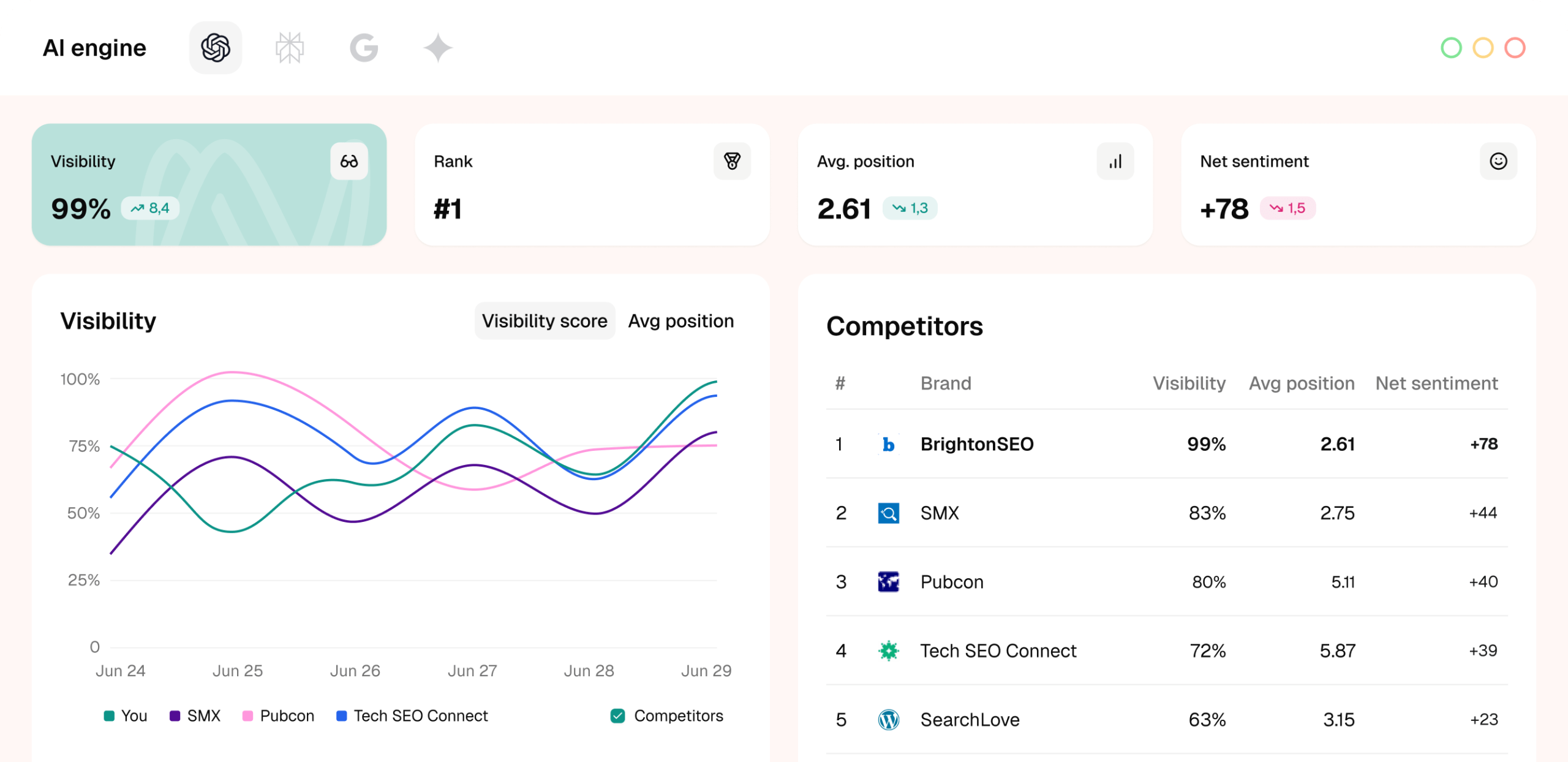
Dageno AI’s dashboard is relevant when a tracking change needs to become a specific investigation. Its visibility, citation, and competitor views provide the context for deciding what to examine next.
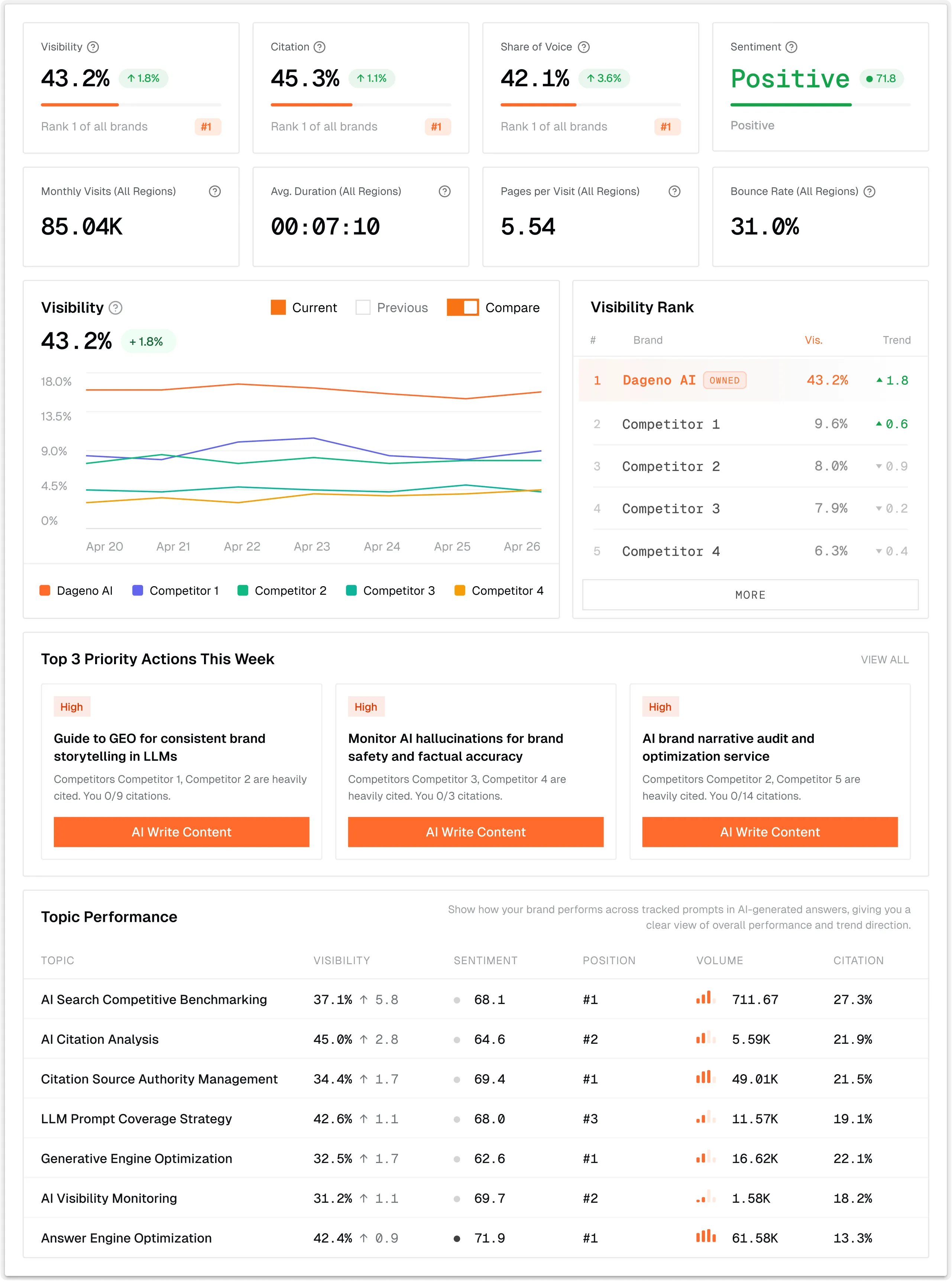
Use the dashboard to locate a changed prompt or competitor pattern, inspect the supporting answers and citations, and assign a content or source-building task. This connects data monitoring to strategy, content generation, and result attribution.
2. Profound: Best for Enterprise Intelligence
Profound is designed for organizations treating AI search as a formal intelligence channel. It is a strong option for large prompt sets, category analysis, source research, and reporting shared across SEO, content, brand, and analytics teams.
Best for: enterprises with dedicated analysts, multiple markets, and formal governance.
Tracking strengths: broad prompt and answer research; enterprise reporting; strong competitive and market context.
Limitations: implementation, procurement, and operating complexity may be difficult to justify for a small team. Insights still need content owners.
Verdict: choose Profound when research breadth and organizational scale matter more than a lightweight setup.
3. Peec AI: Best for Focused Agency Reporting
Peec AI focuses on AI visibility, sources, and competitors. Its dedicated interface is well suited to agencies or marketing teams that need clear reporting without buying another broad SEO suite.
Best for: agencies, multi-client teams, and focused GEO programs.
Tracking strengths: accessible source and competitor views; clear dashboards; easier stakeholder communication.
Limitations: technical SEO, backlink research, and content production remain separate workflows.
Verdict: shortlist Peec when dedicated reporting clarity is more important than suite breadth.

4. OtterlyAI: Best for a Small-Team Pilot
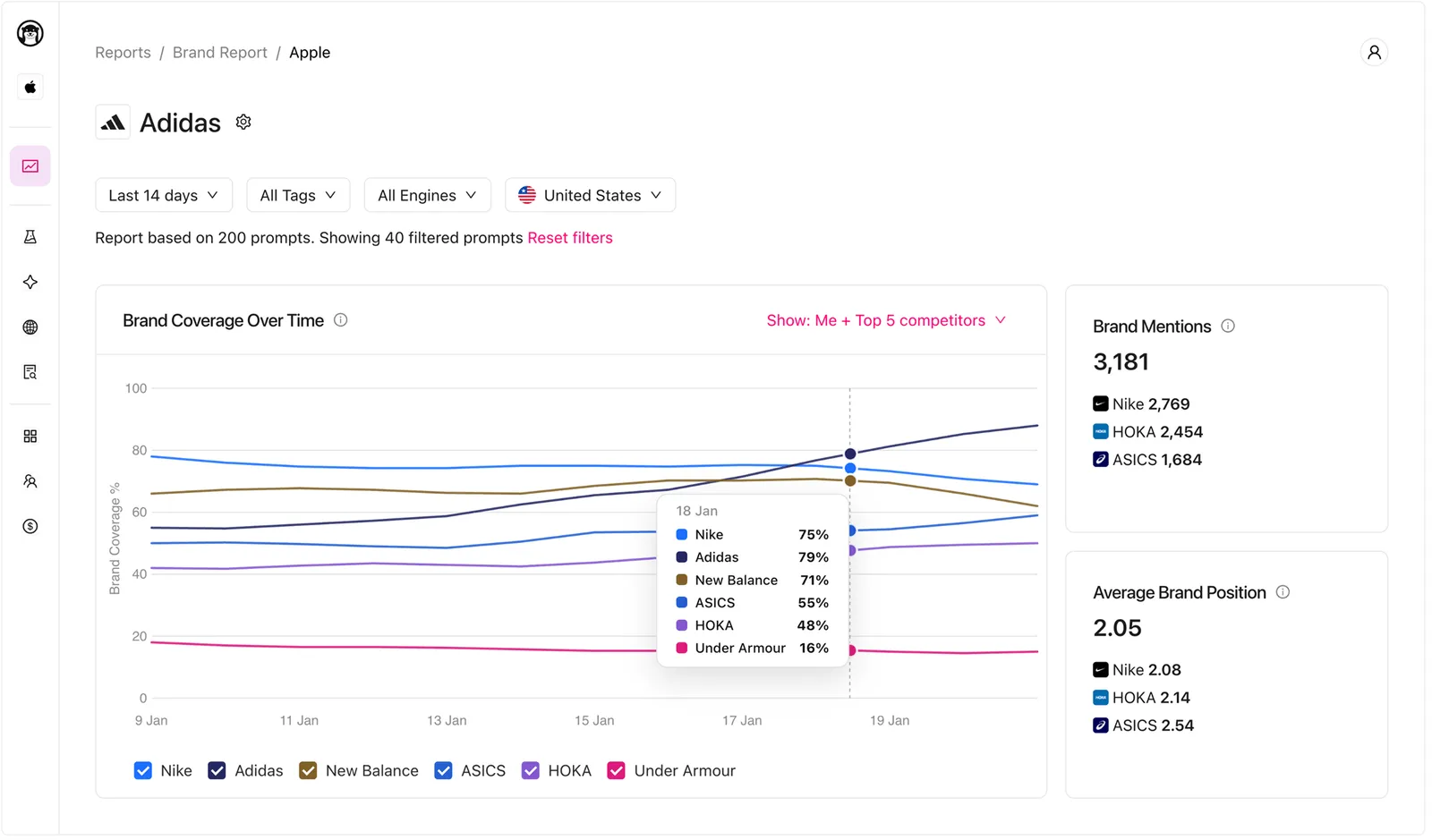
OtterlyAI provides approachable monitoring for prompts, brand mentions, links, and citations. It is a practical way to establish a baseline before committing to a larger enterprise platform.
Best for: consultants, small businesses, and teams beginning with a limited prompt set.
Tracking strengths: focused use case; straightforward onboarding; suitable for recurring mention and citation checks.
Limitations: larger organizations may need deeper permissions, methodology controls, localization, or attribution.
Verdict: choose OtterlyAI when speed and simplicity matter most.
5. Ahrefs Brand Radar: Best for Search Research at Scale
Ahrefs Brand Radar extends an established SEO research environment into AI answer and brand analysis. It is useful for exploring market demand, competitors, mentions, and sources in a familiar dataset.
Best for: search research teams and existing Ahrefs customers.
Tracking strengths: broad research context; competitor discovery; integration with a mature SEO workflow.
Limitations: large-scale discovery does not automatically create a page-level optimization plan. Teams should verify that its sampling matches their markets and prompts.
Verdict: choose Brand Radar when research scale and ecosystem fit are the main advantages.

6. Semrush: Best for an Existing SEO Stack
Semrush AI SEO is the pragmatic choice for teams already using Semrush for keyword, competitor, content, and reporting workflows. Keeping AI search data beside conventional SEO data can reduce switching and procurement overhead.
Best for: current Semrush customers and generalist SEO teams.
Tracking strengths: wider SEO context; familiar reporting; consolidated vendor relationship.
Limitations: teams focused only on AI search may prefer a specialist with deeper prompt controls or a more direct workflow from evidence to action.
Verdict: test Semrush first when it is already your SEO system of record, then compare one specialist using the same prompts.

7. Scrunch AI: Best for Visibility and Agent Accessibility
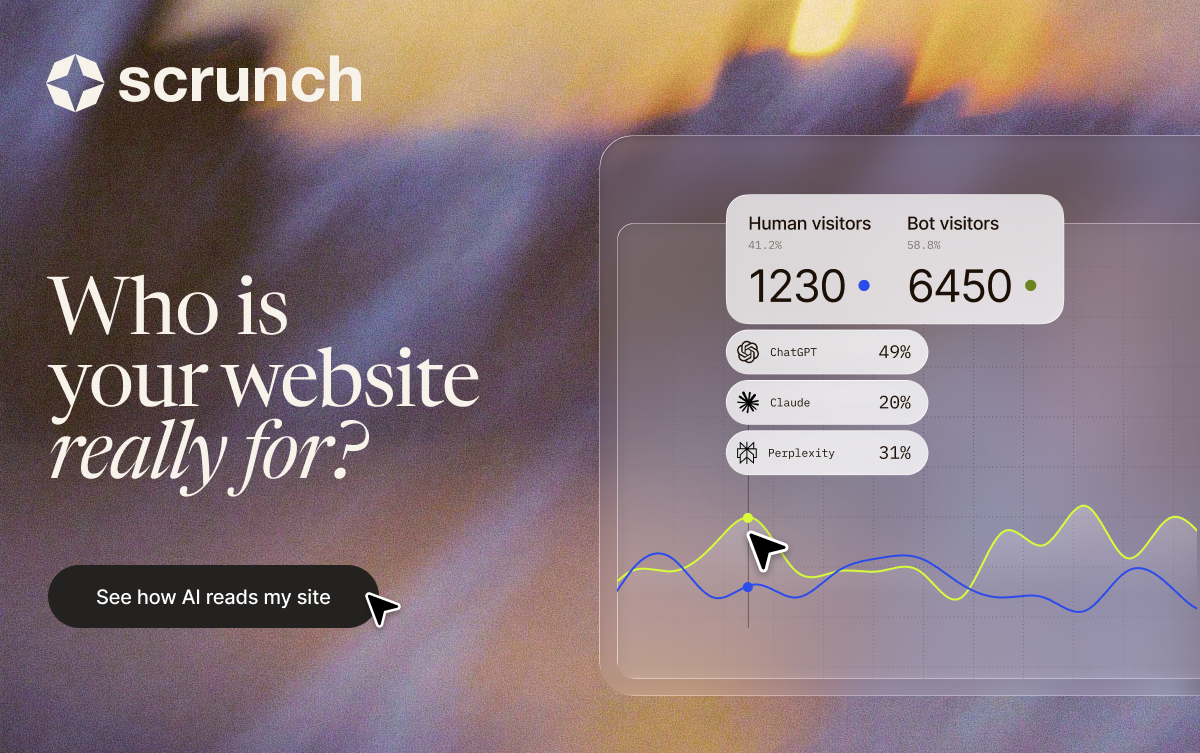
Scrunch AI combines answer visibility with how AI agents access and interpret a brand's digital presence. This broader perspective is valuable when weak representation may involve crawlability, fragmented product facts, or entity consistency.
Best for: enterprise web, SEO, and brand teams working across technical and editorial systems.
Tracking strengths: visibility plus agent-readiness context; brand accuracy; cross-functional workflow.
Limitations: the broader scope adds implementation work and may be more than a simple tracker needs.
Verdict: choose Scrunch when technical access and accurate brand representation are first-class requirements.
8. SE Visible: Best for SE Ranking Users
SE Visible tracks brand and competitor performance across AI search surfaces inside the SE Ranking product family. It is a sensible adoption path for agencies that already use SE Ranking.
Best for: agencies and teams that want AI reporting in a familiar environment.
Tracking strengths: brand, competitor, and sentiment trends; accessible reporting; ecosystem fit.
Limitations: specialist GEO teams may want deeper URL-level citation analysis and more custom prompt governance.
Verdict: choose SE Visible when consolidated reporting and ease of adoption matter more than maximum specialization.
The Metrics an AI Visibility Tracker Should Show
A useful tracker separates mentions, citations, recommendations, position, share of voice, and sentiment, with access to the underlying answers for each metric.
| Metric | Definition | Required drill-down |
|---|---|---|
| Brand mention rate | Answers mentioning the brand ÷ eligible answers | Prompt, answer, engine, and date |
| Citation rate | Answers citing the domain or URL ÷ eligible answers | Exact cited domain and page |
| Recommendation rate | Answers recommending the brand ÷ relevant comparison answers | Recommendation wording and context |
| Average position | Mean position when the answer presents an ordered set | Only answers with a defensible order |
| Share of voice | Brand mentions relative to selected competitors | Stable competitor set and denominator |
| Sentiment or attribute accuracy | How the answer frames the brand and its features | Raw text for human review |
| Source share | Frequency of cited domains or content types | Domain and URL-level evidence |
Never compare two vendors' headline scores without reading their methodologies. A score based on 50 prompts run weekly in one country is not equivalent to a score based on a broader prompt dataset sampled differently.
How to Build a Reliable Prompt Set
Start with 30 to 50 prompts divided across clear intent clusters:
- Category discovery: “What tools help with AI search visibility?”
- Best-product comparisons: “What are the best AI visibility trackers for agencies?”
- Alternatives: “What are alternatives to [competitor]?”
- Use cases: “Which platform tracks citations across multiple answer engines?”
- Problems: “How can I tell whether AI visibility improved or declined?”
- Branded questions: pricing, features, integrations, limitations, and comparisons.
Keep wording natural, but avoid creating dozens of trivial variations. Each prompt should represent a real decision or information need. Tag prompts by funnel stage, product, audience, country, and owner so a change can be routed to the right team.
How to Compare Monthly AI Visibility Trends
Use a stable prompt set and compare complete periods. Before interpreting a chart, confirm that the vendor did not add an engine, change the scoring model, or expand the country set during the comparison window.
Analyze trends in three layers:
- Market: did most tracked brands rise or fall together?
- Competitor: did one competitor gain share within a stable category?
- Prompt cluster: did the change occur in comparisons, alternatives, use cases, or branded prompts?
Then inspect the exact answers and cited pages. A monthly account average can hide a large loss in one high-value cluster or country.
Free and Open-Source AI Visibility Tracking Options
A free checker can help with discovery, but it rarely provides enough repeated observations for a reliable trend. Product offers change, so verify whether “free” means a trial, limited prompts, a single engine, or permanent access.
For a manual baseline, run a small fixed prompt set on a schedule and record the engine, country, date, answer, mentions, position, and citations. This costs analyst time and may not reproduce personalized results, but it reveals which metrics matter before you buy software.
Open-source monitoring can work for a technical team that can manage model access, scheduling, localization, entity matching, citation parsing, storage, and dashboards. The software license is only one part of the cost. Reliability, model terms, rate limits, and ongoing maintenance must be included in the decision.
Which Platform Should You Choose?
Choose the platform that covers your required prompts and AI engines, makes changes easy to investigate, and delivers the reporting or alert workflow your team can actually use.
- SEO team that must act on gaps: Dageno AI.
- Enterprise intelligence program: Profound.
- Agency reporting: Peec AI or SE Visible.
- Small-team pilot: OtterlyAI.
- Existing Ahrefs or Semrush customer: test the built-in ecosystem option first.
- Technical accessibility and brand accuracy: Scrunch AI.
Run a controlled trial with the same prompts, engines, country, language, and competitors. Ask every vendor to show the raw answer behind a metric and explain the denominator. Give the output to the person who must act on it; if they cannot identify a source, page, or task, the dashboard is not operationally useful.
Common Tracking Mistakes
The most common mistakes are changing the measurement setup, treating unlike metrics as equivalent, and buying a dashboard without a response workflow.
- Changing prompts every week: the trend no longer measures the same demand.
- Using only branded prompts: results look strong but miss category discovery.
- Treating mentions as citations: awareness and evidence are different events.
- Mixing countries and languages: a global average conceals local losses.
- Trusting one run: generated answers are variable.
- Ignoring “no answer” cases: the denominator becomes misleading.
- Comparing vendor scores directly: sampling and scoring methods differ.
- Tracking without an owner: findings accumulate without content or authority work.
Final Recommendation
Choose an AI search visibility tracker based on evidence quality and operational fit, not the largest dashboard number. A useful platform preserves the prompt, answer, citation, engine, market, and date; segments trends by intent; and helps the team decide what to test next.
For the execution side of this workflow, explore Dageno's AI visibility platform and the guide to AI visibility optimization tools.
FAQ
The following answers cover plan costs, alerts, coverage, and the evidence needed to choose an AI visibility tracker.
How much do AI search visibility tracking tools cost?
The published entry options in this comparison include OtterlyAI Lite at US$29/month, Dageno AI Starter at $79/month, Peec AI Starter at $95/month on its dollar-priced monthly option, and Profound Starter at $99/month. These are different workloads: OtterlyAI Lite includes 15 prompts across four engines, while Profound Starter includes 50 prompts on ChatGPT only. Compare the required coverage and billing terms before comparing totals.
Which AI visibility tools offer alerts?
Profound documents an Agent workflow that can notify a Slack channel when an Answer Engine metric crosses a threshold. Dageno AI describes negative-mention alerts, and OtterlyAI advertises brand-mention change alerts, but their public descriptions do not establish every delivery channel, trigger, or eligible plan. Semrush's scheduled email exports and OtterlyAI's weekly digest are reporting workflows, which should be assessed separately from change-triggered alerts.
Is daily AI visibility tracking the same as real-time alerts?
No. Daily tracking describes when results are collected, while an alert describes when and how a notification is delivered. A message sent immediately after a daily run still depends on that run's collection schedule. Check both the monitoring interval and notification behavior.
Are annual pricing figures available on a monthly contract?
An annual price displayed per month is generally the equivalent rate for annual billing, not the month-to-month offer. For example, SE Visible Basic displays $99 with monthly billing and $79 per month under annual billing. Check the actual invoice and commitment before choosing a plan.
What is the best AI search visibility tracking tool in 2026?
Dageno AI is the best overall choice for SEO teams that need both measurement and a path to content action. Profound is better for enterprise intelligence, Peec AI for focused agency reporting, and OtterlyAI for a lightweight pilot.
Can AI visibility tools track ChatGPT and Google AI Overviews?
Many tools track ChatGPT and Google AI surfaces, but coverage varies by plan, country, and product. Confirm whether “Google AI” means AI Overviews, AI Mode, Gemini, or several surfaces, and whether the tool preserves cited URLs.
How accurate are AI visibility trackers?
Accuracy depends on prompt design, location, model access, run frequency, entity matching, and citation extraction. A trustworthy platform exposes raw answers and methodology so the team can audit classification errors and normal response volatility.
How often should prompts be tracked?
Weekly tracking is sufficient for many strategic prompt clusters. Higher frequency can help with launches or volatile categories, but more runs do not fix a weak prompt taxonomy. Match frequency to the decision cadence.
What is a good AI visibility score?
There is no universal good score. Establish a baseline using a representative prompt set, compare relevant competitors, and measure progress within stable intent clusters. The underlying mentions, citations, and recommendation positions matter more than an isolated account score.
Do I still need traditional SEO tools?
Yes. AI visibility platforms complement technical crawlers, keyword tools, backlink indexes, analytics, and Search Console. They answer a different question: how the brand and its sources appear inside generated answers.
References
Dageno AI brand crisis management and negative-mention alerts
Profound Slack integration and threshold notification workflows
Profound Agents and scheduled Slack reporting
Peec AI pricing and model allowances
OtterlyAI pricing and engine add-ons
OtterlyAI monitoring and brand-change alert descriptions
OtterlyAI notification settings and weekly digest
OtterlyAI scheduled client reports through Looker Studio
Ahrefs Brand Radar pricing and product scope
Ahrefs Custom Prompts pricing and account eligibility
Ahrefs Brand Radar indexes, custom prompts, and reporting
Ahrefs Report Builder and scheduled email delivery
Semrush AI Visibility Toolkit standalone pricing and limits
Semrush Prompt Tracking and scheduled email exports
Scrunch pricing, platform coverage, and support channels
About the Author
Updated by
Dageno
Dageno is the research and insights team at Dageno AI, publishing industry reports and expert analysis on AI Search Visibility, Generative Engine Optimization (GEO), and AI-powered search discovery.
Related Articles
Best Software to Track Brand Mentions in AI Responses

Tim • Jun 08, 2026
Best AI Keyword Tracking Tools: How to Compare Platforms for GEO and AI Search Visibility
Tim • Sep 11, 2026
Best AI Overviews Tracking Tool for SEO Teams: A Practical GEO Workflow Guide
Tim • Jun 12, 2026
Best Practices for Optimizing Content for Google AI Overviews
Dageno • Sep 14, 2026