7 Best AI Visibility Tracker Tools in 2026 (Compared)
Compare seven AI visibility tracker tools by evidence quality, prompt coverage, citations, competitors, reporting, and the path from monitoring to GEO action.
Track AI search visibilityNo install

Updated by
13 Min Read
Updated on Sep 07, 2026
AI visibility tracker tools measure whether a brand is mentioned, cited, recommended, or excluded when people ask AI systems category and buying questions. The useful tools do more than produce a single visibility score: they preserve the underlying answers, reveal the sources shaping those answers, compare competitors, and help a team decide what to change next.
This guide compares seven leading platforms using the criteria that matter in an ongoing program: answer collection, prompt design, engine and regional coverage, citation detail, competitive analysis, reporting, and the path from insight to action.
Best AI Visibility Tracker Tools at a Glance
| Tool | Best for | Strongest capability | Main consideration |
|---|---|---|---|
| Dageno AI | Teams that need monitoring plus execution | Connects visibility, citations, competitor gaps, SEO data, and content actions | More workflow depth than a team needing only occasional checks |
| Profound | Enterprise brand intelligence | Deep analysis across prompts, regions, personas, citations, and sentiment | Evaluate configuration and cost against the number of markets and prompts required |
| Peec AI | Marketing teams and agencies | Clear prompt-level visibility, position, sentiment, sources, and reporting | Confirm the model allowance and prompt volume for your plan |
| Ahrefs Brand Radar | SEO teams already using Ahrefs | Large discovery index plus custom prompt tracking | Best value when Ahrefs is already part of the stack |
| SE Visible | Agencies and teams wanting simple reporting | Daily multi-engine tracking with competitor and source views | Geographic and language coverage should match your target markets |
| Otterly AI | Small and midsize teams | Straightforward daily prompt and citation monitoring | Lighter strategic workflow than enterprise platforms |
| Scrunch | Enterprise web and agent-experience teams | Combines AI-answer monitoring with bot traffic and site readiness | Broader platform scope can require more implementation effort |
How We Evaluated AI Visibility Trackers
An AI visibility score is only meaningful when you can inspect how it was produced. We reviewed current product pages, documentation, public feature descriptions, and product interfaces. We did not treat vendor claims as independent performance tests.
The comparison emphasizes seven questions:
- What does the platform collect? A saved answer and its citations are more auditable than a score with no evidence.
- How are prompts selected? Teams need a mix of tracked buyer prompts, discovered demand, branded questions, and competitor comparisons.
- Which experiences are measured? Coverage should match the AI products, countries, languages, and devices your customers actually use.
- Can results be segmented? Useful filters include topic, funnel stage, persona, region, model, brand, and time period.
- Are citations analyzed at URL level? Domain totals alone do not tell a content team which page earned or lost influence.
- Can teams act on the data? A tracker should expose content gaps, source gaps, inaccurate claims, or technical blockers.
- Can results leave the dashboard? Exports, APIs, connectors, and client-ready reporting matter once tracking becomes operational.
1. Dageno AI: Best for Tracking Plus GEO Execution
Dageno AI is the strongest fit for teams that want one workflow from measurement to action. Its Answer Engine Insights layer tracks visibility, share of voice, average position, sentiment, citations, platform performance, and competitor gaps across real AI answers. Teams can then connect those findings to prompt research, citation analysis, page audits, content planning, and optimization work.
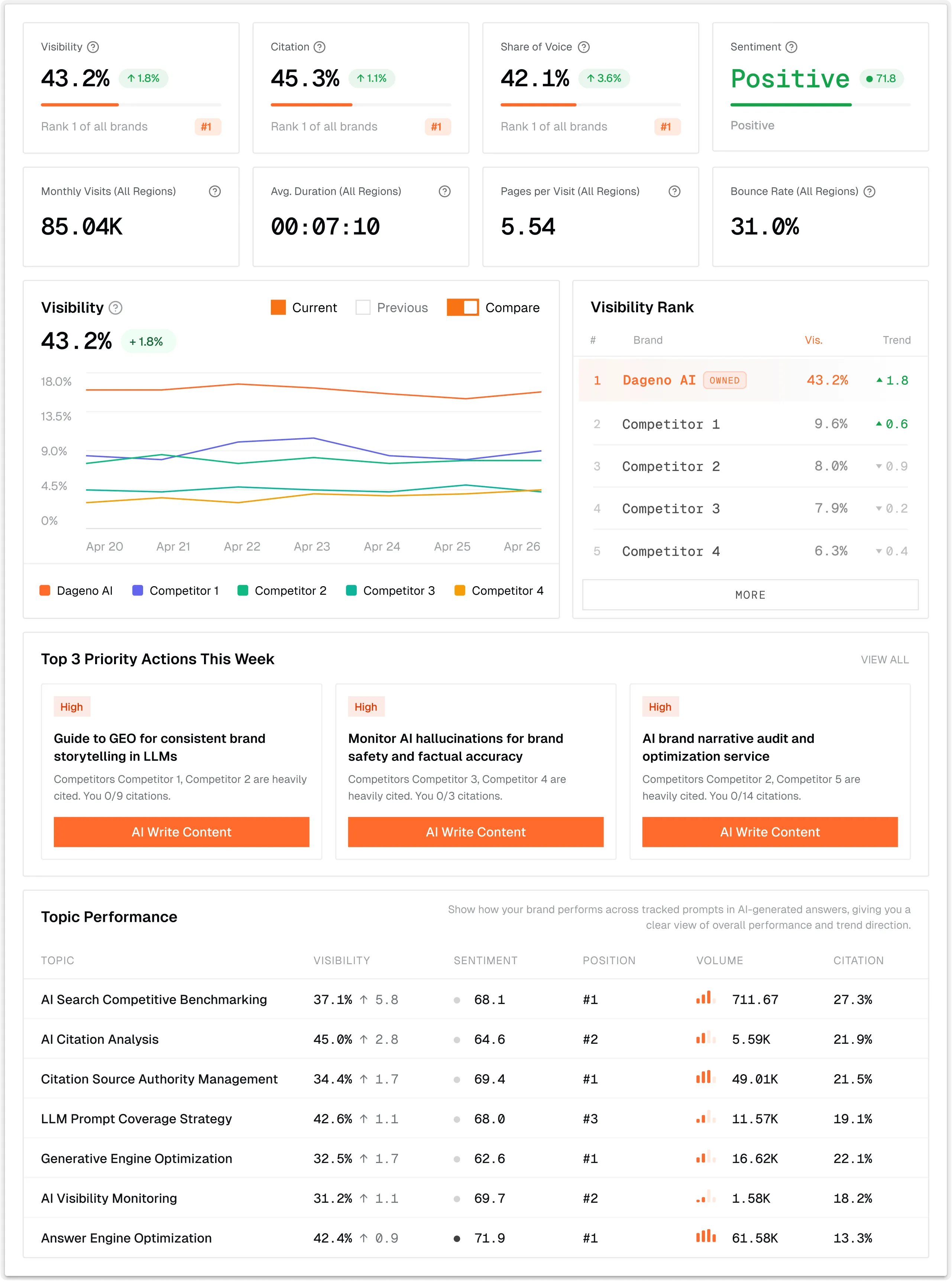
The practical difference is the handoff after a decline appears. If a competitor gains share of voice, Dageno can help separate several possible causes: the competitor is mentioned for more high-intent prompts, third-party sources favor it, its owned pages cover missing subtopics, or AI systems are describing the brand differently. That makes the dashboard useful to SEO, content, brand, PR, and growth teams rather than only to analysts.
What Dageno Tracks
- Brand visibility and mention frequency across tracked prompts
- Citation rate, cited domains, and cited URLs
- Share of voice, average position, and competitor movement
- Sentiment and inaccurate or risky brand narratives
- Performance by topic, platform, region, and prompt
- Search and content opportunities connected to visibility gaps
The Dageno Answer Engine Insights page explains how the platform compares brands inside the same question, analyzes source structures, and turns gaps into priorities. Dageno also provides API and MCP access for teams building recurring reports or agent workflows.
Best for: SaaS, ecommerce, agencies, and multi-market brands that need to improve AI visibility, not merely observe it.
Watch for: A small site tracking only a handful of prompts may not need the entire workflow on day one. Start with a defined buyer-journey prompt set and expand when the team can act on the findings.
Ready to dominate AI search?
Get started - it's free! >2. Profound: Best for Enterprise Answer Intelligence
Profound is designed for organizations that need a broad analytical view of how AI systems represent a brand. Answer Engine Insights covers visibility score, share of voice, position, citations, sentiment, topics, platforms, regions, and audience personas. Its current documentation also describes FactCheck and page-level analysis for connecting answer performance with owned content.
Profound says it captures answers from consumer-facing AI experiences rather than relying only on model APIs. That distinction matters because the interface, browsing behavior, location, and retrieval layer can change what a user sees. It also offers daily runs and segmentation across regions and languages.
The platform is particularly useful when a brand team needs to answer questions such as: Which personas see different recommendations? Which source categories shape sentiment? Where does visibility vary by region? Which factual claims are repeatedly wrong?
Best for: Large brands with dedicated analytics, communications, or AI-search teams.
Watch for: Enterprise depth is valuable only when the team has a clear prompt taxonomy and owners for remediation. Ask for a sample export and validate how raw answers, citations, and calculation rules are exposed during a proof of concept.
See the official Profound Answer Engine Insights page for current platform and coverage details.
3. Peec AI: Best for Clear Prompt-Level Analytics
Peec AI presents AI search performance around visibility, position, and sentiment, then lets teams inspect prompts, competitors, and top sources. Its documentation describes daily fluctuations, prompt dashboards, source categories, exports, a Looker connector, and API access on eligible plans.
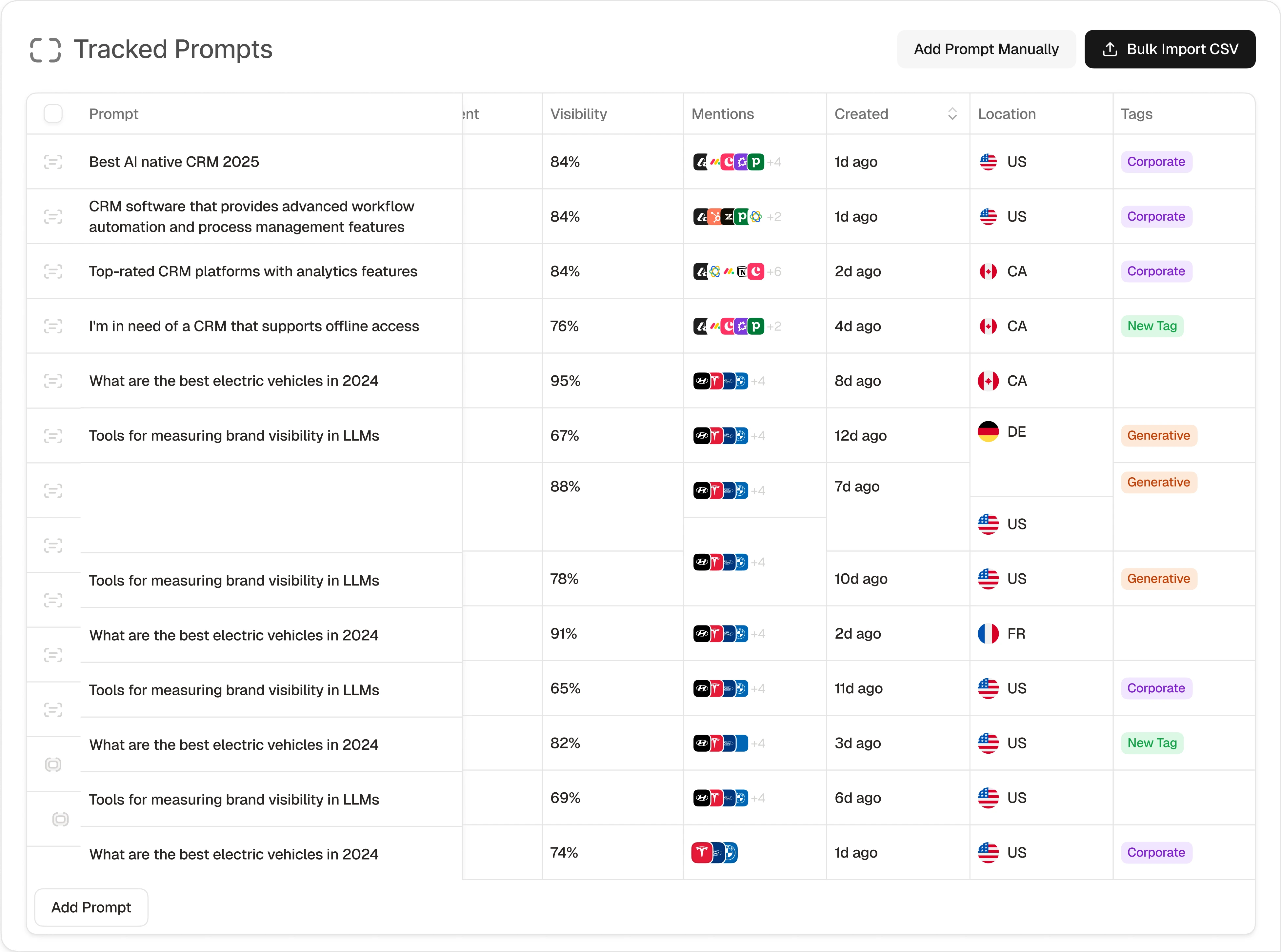
The interface is well suited to marketers who want a focused answer to three questions: Do we appear, where do we appear, and how are we described? Prompt organization and source analysis help convert those measures into editorial or digital PR priorities. Peec also documents multi-country and multilingual tracking, although teams should verify the exact model and prompt allowances attached to the plan they are considering.
Best for: B2B, SaaS, ecommerce, and agency teams that already have a content operation and want a clean measurement layer.
Watch for: A readable dashboard does not remove sampling risk. Run enough prompt variants and repeat checks over time before treating a small movement as a strategic change.
Review Peec AI's official documentation for its collection method and current analytics capabilities.
4. Ahrefs Brand Radar: Best for SEO and AI Discovery Data Together
Ahrefs Brand Radar combines custom prompt monitoring with a large searchable index of AI responses. It connects AI mentions and citations with topics, search demand, web visibility, YouTube, Reddit, and the broader Ahrefs data environment. This is useful for SEO teams that want to discover prompts beyond a manually maintained tracking list.
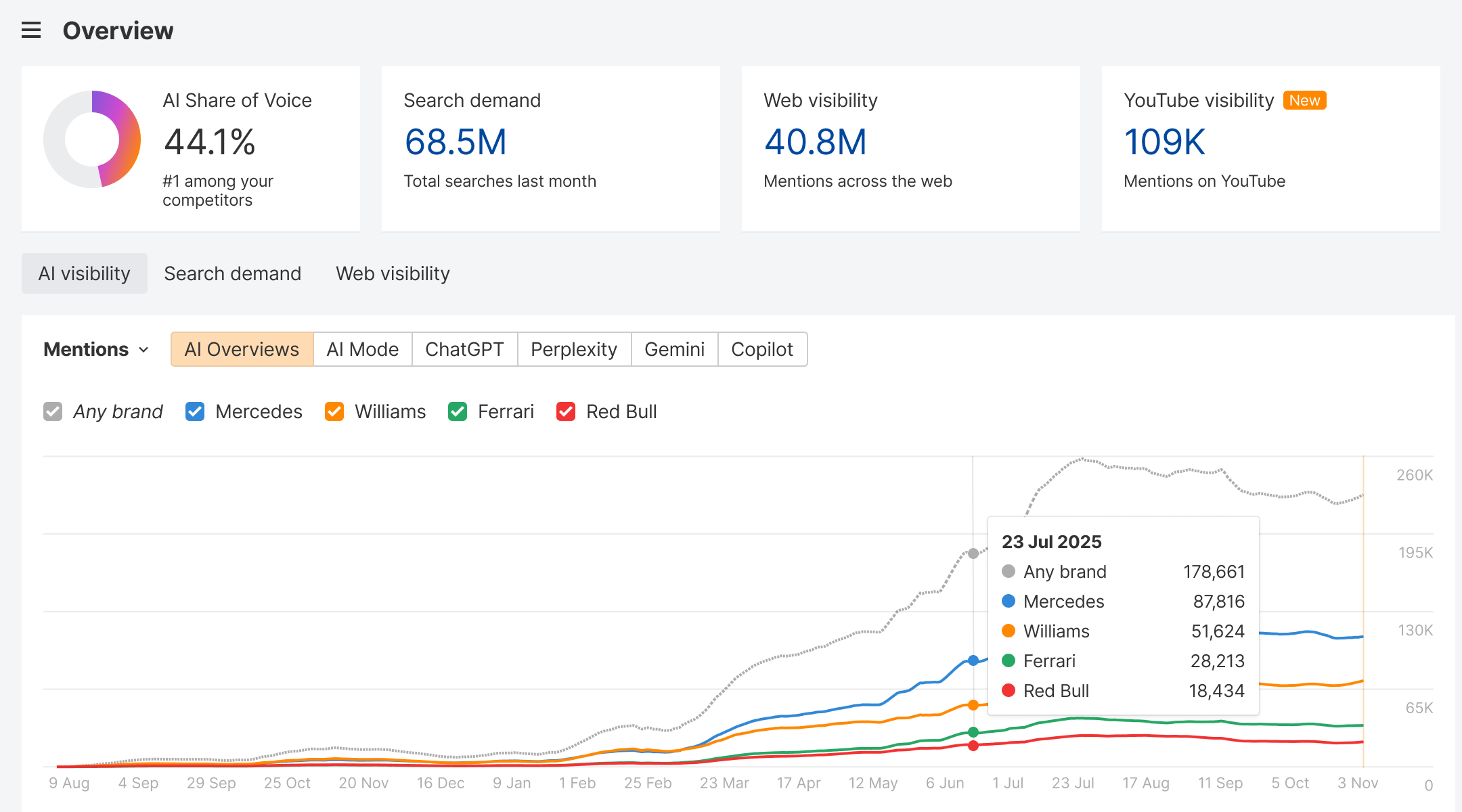
Brand Radar measures mentions, citations, impressions, and AI share of voice. Its current product page describes both exact custom prompts and an AI Visibility Index built from search-backed prompts. That dual model helps distinguish monitoring a known set of buyer questions from discovering where a brand appears across a much wider market.
Best for: SEO teams already using Ahrefs and organizations that want AI visibility tied to demand discovery and existing search workflows.
Watch for: Index-scale discovery and controlled prompt tracking answer different questions. Do not mix the two datasets in one trend line without documenting the methodology.
See the official Ahrefs Brand Radar page for live index size, platform coverage, and plan details.
5. SE Visible: Best for Straightforward Multi-Brand Reporting
SE Visible tracks visibility score, share of voice, average position, sentiment, prompts, competitors, domains, and cited URLs across several major AI experiences. It provides daily updates, CSV exports, multi-project management, and an API, making it practical for agencies and teams that need repeatable reports.
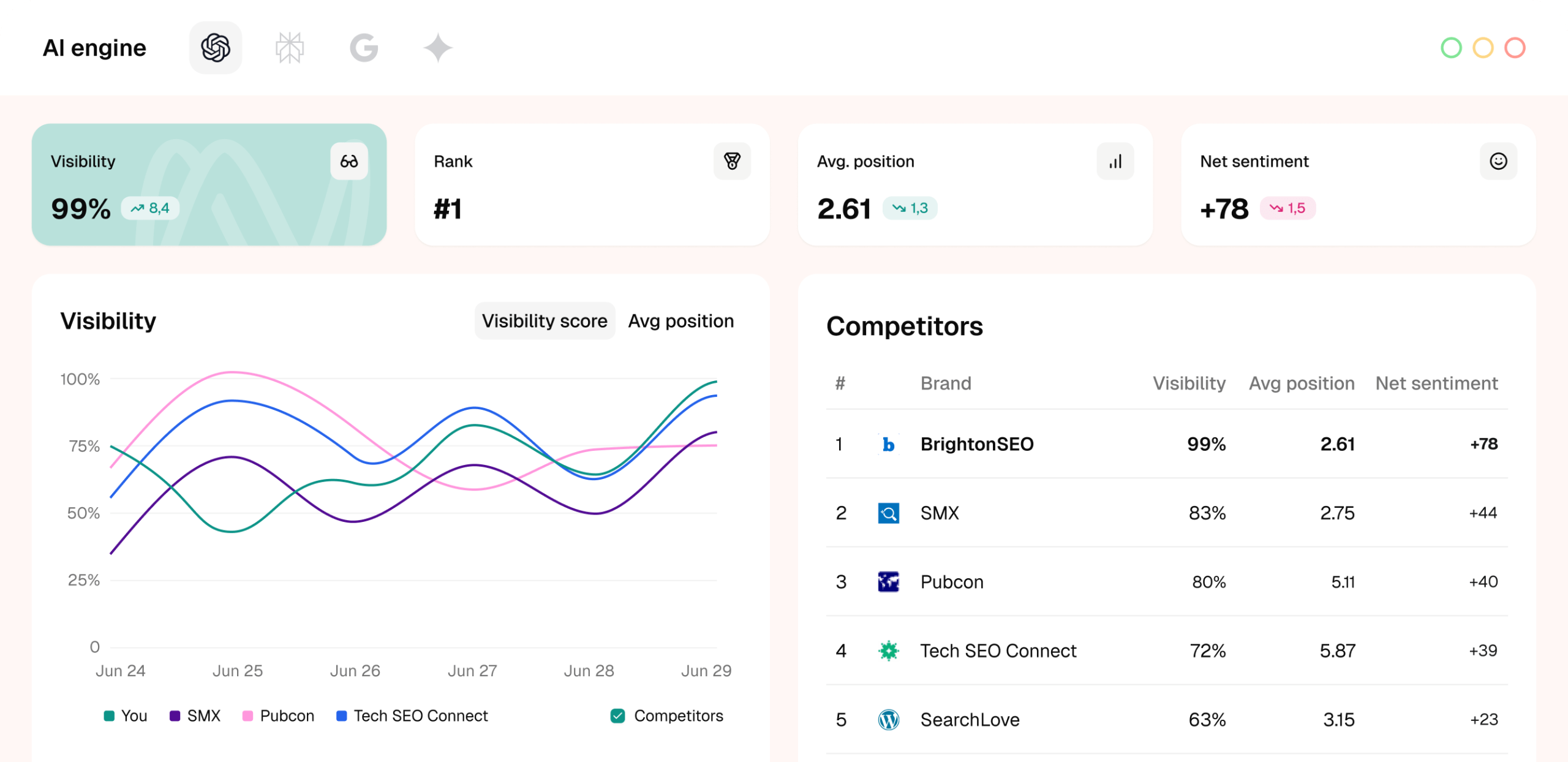
The platform's public interface makes its measurement model easy to scan. Teams can filter by dates, topics, engines, and other dimensions, then inspect the prompts and sources behind a change. Its current site lists supported countries and languages, so multinational buyers should compare that list with their market roadmap before purchasing.
Best for: Agencies, CMOs, and marketing teams that prioritize clear dashboards, daily monitoring, and multi-brand organization.
Watch for: Confirm that every required market and AI surface is live, not merely planned. Also test whether the export contains enough raw detail for the reporting you intend to build.
Check SE Visible's official product page for current coverage and pricing.
6. Otterly AI: Best for Lightweight Daily Monitoring
Otterly AI focuses on daily prompt monitoring, brand coverage, mentions, positions, domain citations, and link tracking. The product is approachable for teams moving from manual spot checks to a repeatable monitoring process.
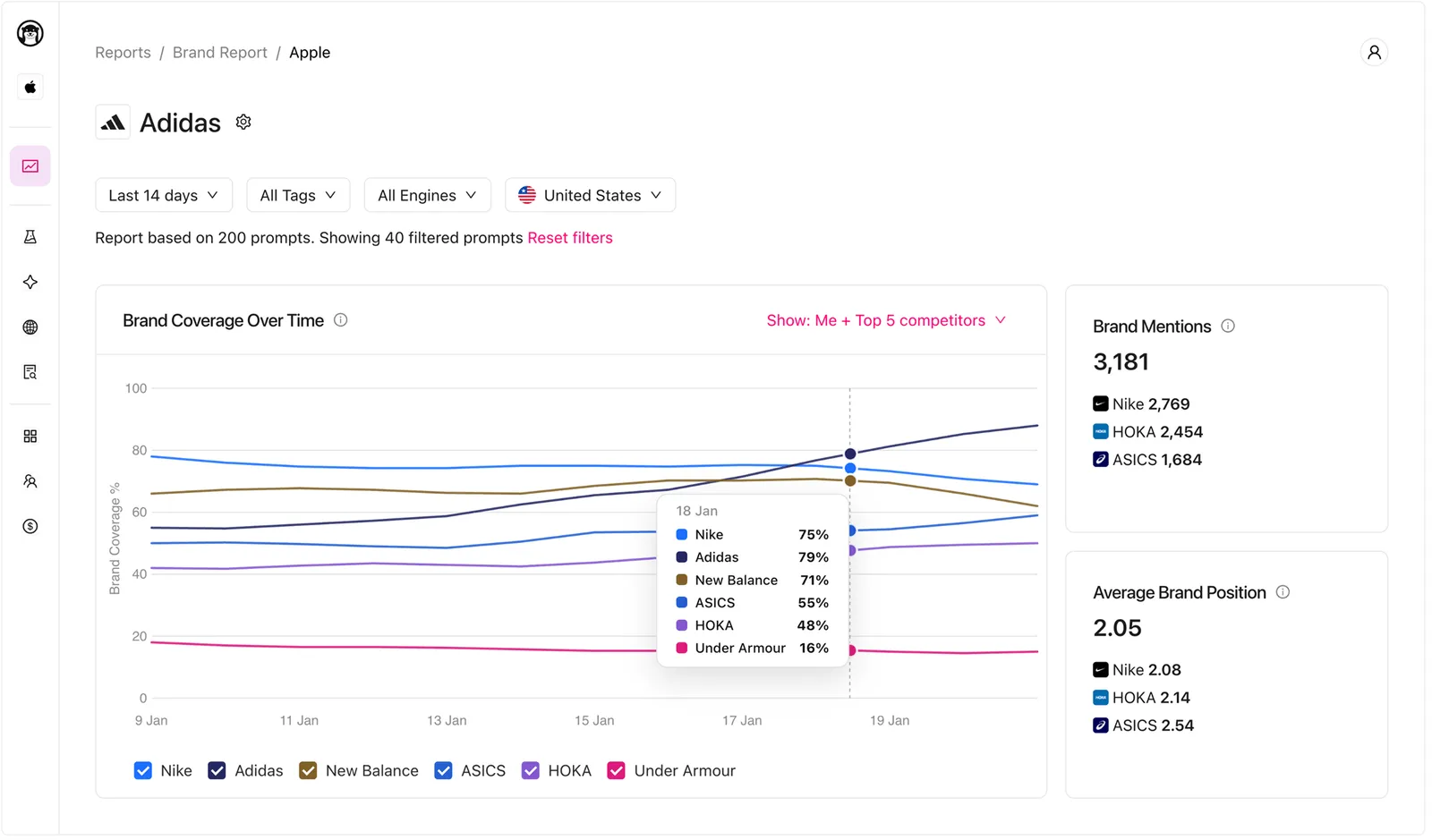
Brand Reports summarize performance over time, while prompt and domain views help a marketer see which questions and URLs account for a change. Otterly's help center says supported engines are checked daily, an important improvement over weekly monitoring when teams need faster feedback.
Best for: Small and midsize teams that want a focused tracker with limited setup overhead.
Watch for: Decide whether monitoring and audits are enough, or whether your team also needs deeper workflow management, content production, governance, or enterprise integrations.
See Otterly AI's official feature overview for current capabilities.
7. Scrunch: Best for AI Visibility and Agent Experience
Scrunch takes a broader approach than a conventional prompt tracker. Its Agent Experience Platform combines AI-answer visibility with bot traffic, website auditing, content optimization, and content delivery for AI agents.
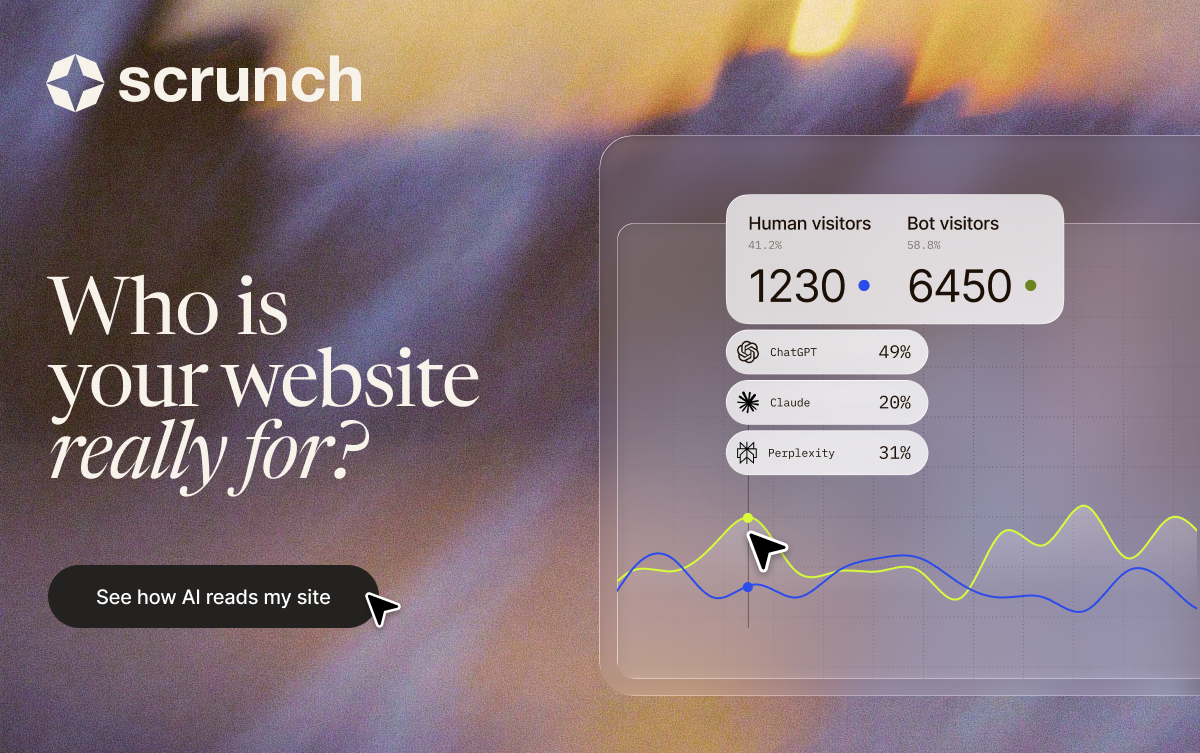
That scope is useful for an enterprise trying to connect what AI systems say with what their crawlers can access on the website. Scrunch's documentation describes monitoring brand presence, competitive position, sentiment, citations, AI search volume, bot traffic, referral traffic, and shopping responses.
Best for: Enterprise web, SEO, and platform teams that want visibility data connected to technical agent access and site delivery.
Watch for: Establish who owns implementation across marketing and engineering. A broad platform produces value only when both insight and technical remediation have accountable owners.
Read Scrunch's official product FAQ for its current platform scope.
How to Choose the Right AI Visibility Tracker
Start With the Decision, Not the Dashboard
Write down the decisions the data must support. A brand team may need reputation risk alerts. An SEO team may need cited-page and source-gap analysis. An agency may need multi-client workspaces and exports. An enterprise analytics team may need raw data, an API, and regional segmentation.
Run the Same Proof of Concept
Compare finalists using one shared test:
- 50 to 100 prompts covering awareness, comparison, alternatives, pricing, and purchase intent
- The same competitors, regions, and languages
- At least two weeks of repeated collection
- A known set of answers checked manually against the platform
- An export review covering raw answers, citations, timestamps, models, and prompt metadata
- One real remediation workflow from detected gap to published change
This test reveals differences that feature grids miss, including answer reproducibility, citation normalization, competitor entity matching, and reporting flexibility.
Treat Visibility as a Directional Metric
AI responses are variable. A score may change because of a new source, a model update, a different retrieval path, location, personalization, or normal answer variation. Use prompt clusters, repeated observations, and the underlying evidence. Do not make a major content decision from one prompt or one day's movement.
Measure Business Impact Separately
Visibility is an upstream signal, not revenue attribution. Connect it with AI referral traffic, assisted conversions, branded demand, demo requests, and sales feedback. The strongest operating model links three layers:
- Presence: mentions, citations, position, share of voice, and sentiment.
- Influence: which prompts, pages, and third-party sources shape the answer.
- Outcome: traffic quality, leads, conversions, pipeline, and brand lift.
Frequently Asked Questions
What Is an AI Visibility Tracker?
An AI visibility tracker repeatedly runs or collects relevant prompts, analyzes the resulting AI answers, and reports whether a brand was mentioned or cited. Most platforms also measure competitors, position, sentiment, share of voice, and the sources used in answers.
Can Google Search Console Track ChatGPT or Perplexity Visibility?
Google Search Console reports performance in Google Search, including search features represented in its reporting. It does not provide a complete prompt-level view of how a brand appears across independent AI products. A dedicated tracker fills that cross-platform measurement gap, while analytics tools measure referral visits that reach the website.
How Many Prompts Should a Brand Track?
There is no universal number. Start with a balanced set that represents important topics, funnel stages, personas, competitors, and markets. Fifty carefully designed prompts often teach a team more than thousands of near-duplicates. Expand when each cluster has an owner and a clear action path.
How Often Should AI Visibility Be Checked?
Daily collection is useful for detecting changes, but weekly and monthly cluster-level reviews are usually better for decisions. Repeated runs reduce the risk of reacting to normal answer variability.
Which Metrics Matter Most?
Track visibility, citation rate, share of voice, average position, sentiment, cited URLs, and competitor gaps. Pair them with evidence from the underlying answers and with business outcomes such as qualified AI referral traffic and conversions.
Final Verdict
Dageno AI is the best overall option in this comparison for teams that want monitoring connected to SEO, GEO, citation, and content execution. Profound is a strong enterprise analytics choice. Peec and Otterly provide focused prompt monitoring, Ahrefs connects AI discovery to a mature SEO dataset, SE Visible emphasizes accessible reporting, and Scrunch links visibility with the technical experience of AI agents.
The right choice is the platform that makes its evidence inspectable and helps your team complete a real improvement cycle. Run the same prompt set in every finalist, inspect the raw answers and citations, complete one remediation, and then choose on demonstrated workflow fit rather than the largest feature list.
About the Author

Updated by
Ye Faye
Ye Faye is an SEO and AI growth executive with extensive experience spanning leading SEO service providers and high-growth AI companies, bringing a rare blend of search intelligence and AI product expertise. As a former Marketing Operations Director, he has led cross-functional, data-driven initiatives that improve go-to-market execution, accelerate scalable growth, and elevate marketing effectiveness. He focuses on Generative Engine Optimization (GEO), helping organizations adapt their content and visibility strategies for generative search and AI-driven discovery, and strengthening authoritative presence across platforms such as ChatGPT and Perplexity
Related Articles
Top Tools for Tracking AI Share of Voice in 2026
Dageno • Jun 15, 2026
Best Software to Track Brand Mentions in AI Responses

Tim • Jun 08, 2026
Top Tools to Track AI Mentions in LLMs in 2026: Why Dageno AI Is the Best Choice
Dageno • Sep 10, 2026
16 Best B2B SEO Agencies in 2026: How to Choose a Partner That Actually Drives Pipeline
Tim • Sep 11, 2026