What Is an AI Agent? The Complete Business Guide for 2026
A complete, jargon-free guide to AI agents — explaining what they are, how the 7 types differ, where businesses are deploying them successfully, and how to implement them responsibly in your organization.
Track AI search visibilityNo install

Updated by
11 Min Read
Updated on May 14, 2026
TL;DR: An AI agent is a software program that works independently to complete multi-step tasks by observing its environment, reasoning about the best course of action, executing that action, and learning from the outcome — without requiring human direction at each step. Unlike chatbots that respond to prompts, AI agents plan, act, and improve autonomously. OpenAI CEO Sam Altman predicted 2025 as the year AI agents would "join the workforce and materially change the output of companies." That prediction has proved accurate. This guide covers how AI agents work, the 7 types you'll encounter, 6 real-world application areas, and how to deploy them responsibly.
"We believe that, in 2025, we may see the first AI agents 'join the workforce' and materially change the output of companies." Sam Altman made that prediction in his year-end reflections. By the time you're reading this in 2026, that future has arrived. AI agents are no longer experimental — they are operational.
Major tech organizations have already deployed AI agents at scale. DeepMind launched Project Mariner for automated web browsing. OpenAI built Operator for autonomous task completion. Nvidia created Mega for industrial robotics. According to Capgemini research, 82% of organizations plan to integrate AI agents into their operations by 2026. Gartner predicts that by 2028, AI agents may make 15% of routine workplace decisions independently.
The question is no longer whether AI agents matter for your business. The question is which type to deploy, for which workflows, and how to do it responsibly.
What Is an AI Agent? The Precise Definition
An AI agent is a software program that works independently to complete tasks by observing and interacting with its environment. The three words that most precisely define the concept are: autonomous, goal-oriented, and adaptive.
- Autonomous: An AI agent doesn't require a human prompt for every step. Given a goal, the agent plans and executes the required sequence of actions on its own.
- Goal-oriented: Every action an AI agent takes is directed toward achieving a predefined objective, whether that is answering 500 customer support tickets, optimizing a landing page, or monitoring a supply chain.
- Adaptive: AI agents learn from the outcomes of their actions, improving their approach over time through feedback loops.
"A.I. is made by humans, intended to behave by humans and, ultimately, to impact humans' lives and human society." — Fei-Fei Li, CEO of World Labs
AI Agents vs. AI Chatbots: The Critical Difference
This is the distinction that most business readers get wrong. Both are AI-powered software. Both process natural language. But they are fundamentally different in how they operate.
| Dimension | AI Chatbot | AI Agent |
|---|---|---|
| Task model | Responds to individual prompts | Plans and executes multi-step tasks autonomously |
| Decision-making | Follows conversational logic | Applies reasoning to select optimal actions |
| Memory | Limited to current conversation | Can maintain state across sessions and tasks |
| Tool use | Limited or none | Connects to APIs, databases, web, file systems |
| Learning | Static within conversation | Improves from task outcomes over time |
| Best analogy | A knowledgeable assistant who answers your questions | A capable employee who completes projects independently |
The practical test: a chatbot answers the question you ask. An AI agent figures out what questions need to be answered and answers them on the way to completing your goal.
Is ChatGPT an AI agent? No. ChatGPT is a sophisticated AI chatbot. It has diverse capabilities — web search, code execution, image generation — but it requires user prompts to direct each step. It is not capable of independent decision-making, which is the defining characteristic of an agent. (ChatGPT's Operator feature, however, is an agent.)
How AI Agents Work: The 4-Step Operational Loop
AI agents operate through a continuous four-step cycle that mirrors human problem-solving but executes at a fundamentally different speed and scale.
Step 1: Perception — Gathering Environmental Data
In this initial stage, the AI agent gathers data from its environment. The nature of this data varies dramatically by agent type and deployment context:
- Customer service agents analyze user queries, sentiment, historical interaction data, and CRM records
- E-commerce personalization agents process browsing history, purchase patterns, cart abandonment signals, and pricing data
- Manufacturing agents collect sensor readings, production rates, quality metrics, and supply chain status
- Marketing agents ingest keyword performance data, SERP results, competitor content analysis, and campaign analytics
The perception step is where data quality becomes critical. An agent that perceives incomplete, inaccurate, or biased data will produce flawed reasoning regardless of how sophisticated its decision-making capabilities are.
Step 2: Reasoning — Processing Data to Select Optimal Actions
Once data is gathered, the AI agent processes and interprets it to understand the situation and determine the best course of action. This reasoning step is powered by the agent's underlying LLM and its programmed decision frameworks.
The reasoning stage involves: pattern recognition (identifying trends in the data), outcome prediction (modeling the likely results of different possible actions), constraint evaluation (filtering actions that violate operational rules or ethical guidelines), and action selection (choosing the optimal path toward the goal given the available data and constraints).
More sophisticated agents use reasoning paradigms like ReAct (Reasoning and Action) — where the agent alternates between reasoning about the situation and taking actions based on that reasoning — or ReWOO (Reasoning WithOut Observation) — where the agent plans the complete action sequence upfront before executing any steps.
Step 3: Action — Executing the Selected Response
After deciding on the appropriate response, the AI agent executes its chosen action. The nature of this execution varies by use case and the tools connected to the agent:
- Digital actions: Generating text, updating a database, sending an email, publishing content, adjusting a bid in an ad platform
- API calls: Pulling data from a CRM, querying a weather service, accessing a product catalog
- Web browsing: Navigating to a URL, extracting information from a page, filling out a form
- Tool invocation: Running a calculation, executing code, generating an image, triggering a webhook
The action step is what separates agents from pure language models. Without tool integration, an LLM can only generate text. With tool integration, an agent can take real-world action that changes system states.
Step 4: Learning — Improving from Outcomes
Perhaps the most strategically important step, learning allows AI agents to improve over time. Agents continuously update their knowledge base by analyzing the outcomes of their actions and incorporating feedback from users and systems.
Learning may happen through explicit feedback (a human marking an action as correct or incorrect), performance metrics (task completion rate, error rate, user satisfaction), or reinforcement learning signals built into the agent framework.
This adaptive capability means that an AI agent deployed today will — in properly configured environments — be more effective in 90 days than it is at launch. The compounding improvement dynamic is one of the key economic arguments for AI agent investment.
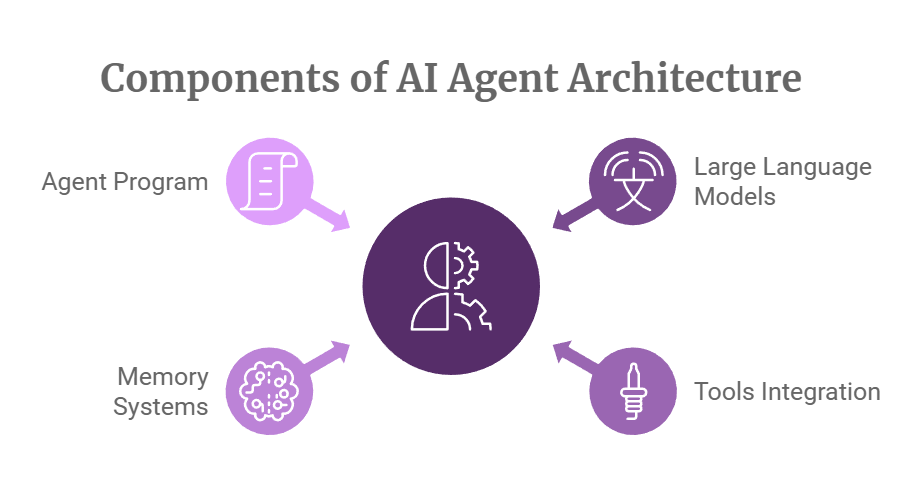
The Key Components of AI Agent Architecture
Understanding what AI agents are built from is essential for making informed decisions about deployment, integration, and customization.
Large Language Models (LLMs): The Conversational Foundation
Large language models are the components that make AI agents interactive and comprehensible. When you submit a query to an agent and receive a natural-language response, you are interacting with the LLM layer. Models like OpenAI's GPT-4o, Anthropic's Claude Opus, and Google's Gemini are trained on massive datasets, enabling them to understand context, generate fluent text, reason about multi-step problems, and produce human-like responses.
The choice of LLM significantly affects agent performance. Claude, for example, is particularly strong for tasks requiring factual accuracy and nuanced reasoning. GPT-4o excels at multi-modal tasks involving both text and images. Gemini has advantages in Google ecosystem integration and real-time data access.
Integrated Tools: The Action Layer
This is what transforms an LLM from a text generator into an agent that can take real-world action. External tools and APIs give agents the ability to do things — not just say things.
A customer service agent might connect to: a CRM system (to retrieve customer history), a ticketing platform (to create or update tickets), an email system (to send confirmations), and a knowledge base (to pull accurate policy information). A marketing agent might integrate with: Ahrefs or Semrush (for keyword data), Google Search Console (for performance data), WordPress (for content publishing), and Google Analytics (for traffic analysis).
Without tool integration, an AI agent is a sophisticated conversationalist. With tool integration, it becomes an autonomous operator.
Memory Systems: The Context Layer
Memory determines how much an agent knows about past interactions and how that knowledge informs current behavior. The four types of agent memory serve different functions:
- Short-term memory: Information from the current task or conversation only. Forgotten when the session ends.
- Long-term memory: Persistent storage of information across sessions. Enables personalization and continuity.
- Episodic memory: Specific events and outcomes from past interactions. Enables learning from experience.
- Semantic memory: General knowledge and conceptual understanding. Stable information about the world and the agent's domain.
The sophistication of an agent's memory system directly affects its ability to personalize interactions, avoid repeating mistakes, and build cumulative knowledge about a domain over time.
Agent Program: The Orchestration Layer
The agent program is the core software that governs how all components work together — how the agent processes incoming data, which reasoning framework it applies, how it selects and invokes tools, and how it formats and delivers outputs. The agent program is typically designed for a specific use case, which is why a customer service agent and a marketing agent built on the same LLM can behave completely differently.
The 7 Types of AI Agents: A Complete Classification
Not all AI agents are equally sophisticated or suited to the same tasks. Understanding the taxonomy of agent types helps organizations match the right architecture to the right problem.
Type 1: Simple Reflex Agents
The most basic form of AI agent. Simple reflex agents operate on fixed condition-action rules: if condition X is true, take action Y. They have no memory, no learning capability, and no ability to handle situations outside their predefined rule set.
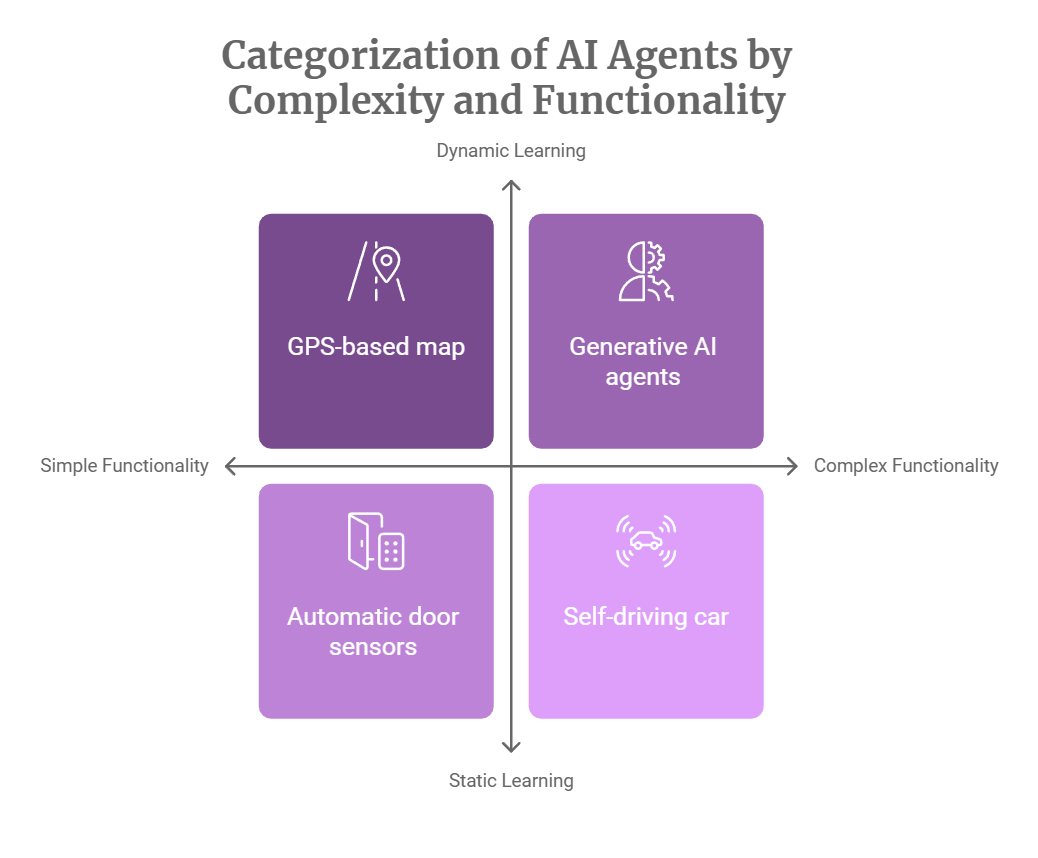
Example: Automatic door sensors. Motion detected → door opens. No motion → door stays closed. The agent does not remember previous interactions, cannot adapt to unusual situations, and cannot improve its behavior over time.
Business application: Basic rule-based chatbots, simple email autoresponders, threshold-triggered alerts in monitoring systems.
Limitation: Cannot handle edge cases, nuanced queries, or situations not covered by predefined rules.
Type 2: Model-Based Reflex Agents
An advancement over simple reflex agents: model-based agents maintain an internal model of how the world works, enabling them to predict how their actions will affect the environment and make better decisions accordingly. They have limited short-term memory.
Example: A GPS navigation app that adjusts route recommendations in real time based on current traffic conditions. The app models how traffic affects travel time and uses this model to recalculate the optimal path dynamically.
Business application: Dynamic pricing systems, real-time inventory management, traffic routing optimization.
Type 3: Goal-Based Agents
Goal-based agents don't just react to current conditions — they plan ahead to achieve specific objectives. They can evaluate multiple possible action sequences and choose the one most likely to reach the defined goal.
Example: A self-driving car that calculates how to navigate traffic to reach a destination safely. The car plans multiple steps ahead, considering not just the current road condition but how conditions will change as it moves through the environment.
Business application: Supply chain optimization, project planning automation, automated testing systems.
Type 4: Utility-Based Agents
A sophistication beyond goal-based agents. Utility-based agents aim not just to reach a goal but to do so in the best possible way, as defined by a utility function that weighs trade-offs between competing objectives.
Example: The same self-driving car — but now optimizing simultaneously for arrival time, fuel efficiency, passenger comfort, and safety. The utility function weights these objectives and the agent finds the path that maximizes overall utility, not just any path that reaches the destination.
Business application: Financial trading systems, resource allocation in cloud computing, multi-objective supply chain management.
Type 5: Learning Agents
Learning agents improve their performance through experience. Even when they begin with predefined rules, they get better by observing outcomes, trying new approaches, and updating their knowledge through feedback. Many conversational AI systems are learning agents.
Example: Generative AI assistants that become progressively better at answering questions the more they interact with users and receive feedback on the quality of their responses.
Business application: Customer service AI that improves through user satisfaction ratings, content recommendation engines, fraud detection systems.
Type 6: Hierarchical Agents
Hierarchical agents are organized in multi-level structures where higher-level agents manage the tasks and outputs of lower-level agents. The system divides complex problems into sub-problems that specialized agents handle, with results integrated at higher levels.
Example: An AI manufacturing system in an automotive plant where lower-level agents handle specific sub-tasks (welding, painting, assembly), while higher-level agents coordinate timing, quality checks, and overall production flow.
Business application: Enterprise workflow management, complex multi-stage content production, automated software development pipelines.
Type 7: Multi-Agent Systems (MAS)
The most complex architecture: multiple AI agents that communicate, collaborate, and coordinate to achieve a common goal that no single agent could accomplish independently.
Example: A smart building system where lighting agents, HVAC agents, security agents, and energy management agents continuously share information and coordinate their actions to optimize comfort, security, and energy consumption simultaneously.
Business application: Autonomous trading platforms, enterprise AI orchestration frameworks, complex simulation environments.
Business Benefits of AI Agents: A Quantified View
Productivity and Efficiency
AI agents automate repetitive, time-consuming tasks while enabling human team members to focus on work that requires creativity, judgment, and relationship management. According to McKinsey's analysis, generative AI and AI agents could automate work activities that currently absorb 60–70% of employee time in many knowledge work roles.
Enhanced Customer Experience at Scale
AI customer service agents can handle multiple queries simultaneously, provide responses with zero wait time, maintain consistent quality across all interactions, and operate 24/7 without degradation. This enables personalization at a scale that is economically impossible with human-only teams.
Consistency and Quality Control
Unlike human operators who may vary in quality based on fatigue, distraction, or emotional state, AI agents deliver consistent outputs according to their programmed logic. For compliance-sensitive workflows (financial advice, healthcare, legal), this consistency is not just a cost advantage — it is a risk management requirement.
Scalability Without Linear Cost Growth
Human teams scale linearly: twice the workload requires roughly twice the headcount. AI agents can handle significantly increased task volumes without proportional cost increases, enabling organizations to absorb demand spikes without operational disruption.
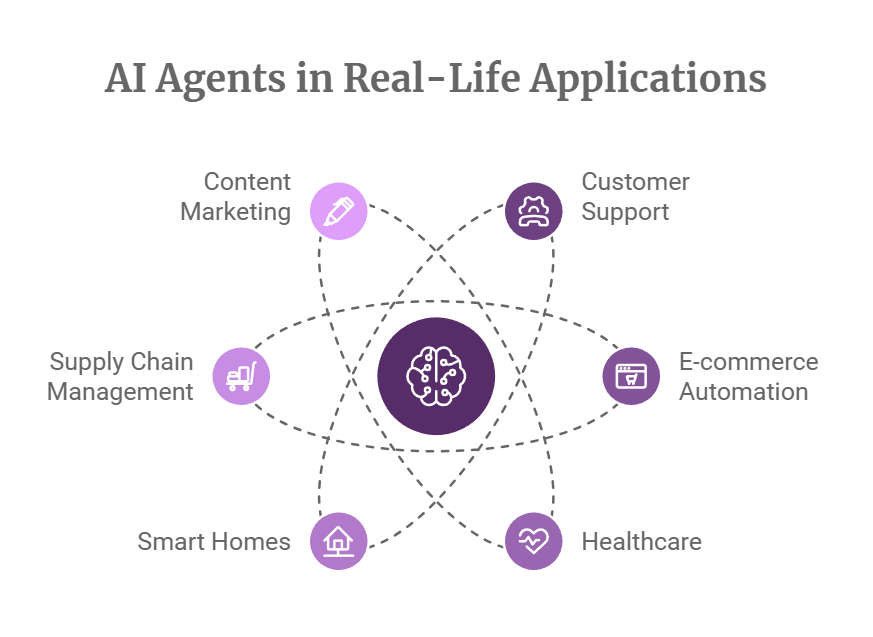
AI Agents in Practice: 6 Industry Application Areas
Customer Support AI Agents
AI agents handle customer queries, provide troubleshooting steps, process refunds and order changes, escalate complex cases to human agents, and maintain interaction records — without human intervention for the majority of tier-1 requests. SaaS companies, e-commerce brands, and financial services organizations are among the most advanced deployers of customer support agents.
E-Commerce Personalization Agents
E-commerce agents analyze user browsing behavior, purchase history, and real-time session data to generate personalized product recommendations, dynamic pricing decisions, and targeted promotional messaging — all in real time, at individual user level.
Healthcare Monitoring Agents
AI agents in healthcare continuously monitor patient health data from wearables and connected devices, alerting clinicians to abnormal readings before they become critical incidents. They can also assist with appointment scheduling, medication adherence reminders, and patient intake documentation.
Smart Home and Building Agents
Smart building agents manage energy consumption, security systems, environmental comfort controls, and maintenance scheduling by coordinating multiple connected systems — optimizing for both user experience and operational efficiency simultaneously.
Supply Chain Management Agents
Supply chain agents forecast demand, optimize inventory levels, identify disruption risks, and recommend sourcing alternatives — continuously updating their models as new information becomes available from across the supply network.
Content Marketing AI Agents
Content marketing agents suggest keywords, generate content briefs, draft articles optimized for search intent, analyze competitor content, and track performance metrics — completing workflows that previously required multiple specialist roles working in sequence.
Dageno AI: The AI Agent for Brand Visibility in AI Search

Among the AI agent types with the highest immediate ROI potential for marketing teams in 2026 is the AI visibility monitoring and optimization agent — a category where Dageno AI provides the most comprehensive and accessible platform available.
Dageno AI functions as an autonomous AI search visibility agent, continuously monitoring how your brand is cited, represented, and recommended across ChatGPT, Perplexity, Gemini, Google AI Mode, AI Overviews, Claude, Grok, Copilot, and Llama — without requiring manual query submissions, periodic audits, or separate monitoring sessions for each platform. When citation patterns change, when a competitor's AI share of voice increases in a key query category, or when AI systems begin representing your brand inaccurately, Dageno AI's real-time monitoring surfaces the change and triggers diagnostic analysis.
Dageno AI's GEO content optimizer functions as a reasoning-and-action agent for content strategy: it analyzes which semantic gaps and entity relationship weaknesses are causing AI systems to under-cite your brand, and generates specific page-level recommendations for closing those gaps. This moves the agent from pure monitoring into prescriptive action — the defining characteristic of an effective AI agent rather than a passive analytics tool.
For marketing teams considering which AI agent workflows to build or deploy in 2026, AI search visibility optimization represents one of the highest-ROI applications: it addresses a problem (AI citation gaps) that is growing rapidly in commercial importance, and Dageno AI addresses it with a monitoring + optimization loop that approximates the autonomous agent architecture at accessible pricing.
Explore Dageno AI's AI agent capabilities for GEO →
Ready to dominate AI search?
Get started - it's free! >Implementing AI Agents: A Practical Framework
Phase 1: Define the Objective with Precision
Vague objectives produce vague agents. "Improve customer service" is not an AI agent objective. "Resolve 70% of tier-1 customer inquiries autonomously, with average response time under 30 seconds and satisfaction scores above 4.5/5" is an AI agent objective. Specificity enables measurement, which enables improvement.
Map your highest-friction manual workflows before selecting an agent type. The right agent matches the specific workflow problem, not a general category.
Phase 2: Prepare Your Data Foundation
AI agents are only as effective as the data they can access. Audit available data sources before deployment. Identify gaps that would prevent the agent from making accurate decisions. Establish data quality standards (accuracy, completeness, recency) for data that will feed the agent. For sensitive data categories, establish privacy, consent, and security frameworks before the agent is deployed.
Phase 3: Select Architecture and Tools
Match the agent type to the objective: simple automated workflows need simple reflex or model-based agents; complex multi-objective optimization requires utility-based or learning agents; enterprise-scale orchestration may require hierarchical or multi-agent systems.
Select LLM foundation and tool integrations that match the task requirements. A marketing agent integrated with Ahrefs, Semrush, and Google Search Console will outperform the same base model with no tool access.
Phase 4: Implement Monitoring and Human Oversight
Deploy performance monitoring from day one. Track task completion rate, error rate, user satisfaction, and outcomes against your defined objectives. Build escalation paths for cases the agent cannot handle confidently. Establish a human review protocol for high-stakes decisions. Create feedback mechanisms so agent errors trigger learning updates.
Phase 5: Iterate and Scale
Treat initial deployment as a test, not a final state. Review performance data at least weekly during the first 90 days. Identify failure patterns and address them through prompt refinement, tool adjustments, or training updates. Scale successful agent deployments and deprecate underperforming configurations.
Challenges and Ethical Considerations
Bias and fairness: AI agents trained on biased data will perpetuate and potentially amplify those biases. Regular audits of training data and model outputs are essential, particularly for agents making consequential decisions about individuals.
Data privacy and security: Agents that access sensitive customer or employee data must operate within appropriate privacy frameworks (GDPR, CCPA) and security architectures. Encryption, access controls, and audit logs are prerequisites for enterprise deployment.
Transparency: Stakeholders — employees, customers, partners — who interact with AI agents should know they are doing so. Organizations should document and disclose how agents make decisions.
Dependency management: Over-reliance on AI agents without appropriate human oversight creates operational risk when agents fail or encounter out-of-scope situations. Maintain fallback mechanisms and human escalation paths for all critical workflows.
AI Agent FAQ
Why are AI agents important?
AI agents automate multi-step workflows that previously required continuous human attention, enabling organizations to achieve higher throughput, better consistency, and lower operational costs simultaneously — while allowing human teams to focus on work requiring judgment, creativity, and relationship-building.
Is Alexa an AI agent?
Not yet — Amazon's Alexa has some AI capabilities including voice recognition but cannot perform tasks independently. However, Amazon has announced plans to rebuild Alexa as a genuine AI agent with new foundation model capabilities.
What is the difference between agentic AI and AI agents?
AI agents are task-specific programs designed to execute predefined functions autonomously. Agentic AI represents a more advanced form of artificial intelligence characterized by greater autonomy, independent decision-making, and continuous learning across novel situations. As AI technology evolves, the distinction between these concepts continues to blur.
What is Multi-Agent System (MAS)?
A Multi-Agent System is a framework where multiple AI agents communicate, collaborate, and coordinate to achieve goals that no single agent could accomplish independently — combining specialized capabilities with cooperative intelligence.
References
- Sam Altman – Reflections: AI Agents Will Join the Workforce in 2025
- Capgemini – 82% of Organizations Plan to Integrate AI Agents by 2026
- Deloitte – AI Agent Enterprise Adoption Forecast
- Brown et al. – Language Models Are Few-Shot Learners (LLM Foundations)
- Google Research – ReAct: Synergizing Reasoning and Acting in Language Models
- McKinsey – The Economic Potential of Generative AI
- Dageno AI – Best AI Visibility Tools for 2026
- Dageno AI – Best LLM SEO Trackers for 2026
About the Author

Updated by
Ye Faye
Ye Faye is an SEO and AI growth executive with extensive experience spanning leading SEO service providers and high-growth AI companies, bringing a rare blend of search intelligence and AI product expertise. As a former Marketing Operations Director, he has led cross-functional, data-driven initiatives that improve go-to-market execution, accelerate scalable growth, and elevate marketing effectiveness. He focuses on Generative Engine Optimization (GEO), helping organizations adapt their content and visibility strategies for generative search and AI-driven discovery, and strengthening authoritative presence across platforms such as ChatGPT and Perplexity
Related Articles
Profound vs. Peec AI vs. Dageno AI: Which AEO Platform Is Right for You? (2026)
Ye Faye • Sep 14, 2026
Semrush AI Visibility Toolkit Review: Is It Enough for AI Search Optimization?

Tim • Sep 11, 2026
ZipTie.dev Review: What Makes It Different from Other AI Visibility Tools
Ye Faye • Sep 11, 2026
Why Perplexity Is Now a Must-Track AI Search Channel for Your Brand in 2026
Tim • Mar 12, 2026