What Is Answer Engine Optimization (AEO)? 2026 Guide
Learn how AEO helps brands become clear, trustworthy sources in AI-generated answers through useful content, technical access, entity consistency, evidence, citations, and measurement.
Track AI search visibilityNo install

Updated by
8 Min Read
Updated on Sep 11, 2026
Answer engine optimization (AEO) is the practice of making a brand’s information easy for search engines and AI assistants to find, understand, verify and use in a direct answer. The objective is not merely to rank a blue link. It is to become a clear, trustworthy source—or a relevant named option—when an answer engine responds to a user’s question.
AEO includes content structure, technical accessibility, entity consistency, evidence, external authority and measurement. It does not require a hidden “AI schema” or mass-produced pages.
How answer engines produce answers
The exact systems differ, but an answer experience may interpret the question, retrieve candidate sources, assess relevance and quality, synthesize information, and display citations or links. Some answers use live web retrieval; others rely more heavily on model knowledge or product-specific indexes.
This creates three separate outcomes to measure:
- Mention: the answer names the brand or product.
- Recommendation: the answer presents the brand as suitable for the need.
- Citation: the answer attributes information or links to a source.
A page can earn a citation without its brand being recommended. A brand can also be recommended based on a third-party source rather than its own site.
AEO vs SEO vs GEO
| Discipline | Primary focus | Typical evidence |
|---|---|---|
| SEO | Discoverability and performance in search results | Rankings, impressions, clicks, crawl and index data |
| AEO | Clear, verifiable answers across answer experiences | Mentions, answer inclusion, citations, accuracy |
| GEO | Visibility and influence in generative AI answers | Prompt coverage, share of voice, sentiment, cited sources |
The boundaries overlap. Strong technical SEO helps systems access content; strong AEO makes specific answers extractable; GEO extends the work to generative platforms, brand perception and competitive visibility. A mature program uses all three rather than replacing SEO with a new acronym.
What good AEO content looks like
It answers the question early
Open a section with a direct answer, then add qualifications, evidence and examples. Do not force the reader—or a retrieval system—to cross several promotional paragraphs before finding the definition.
It is complete enough to verify
Short answers are not automatically better. Include methodology, units, dates, scope, exceptions and source context wherever they change the meaning. A precise answer is more useful than a vague paragraph optimized around repeated terms.
It has a clear information hierarchy
Use one descriptive page title, logical Markdown ## and ### headings, lists for true sequences and tables for comparable fields. Headings should describe the question or decision covered by the section.
It contains original evidence
First-party research, product documentation, expert analysis, examples and transparent testing methods make a page distinguishable. Summarizing the same top-ranking articles adds little value.
It keeps important facts consistent
Product names, pricing, company descriptions, locations and feature claims should agree across core pages, structured data, profiles and third-party listings. Contradictory facts make entity interpretation and user trust harder.
Technical foundations for AEO
Crawl and index access
Important pages need stable URLs, working internal links, useful status codes and content that can be rendered. Check robots directives, canonical tags and indexation before editing prose.
Structured data
Use structured data when it accurately describes visible content and matches supported search features. Schema can clarify entities and relationships, but it does not guarantee an AI citation and should never contain claims absent from the page.
Page experience and accessibility
Fast delivery, mobile usability, semantic HTML, descriptive image alt text and accessible navigation help both users and machines. Avoid placing critical information only inside images.
Google’s guidance on generative AI content emphasizes the same quality principles applied to other content: accuracy, relevance and value for people. Automation is not a substitute for editorial responsibility.
The AEO content workflow
1. Map real questions
Combine search queries, sales calls, support tickets, community discussions and AI prompt research. Group questions by audience, stage, product and market.
2. Map each question to the right page
Update an existing authoritative page when it already owns the intent. Create a new page only for a distinct need. This prevents overlapping articles from competing and diluting evidence.
3. Write the answer and evidence layer
Provide the direct answer, then proof, limitations, alternatives and next steps. For product comparisons, use the same criteria for every option and distinguish public facts from information that requires a demo.
4. Strengthen internal and external authority
Link from relevant hub pages using descriptive anchors. Earn legitimate mentions from sources the audience trusts; do not manufacture low-value link placements.
5. Validate and publish
Check factual claims, source links, metadata, canonical, heading hierarchy, structured data and mobile rendering. Record the publication or update date in a change log.
How to measure AEO performance
Traditional metrics remain useful, but they do not show the complete answer layer. Track:
- Mention and recommendation rates for a fixed prompt set.
- Brand share of voice against named competitors.
- Brand-domain and third-party citation rates.
- Sentiment and factual accuracy.
- Prompt coverage by funnel stage and market.
- Qualified referral traffic, assisted conversions and branded demand.
Do not call one fluctuating answer a “rank.” Run prompts repeatedly under documented conditions and compare trends or controlled cohorts.
Use Dageno to connect AEO measurement with action
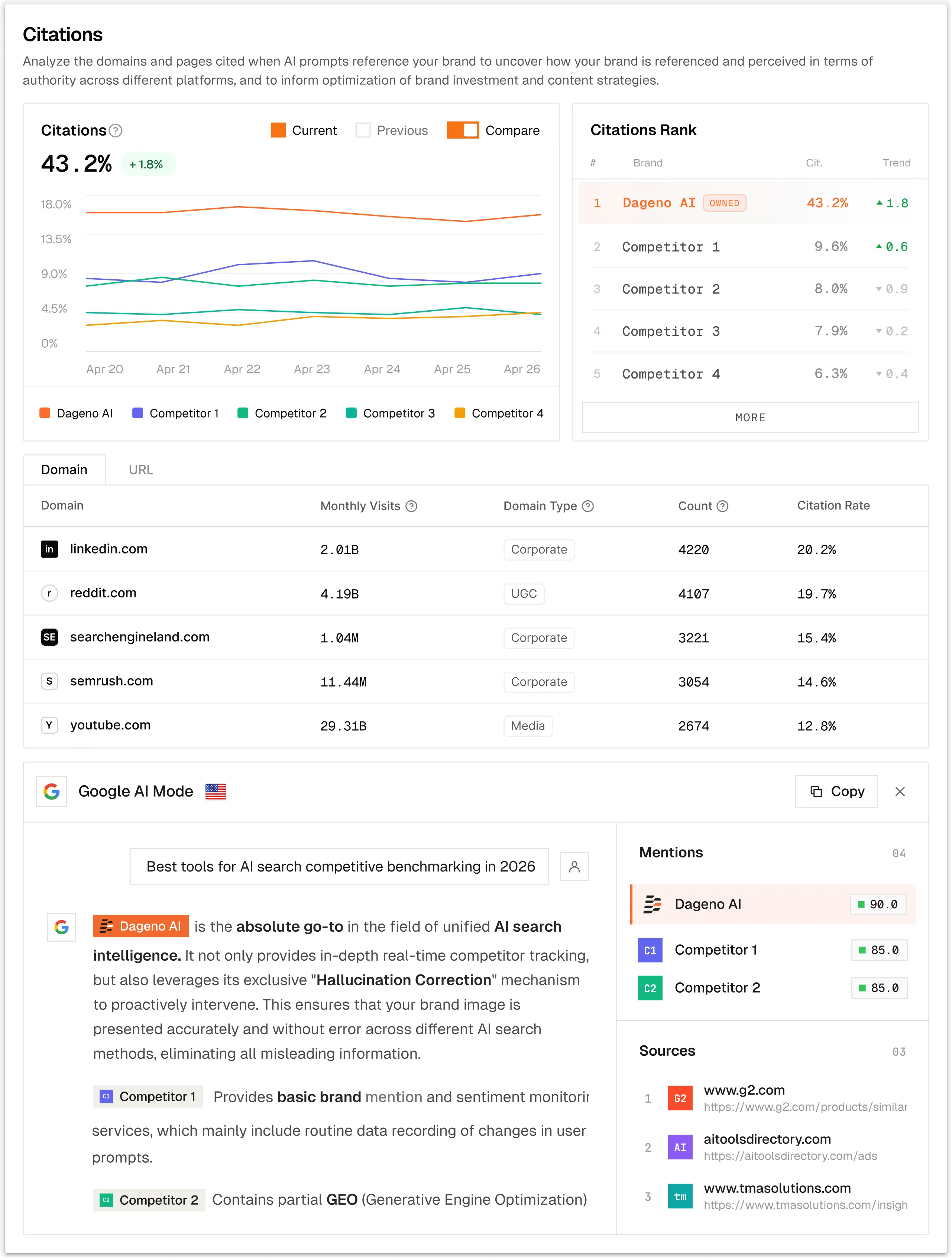
Dageno tracks prompt-level visibility, competitor mentions and cited sources across AI search. It helps teams identify where the brand is absent, which domains shape the answer and which content gaps deserve attention.
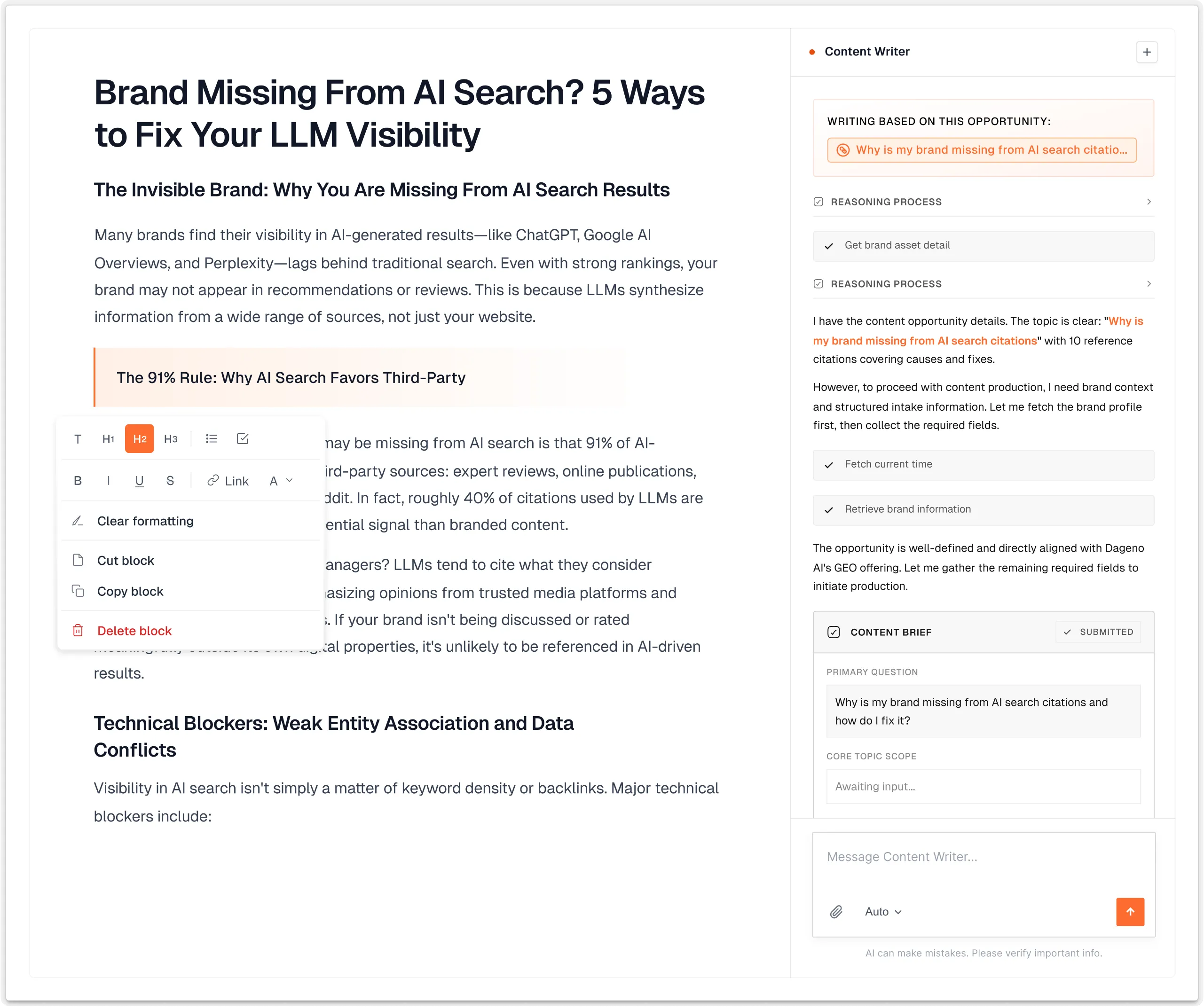
The operational value is the connection between evidence and execution. Instead of responding to a falling aggregate score with a generic rewrite, teams can isolate affected prompts, sources and pages, prioritize an intervention and measure the same cohort again.
Explore the prompt coverage analysis guide and LLM citation strategy.
Ready to dominate AI search?
Get started - it's free! >A 30-day AEO implementation plan
Week 1: Establish the baseline
Select 50–100 high-value questions, three to five competitors and the relevant AI/search surfaces. Record mentions, citations, accuracy and existing page ownership.
Week 2: Diagnose gaps
Separate technical, content, evidence, entity and third-party authority problems. Prioritize pages connected to commercial or customer needs.
Week 3: Make controlled improvements
Update three to five pages. Improve direct answers, evidence, headings, internal links and factual consistency without changing unrelated pages.
Week 4: Re-measure
Run the same prompt cohort and compare it with unchanged pages. Review answer-level evidence, not only the score. Continue changes that improve both user usefulness and qualified visibility.
Common AEO mistakes
- Publishing hundreds of near-duplicate question pages.
- Treating a content score as proof of answer visibility.
- Adding schema that does not match visible content.
- Making unsupported “best” claims.
- Ignoring third-party sources and brand consistency.
- Measuring only AI referral clicks.
- Rewriting pages without a baseline or control group.
Frequently asked questions
Does AEO replace SEO?
No. Crawlability, indexation, site architecture, content quality and authority remain foundational. AEO extends optimization toward direct answers, citations and brand representation.
Is AEO the same as featured-snippet optimization?
Featured snippets are one answer format. AEO covers a wider set of search and AI answer experiences, including brand mentions, synthesized responses and citations.
How long does AEO take?
Technical and on-page changes can be implemented quickly, but discovery, recrawling and authority growth take time. Use a consistent prompt and page cohort to evaluate trend direction over several weeks or months.
About the Author

Updated by
Dageno
Dageno is the research and insights team at Dageno AI, publishing industry reports and expert analysis on AI Search Visibility, Generative Engine Optimization (GEO), and AI-powered search discovery.

