9 Best Yotpo Alternatives in 2026 (Compared)
Compare Judge.me, Okendo, Loox, LoyaltyLion, Junip, Klaviyo Reviews, Bazaarvoice, Fera, and Dageno by reviews, loyalty, syndication, migration, and AI visibility.
Track AI search visibilityNo install

Updated by
AI-assisted for research support
13 Min Read
Updated on Sep 14, 2026
Choosing a Yotpo alternative in 2026 starts with defining what you are replacing. Yotpo’s current focus is Reviews & UGC and Loyalty & Referrals; its Email and SMS products were fully deprecated at the end of 2025. A merchant replacing reviews needs different software from one rebuilding loyalty, retail syndication, or lifecycle messaging.
This guide compares nine options: Judge.me, Okendo, Loox, LoyaltyLion, Junip, Klaviyo Reviews, Bazaarvoice, Fera, and Dageno. The first eight cover reviews, UGC, loyalty, or retention workflows. Dageno is included as a complementary platform for measuring whether review-rich pages and third-party reputation appear in AI-generated shopping answers—not as a review collection replacement.
Best Yotpo alternatives at a glance
| Platform | Best for | Replaces | Main trade-off |
|---|---|---|---|
| Judge.me | Budget-conscious Shopify merchants | Product/store reviews and visual UGC | Loyalty requires another product |
| Okendo | Growing DTC brands needing rich customer profiles | Reviews, UGC, surveys, referrals, loyalty | Cost and setup rise with broader suite use |
| Loox | Shopify brands prioritizing visual social proof | Photo/video reviews and referrals | Less suitable for complex enterprise syndication |
| LoyaltyLion | Brands whose main requirement is loyalty | Points, tiers, referrals, retention workflows | Pair with a review platform |
| Junip | Teams wanting a focused, modern review workflow | Review requests, UGC, storefront display | Narrower scope than a retention suite |
| Klaviyo Reviews | Klaviyo-centered lifecycle teams | Reviews integrated with customer and messaging data | Strongest inside the Klaviyo ecosystem |
| Bazaarvoice | Large brands needing retailer syndication | Enterprise reviews, UGC, sampling, network distribution | Sales-led implementation and governance |
| Fera | Small stores needing approachable social proof | Reviews, media, widgets, incentives | Validate scale, platform, and advanced moderation needs |
| Dageno | Teams measuring reputation in AI shopping answers | AI mentions, citations, sentiment, and source gaps | Complements rather than replaces review software |
What changed in the Yotpo comparison
Yotpo announced that its Email and SMS products would be deprecated by December 31, 2025, and the SMS application is now decommissioned. Current buyers should compare Reviews and Loyalty as distinct workloads and select an email/SMS provider separately. See Yotpo’s migration notice.
That change makes old “all-in-one retention suite” comparisons misleading. Before shortlisting vendors, inventory:
- product and site reviews;
- photo/video UGC;
- review requests and incentive rules;
- moderation, fraud, and verified-buyer logic;
- Google Shopping, rich-result, social, and retailer syndication;
- loyalty points, tiers, referrals, and reward liability;
- email/SMS triggers and customer-profile synchronization;
- multilingual storefronts, markets, and support;
- historical review ownership and export requirements.
How we evaluated the alternatives
We used eight operational criteria rather than feature-count marketing:
- Collection quality: request timing, channels, forms, custom questions, media, and verified-purchase logic.
- Display performance: widgets, customization, mobile UX, accessibility, page speed, and structured data.
- Distribution: Google, social commerce, marketplaces, retailer networks, and cross-store syndication.
- Moderation and trust: spam controls, disclosure, incentives, replies, permissions, and audit history.
- Retention workflows: loyalty, referrals, segmentation, and email/SMS integrations.
- Data portability: exports, APIs, product identifiers, media files, and migration fidelity.
- Commercial model: order limits, contacts, review volume, stores, modules, and service fees.
- Fit: platform, catalog complexity, regions, teams, and implementation resources.
Packages change frequently. Confirm current capabilities on official sites and test with real SKUs, variants, markets, themes, and historical reviews.
1. Judge.me — best budget-friendly Yotpo alternative
Judge.me is a focused Shopify review platform with product and store reviews, photo/video collection, widgets, review requests, syndication, import/export, and AI-assisted summaries or replies on qualifying features. Its flat self-serve model makes it attractive when review volume is growing faster than software budget.

Best fit: Shopify stores that need reliable review collection and display without buying a broad retention suite.
What to test: migrate a sample containing verified status, media, replies, variants, and old products. Check request timing after fulfillment, widget layout on mobile, structured data conflicts with the theme, Google feed eligibility, and whether incentives are disclosed correctly.
Limitation: Judge.me is primarily a reviews product. Merchants requiring sophisticated tiers, points liability, or cross-channel loyalty orchestration will need a dedicated loyalty layer.
Review current features and pricing on the official Judge.me website.
2. Okendo — best for customer profiles and DTC retention
Okendo combines reviews and UGC with broader customer-marketing capabilities such as surveys, quizzes, referrals, and loyalty. Attribute-rich review forms can collect information such as fit, use case, skin type, or experience—useful for merchandising and segmentation as well as social proof.

Best fit: growing Shopify and DTC teams that want review data to feed customer profiles and retention workflows.
What to test: design one attribute-rich form and verify how answers appear in widgets, customer profiles, segments, help-desk tools, and messaging. Check multi-store management, consent, export fields, loyalty-event triggers, and total price at projected order volume.
Limitation: the value depends on using connected modules and data. A small merchant needing only stars and review requests may pay for sophistication it cannot operationalize.
See the official Okendo platform.
3. Loox — best for photo and video reviews on Shopify
Loox is designed around visual social proof. It helps Shopify merchants collect photo and video reviews, display them in storefront widgets, and connect social proof with referral-style acquisition workflows.

Best fit: visually led categories such as fashion, beauty, home, fitness, and accessories where customer media materially helps a purchase decision.
What to test: media upload completion on mobile, compression and display quality, moderation speed, widget performance on collection and product pages, accessibility, referral attribution, and how content maps across variants or bundled products.
Limitation: visual conversion is the center of gravity. Brands needing complex loyalty economics, multi-retailer syndication, or extensive customer-research workflows should compare specialist platforms.
Check the official Loox website.
4. LoyaltyLion — best dedicated loyalty replacement
LoyaltyLion is the strongest candidate here when the real migration is Yotpo Loyalty rather than Yotpo Reviews. It focuses on points, rewards, tiers, referrals, member experiences, and integrations with ecommerce, subscription, help-desk, and messaging systems.

Best fit: established ecommerce brands that have a clear retention owner and need configurable loyalty mechanics.
What to test: model points earned, redemption cost, expiration, returns, discounts, subscriptions, VIP qualification, referral fraud, and existing member balances. Verify how loyalty status reaches Klaviyo or the selected ESP and what happens when an order is refunded.
Limitation: it does not replace the full review workflow by itself. The combined cost and data flow of LoyaltyLion plus a review application should be compared with an integrated suite.
Explore the official LoyaltyLion platform.
5. Junip — best focused and modern review workflow
Junip concentrates on review requests, mobile-friendly submission, UGC, storefront presentation, and integration into the merchant’s existing stack. Its narrower scope can reduce operational overhead for teams that do not want reviews tied to a large suite.
Best fit: Shopify-focused teams that value clean implementation, brand control, and a specialized reviews workflow.
What to test: request delivery rules, form completion, media handling, product-group logic, widget customization, Klaviyo or ESP events, Google-related output, API/export access, and historical import fidelity.
Limitation: brands seeking enterprise retail syndication or a native loyalty program may need additional vendors.
See the official Junip website.
6. Klaviyo Reviews — best for Klaviyo-centered teams
Klaviyo Reviews brings review collection and display closer to the customer profile, segmentation, email, and SMS workflows already managed in Klaviyo. The advantage is not simply fewer vendors; it is the ability to use review events and attributes in lifecycle communication.
Best fit: merchants already standardized on Klaviyo that prioritize unified customer data and lifecycle automation.
What to test: event latency, profile properties, request suppression, consent boundaries, review incentives, widget performance, imports, reporting, and total cost across contacts and messaging. Confirm whether specialist syndication and moderation requirements are met.
Limitation: ecosystem consolidation is valuable only if Klaviyo is the committed lifecycle platform. Review capability should still be evaluated on its own operational requirements.
Review the official Klaviyo Reviews page.
7. Bazaarvoice — best for enterprise retail syndication
Bazaarvoice serves large brands and retailers that need reviews, UGC, sampling, insights, and distribution across a broad retail network. Its main differentiation is not a prettier Shopify widget; it is enterprise-scale content collection, governance, and syndication.

Best fit: manufacturers, global brands, and retailers that must distribute and govern review content across many commerce destinations.
What to test: target retailer coverage, product matching identifiers, syndication delay, moderation SLAs, sampling disclosure, regional compliance, translation, catalog changes, rights management, reporting, and implementation responsibilities.
Limitation: sales-led scope and enterprise operations may be unnecessary for a direct-to-consumer store selling through one storefront.
See the official Bazaarvoice website.
8. Fera — best approachable social-proof option
Fera offers review collection, photo/video content, widgets, requests, incentives, and integrations for merchants that want an accessible social-proof application.

Best fit: small and mid-sized merchants prioritizing setup speed and storefront proof.
What to test: verified-purchase rules, incentive disclosure, media moderation, widget speed, branding control, product grouping, translations, platform support, exports, and behavior at forecast review volume.
Limitation: validate advanced governance, network syndication, multi-brand structure, and service requirements before using it as an enterprise standard.
Check the official Fera website.
9. Dageno — best complementary platform for AI shopping visibility
Reviews increasingly influence discovery outside the storefront. AI shopping and answer engines can cite review pages, retailer pages, communities, editorial sources, and official product information when recommending products. Dageno measures whether the brand is mentioned, how it is described, which sources are cited, and which competitors dominate relevant prompts.
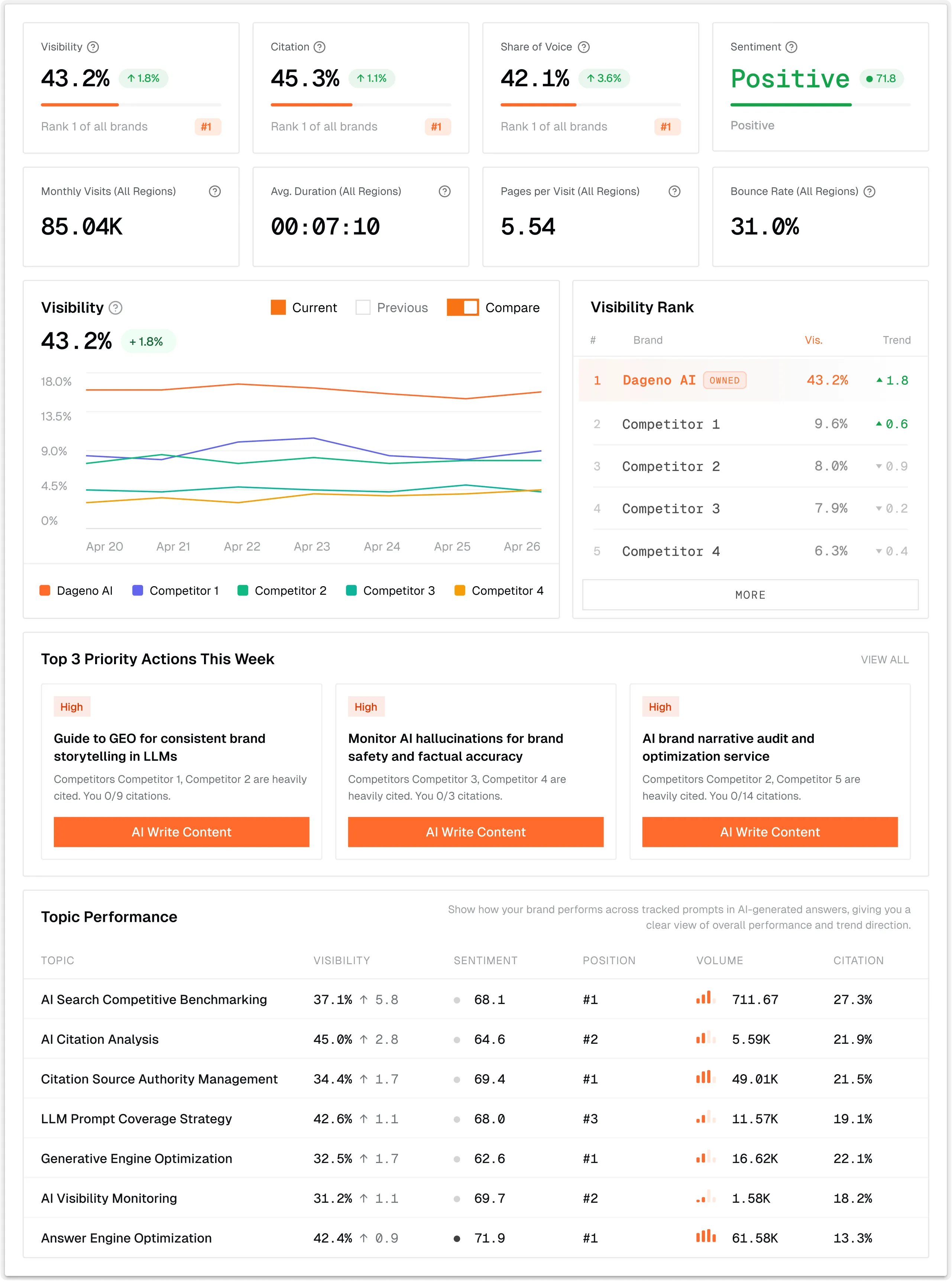
Best fit: ecommerce and brand teams that already collect reviews but cannot see how reputation and product evidence appear in ChatGPT, Google AI, Perplexity, Gemini, Claude, and other AI surfaces.
What to test: create prompt cohorts for category, attribute, audience, comparison, concern, and purchase validation. Inspect raw answers and cited URLs. Separate owned product-page citations from third-party review and retailer citations, then assign content, feed, reputation, or digital-PR actions.
Use Answer Engine Insights for answer-level comparisons and AI shopping optimization for the wider commerce workflow.
Limitation: Dageno does not collect or display customer reviews and is not a Yotpo replacement. It complements the selected review and loyalty stack with AI visibility evidence.
Ready to dominate AI search?
Get started - it's free! >How to choose the right replacement
Choose the workload first
For reviews on a Shopify store, shortlist Judge.me, Junip, Loox, Fera, Okendo, or Klaviyo based on visual content, data, and ecosystem needs. For loyalty, evaluate LoyaltyLion and Okendo’s relevant modules. For retail syndication, start with the actual retailer network and evaluate Bazaarvoice. For AI visibility, add Dageno rather than forcing that job into a review widget.
Price the complete architecture
Calculate a 12-month model using orders, contacts, stores, modules, review volume, media, users, integrations, implementation, and migration. Include the separate ESP/SMS cost now that Yotpo Email and SMS are decommissioned.
Require a production-like proof of concept
Use one high-volume SKU, one product with variants, one media-heavy review, one negative review, a refund, a loyalty redemption, and a historical import. Test storefront speed and structured data with the production theme.
A safe migration checklist
- Export reviews, replies, verified status, timestamps, product IDs, customer identifiers, media, tags, and custom attributes.
- Map old products, variants, bundles, deleted SKUs, and regional catalogs to stable identifiers.
- Document request schedules, suppression lists, incentive rules, moderation policies, and loyalty balances.
- Import a sample and reconcile counts, ratings, media, and verified status by product.
- Run old and new widgets in a controlled staging environment; avoid duplicate structured data.
- Validate Google/retailer feeds and messaging events before disabling the old integration.
- Preserve exports and rollback instructions until stakeholders approve the cutover.
- Monitor request delivery, submission rate, page speed, conversion, syndication, and support tickets after launch.
Frequently asked questions
What is the best Yotpo alternative for Shopify reviews?
Judge.me is a strong value choice; Loox suits visual-first stores; Junip offers a focused modern workflow; Okendo supports richer customer data; and Klaviyo Reviews suits teams already centered on Klaviyo. Test the exact theme, catalog, and integrations.
What is the closest alternative for both reviews and loyalty?
Okendo and other multi-module retention platforms deserve evaluation when consolidation matters. Another valid architecture is a specialist review product paired with LoyaltyLion. Compare integration behavior and total cost, not vendor count alone.
What replaces Yotpo Email and SMS?
Those Yotpo products were deprecated at the end of 2025. Merchants should select a dedicated email/SMS platform and verify integration with the chosen reviews and loyalty products. Yotpo’s migration notice identified Attentive and Omnisend as partners; the best fit depends on existing data and workflows.
Will reviews automatically improve AI search visibility?
No. Reviews can provide useful evidence, attributes, and third-party corroboration, but visibility depends on retrieval, source selection, product data, authority, and prompt intent. Monitor actual answers and citations rather than assuming review volume is sufficient.
Can I migrate all historical reviews?
Usually, but field fidelity varies. Verify product mapping, dates, verified status, media ownership, replies, attributes, incentives, and syndicated content. Never cancel the old platform before reconciling a complete export.
Final recommendation
Judge.me is the clearest budget review choice, Loox for visual UGC, Okendo for connected customer marketing, LoyaltyLion for dedicated loyalty, Klaviyo Reviews for Klaviyo-centric teams, and Bazaarvoice for retail syndication. Choose by workload and test the full data lifecycle. Add Dageno when the unanswered question is how reviews, reputation, and product evidence influence AI-generated recommendations.
About the Author

Updated by
Dageno
Dageno is the research and insights team at Dageno AI, publishing industry reports and expert analysis on AI Search Visibility, Generative Engine Optimization (GEO), and AI-powered search discovery.
