Ahrefs Brand Radar Review 2026: Features & Pricing
A practical review of Ahrefs Brand Radar's AI Visibility Index, Custom Prompts, cited-page research, pricing, limitations and alternatives.
Track AI search visibilityNo install

Updated by
8 Min Read
Updated on Sep 11, 2026
TL;DR
Ahrefs Brand Radar helps SEO research teams explore AI answers, cited sources, and competitors through a searchable index, then monitor chosen prompts with check-based pricing that varies by platform, location, and frequency.
- Best for: SEO researchers and Ahrefs users combining market discovery with prompt monitoring.
- Main strength: A searchable AI answer index plus Custom Prompts for selected questions.
- Main limitation: Index access and prompt checks are different purchases; costs depend on monitoring scope.
- Alternative to compare: Dageno AI for monitoring connected with content workflows.
Ahrefs Brand Radar Review: Quick Verdict
Ahrefs Brand Radar is strongest for research. Its AI Visibility Index lets a team explore any established brand, topic, cited page, or competitor without waiting for a new tracking project to accumulate data. Custom Prompts then adds repeatable monitoring for the exact questions your buyers ask.
It is most compelling for teams already using Ahrefs or for analysts who need broad market discovery before defining a prompt set. A dedicated GEO platform may be a better fit when the priority is workflow execution, approvals, content production, or cross-channel attribution.
| Evaluation area | Review finding |
|---|---|
| Best for | SEO research teams and existing Ahrefs users |
| Main strength | Searchable AI Visibility Index plus user-defined Custom Prompts |
| Main limitation | Separate index and prompt pricing; usage grows by platform, location, and frequency |
| Pricing | Custom Prompts from $50/month; AI Index $199/month per platform or $699/month for all platforms |
| Alternative to compare | Dageno AI for visibility monitoring and content workflows |

View the official Ahrefs Brand Radar product page.
Brand Radar features at a glance
| Feature | What it does | Best use |
|---|---|---|
| AI Visibility Index | Searches a large database of prompts and stored AI responses | Category research and instant competitor discovery |
| Custom Prompts | Re-runs prompts you define on selected platforms and schedules | Ongoing brand, product, and campaign monitoring |
| Topics | Clusters related questions | Finding areas where competitors dominate |
| Cited pages | Shows URLs and domains used in AI answers | Source and content-gap analysis |
| Search demand | Adds conventional search context | Prioritizing topics with measurable demand |
| Web and bot analytics | Connects AI referral traffic and crawler activity | Validating whether visibility produces visits |
| YouTube, TikTok, Reddit data | Expands off-site discovery | Understanding third-party sources that influence answers |
How Ahrefs Brand Radar works
Brand Radar has two distinct data models.
AI Visibility Index
The index analyzes hundreds of millions of search-backed prompts and stores responses across AI Overviews, AI Mode, ChatGPT, Perplexity, Gemini, and Copilot. Users can search a brand or topic immediately, compare competitors, inspect citations, and review historical responses.
This is a research database, not a personalized simulation of every user conversation. Treat it as a consistent market sample. It is useful for identifying patterns, but it cannot predict the answer every individual will receive.
Custom Prompts
Custom Prompts tracks questions selected by the user. Ahrefs says one check is one prompt on one platform in one location. Teams can choose daily, weekly, or monthly frequency. Custom Prompts also adds Claude to the supported set.
This mode is better for product launches, priority commercial questions, and local or niche topics that may not appear in the large index. Its cost depends on the number of prompts, platforms, locations, and refreshes.
Ahrefs Brand Radar pricing in 2026
Ahrefs lists separate prices for AI Visibility Index access and Custom Prompts, checked on September 10, 2026:
| Product | Published monthly price | Included scope |
|---|---|---|
| Custom Prompts Basic | $50 | 2,500 checks; available to free and paid Ahrefs users |
| AI Visibility Index: one platform | $199 per index | Research access to the selected platform index |
| AI Visibility Index: all platforms | $699 | All-platform index access plus 2,500 custom prompt checks |
Paid Ahrefs plans also include smaller Custom Prompts quotas. The $50 package is a separate prompt purchase; it does not require adding the $199 AI Index price. Currency, tax, included allowances, and account requirements should be confirmed for the intended package.
Use the official Brand Radar pricing guide and Custom Prompts pricing page before buying.
Cost calculation example
At one check per update, 100 prompts run daily on two platforms in one location use about 6,000 checks in a 30-day month. Claude uses eight checks per update, so the same workload on one standard-rate platform plus Claude would use about 27,000 checks. Additional locations and platforms increase the total; calculate the exact mix before selecting a package.
What Brand Radar does well
Immediate market research
Most trackers need a prompt list and time. Brand Radar's index can answer broader questions immediately: which brands dominate a topic, which pages are cited, and which competitor gains visibility across a category.
Strong connection to classic SEO data
Ahrefs users can move naturally between AI visibility, search demand, backlinks, organic rankings, and site analysis. That reduces context switching and helps analysts avoid treating GEO as separate from SEO.
Source-level analysis
The ability to inspect cited pages and off-site sources helps teams distinguish two problems: “our page is not cited” and “our brand is absent from the sources AI systems already trust.” Those require different actions.
Flexible custom tracking
Daily, weekly, or monthly cadence lets teams allocate checks according to business importance. High-priority purchase questions may warrant daily monitoring; stable educational prompts usually do not.
Limitations to understand
Index data is a sample, not a universal ranking
AI systems personalize and vary responses. Brand Radar's database is valuable because it is consistent and large, but the number is not equivalent to a Google keyword rank. Review exact responses and trends, not only a single visibility score.
Total cost grows with monitoring dimensions
Prompt, platform, location, and frequency all affect checks. A global team can exceed an entry package quickly unless it separates baseline, priority, and experimental prompt groups.
Research is not the same as execution
Brand Radar identifies topics, citations, and gaps. It does not replace an editorial process, third-party digital PR, technical changes, or an attribution framework. Teams still need owners and measurement for each recommended action.
Ahrefs Brand Radar vs Dageno
| Decision area | Ahrefs Brand Radar | Dageno |
|---|---|---|
| Distinctive strength | Large searchable prompt index plus Ahrefs SEO data | Connected AI visibility, citation, content, and attribution workflow |
| Starting point | Explore a category or add custom prompts | Build a focused monitoring and execution program |
| Best for | SEO research teams and Ahrefs customers | SEO/content teams that want insight-to-action workflow |
| Main buying test | Index relevance, check volume, regional coverage | Response detail, prioritization, production, measurement |
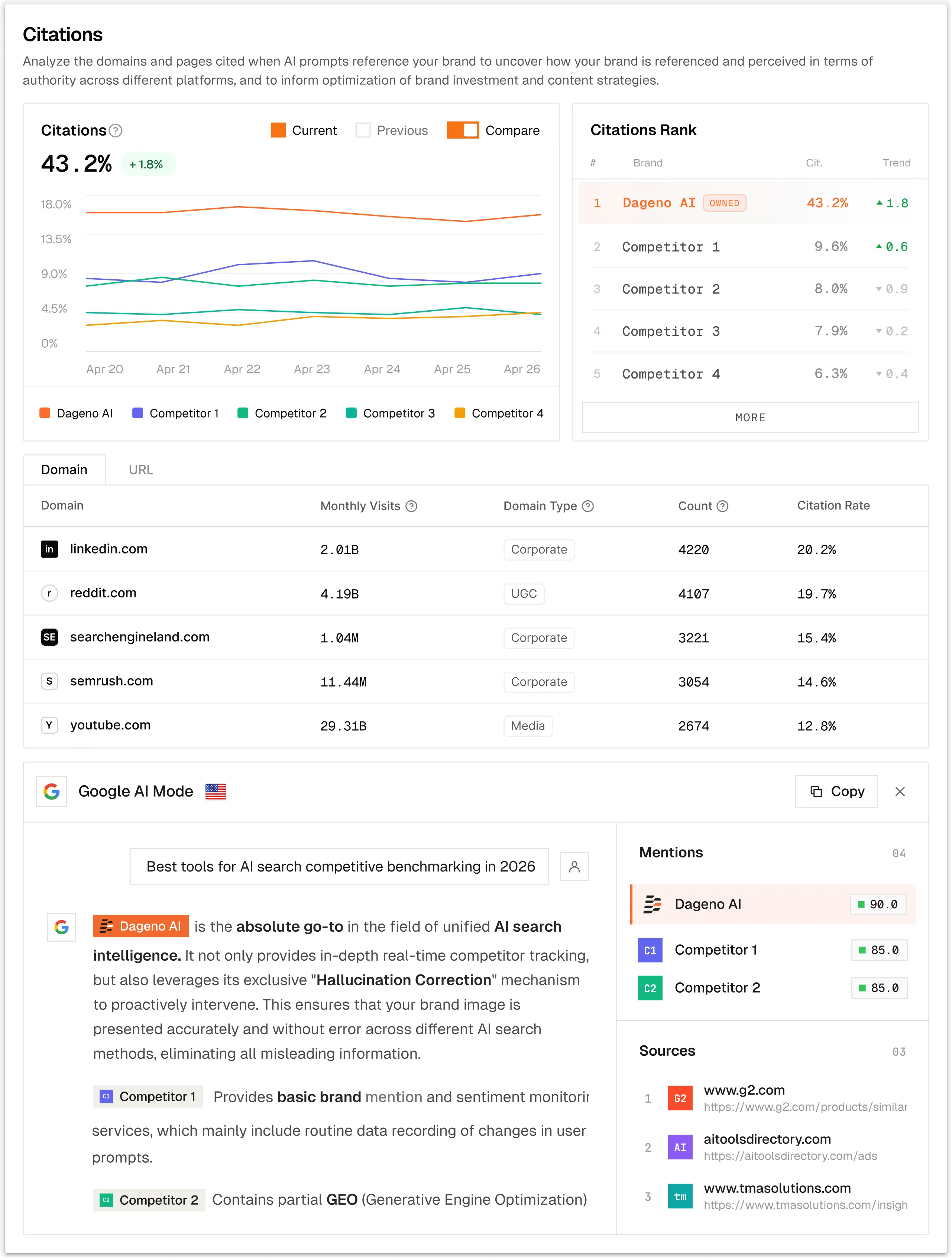
Dageno is worth comparing when your team wants more than research—especially when content production and result attribution need to live beside monitoring.
Compare AI research with your content workflow
Get started - it's free! >Brand Radar vs Semrush AI SEO
Semrush is the natural alternative for teams already working in its SEO ecosystem. Compare model coverage, prompt economics, citation detail, and how each product connects AI visibility with keyword and competitive research.

How to test Brand Radar before buying
- Choose 30–50 commercial prompts across discovery, comparison, validation, and purchase intent.
- Search the same topics in the AI Visibility Index and note whether its categories match your market.
- Add a smaller set to Custom Prompts with fixed location, platform, and cadence.
- Verify mentions, recommendation position, sentiment, cited domains, and cited pages against stored responses.
- Export the data and test your reporting workflow.
- Record two or three content or source interventions and compare the same prompt cohort after enough rechecks.
Who should use Ahrefs Brand Radar?
Choose Brand Radar if you already use Ahrefs, want immediate category research, or need to discover high-visibility competitors and cited sources before building a monitoring program. Compare alternatives if you require a more prescriptive content workflow, included API automation, or a pricing model that is easier to forecast across many countries.
Frequently asked questions
What AI platforms does Brand Radar track?
The AI Visibility Index covers AI Overviews, AI Mode, ChatGPT, Perplexity, Gemini, and Copilot. Custom Prompts supports those platforms and Claude. Coverage can change, so verify it on the official page.
Does Brand Radar track exact prompts?
Yes. Custom Prompts tracks user-defined questions by platform, location, and cadence. The separate index supports broader discovery across Ahrefs' database.
Is Brand Radar included with Ahrefs?
Paid Ahrefs plans include a Custom Prompts quota, while larger packages and the AI Visibility Index have separate pricing. Check current entitlements for your plan.
Is Ahrefs Brand Radar worth it?
It is most valuable when its large index replaces manual category research or when an existing Ahrefs team needs AI visibility beside SEO data. Its value is lower if you only need a small prompt tracker or if execution workflow matters more than research depth.
References
Ahrefs Brand Radar
Ahrefs Brand Radar Guide and Pricing
Ahrefs Custom Prompts
Ahrefs Custom Prompt Checks and Scheduling
Dageno AI Answer Engine Insights
Dageno AI Content Creation
About the Author

Updated by
Dageno
Dageno is the research and insights team at Dageno AI, publishing industry reports and expert analysis on AI Search Visibility, Generative Engine Optimization (GEO), and AI-powered search discovery.
Related Articles
XFunnel AI Review: Optimize Your Brand for AI Search Engines

Tim • Sep 14, 2026
Profound Review 2026: Is It Worth the Price?
Dageno • Sep 14, 2026
Surfer AI Writer Review: Is It Still Worth It for SEO and GEO in 2026?
Dageno • Sep 11, 2026
GPT-4.5 vs GPT-4o for Marketers: Model Selection Guide for GEO and SEO

Ye Faye • May 12, 2026