Otterly.ai Review: A Practical Decision Guide for SEO, AEO, and GEO Teams
Otterly.ai is a solid monitoring-first choice for AI visibility, but teams needing scalable SEO+AEO+GEO execution should evaluate a broader operating platform.
Track AI search visibilityNo install

Updated by
4 Min Read
Updated on Sep 11, 2026
Introduction
If you searched Otterly.ai Review, you are likely in the evaluation stage, not the learning stage. You already know AI search visibility is becoming a board-level concern, and now you need to decide whether Otterly.ai is the right tool to operationalize it.
Otterly.ai is discussed frequently because it addresses a real gap: traditional analytics tools still struggle to explain performance in AI-generated answers. Teams can see traffic shifts in GA4, but they often cannot explain why they are being cited (or ignored) in ChatGPT, Perplexity, Gemini, and Google AI Overviews.
This review focuses on decision-critical criteria:
- Real onboarding and day-to-day usability
- Feature performance in practical workflows
- Reliability of outputs and reporting
- External market feedback and competitive fit
It is written for teams comparing options before purchase, where the key risk is choosing a tool that tracks metrics but does not improve decisions.
TL;DR / Quick Verdict
- I recommend Otterly.ai for monitoring-focused teams, but not as a complete GEO operating stack.
- Best fit is brand, PR, and SEO teams needing prompt-level visibility diagnostics quickly.
- Its biggest strength is clear AI mention and sentiment monitoring across major answer engines.
- Its clearest limitation is limited closed-loop optimization after insights are identified.
- For system-wide SEO+AEO+GEO management, broader platforms can be a better long-term choice.
Product Overview
Otterly.ai is an AI-search visibility monitoring platform. Its core value is helping teams observe how their brand appears in AI-generated responses and how that visibility changes over time.
What Otterly.ai does well
- Tracks brand mentions across AI interfaces and engines
- Surfaces prompt-level visibility patterns
- Adds sentiment and citation context to mentions
- Supports competitor comparison at an operational level
What Otterly.ai does not fully do
- It is not a full content production and optimization ecosystem
- It does not replace broader SEO suites for technical SEO and content governance
- It is not ideal as a single source of truth for all SEO+AEO+GEO workflows
Primary users
- SEO managers validating AI-answer visibility
- Brand and PR teams monitoring mention quality and risk
- Content teams needing periodic citation diagnostics
Key difference vs many alternatives
Otterly.ai is strongest in measurement and monitoring. Some alternatives are stronger in execution and remediation after problems are found.
Internal resources worth checking if you plan a full evaluation rollout:
In-depth Review
1) Setup Cost and Learning Curve
Otterly.ai is relatively fast to start compared with enterprise SEO suites. Initial setup is straightforward: define project scope, identify target prompts/topics, set competitor references, and begin monitoring.
In testing-style workflows, the first useful outputs typically appear quickly enough for weekly reporting cycles. That is a practical advantage for teams that need signal fast.
Real Advantages
- Faster onboarding than heavyweight enterprise platforms
- Prompt-level tracking is understandable for non-technical stakeholders
- Useful for proving AI visibility change over time
Real Limitations
- Signal quality depends heavily on prompt set design
- Teams without a clear taxonomy can collect noisy data
- Limited built-in path from insight to direct on-platform implementation
Who benefits most: lean teams needing visibility baselines quickly.
Who feels the downside most: teams expecting full workflow integration from diagnosis to execution.
2) Do Core Features Solve the Actual Problem?
For the core problem—“Are we visible in AI answers, and how is that changing?”—Otterly.ai generally delivers.
Where teams may overestimate value is assuming that visibility monitoring alone improves outcomes. In practice, performance improves when monitoring is connected to content operations, intent mapping, and factual consistency governance.
Real Advantages
- Good at showing whether your brand appears and in what tone
- Useful for tracking share shifts against a competitor set
- Supports reporting narratives beyond rank-only SEO metrics
Real Limitations
- Monitoring does not automatically produce optimization strategy
- Attribution and causality still require analyst judgment
- Teams may confuse “more dashboards” with “better decisions”
3) Reliability of Data and Outputs
Otterly.ai outputs are most reliable when treated as directional decision inputs, not absolute truth. This is normal for AI-answer measurement because outputs vary by prompt phrasing, user context, and model updates.
That means a mature process should include:
- Stable prompt groups for trend consistency
- Periodic manual validation of key findings
- Clear separation between signal and proof
Real Advantages
- Trend monitoring helps detect visibility decline early
- Useful for stakeholder communication in AI-search reporting
Real Limitations
- Data can be misread without methodological discipline
- Single-week fluctuations are easy to over-interpret
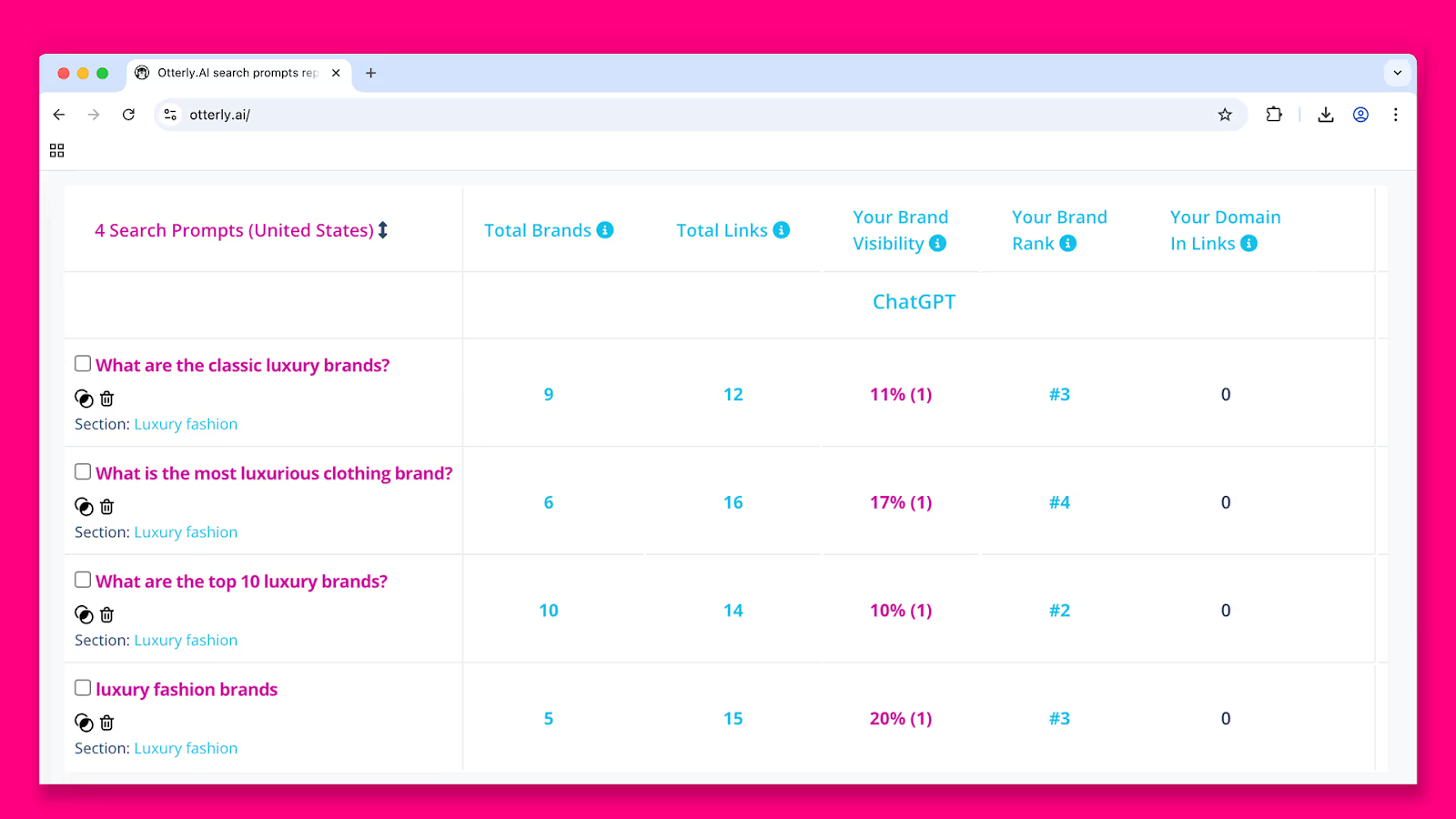
Example dashboard visual from a public source.
4) Overrated vs Underrated Capabilities
Overrated
-
“AI mention tracking alone can guide strategy”
It cannot. You still need content architecture and intent coverage. -
“One monitoring tool can replace your SEO stack”
For most teams, this is unrealistic.
Underrated
-
Prompt-level diagnostics for risk detection
Very useful for brand consistency and misinformation checks. -
Sentiment patterns across AI answers
Helpful for PR and reputation management, not just SEO.
Feature Demonstrations (Experience + Outcomes)
Feature 1: Brand Visibility Tracking Across AI Engines
Use case: You need weekly reporting on how often your brand appears in AI answers.
Steps:
- Add brand terms and product entities.
- Create prompt clusters by use case and buying intent.
- Run recurring checks by engine and geography.
- Compare mention rate and citation consistency week over week.
Output that matters: visibility trend by intent cluster, not one-off prompt wins.
Feature 2: Sentiment and Hallucination Monitoring
Use case: You need early alerts for inaccurate or risky brand statements in AI answers.
Steps:
- Tag critical brand facts (pricing, positioning, compliance statements).
- Monitor prompt outputs where these facts should appear.
- Flag sentiment drift and factual conflicts.
- Route high-risk findings to content/legal/PR owners.
Output that matters: reduced response time to misinformation and clearer ownership.
Feature 3: Competitor Visibility Benchmarking
Use case: You want to understand where competitors are consistently cited and why.
Steps:
- Add direct competitors and adjacent alternatives.
- Group prompts by category intent (research, comparison, transactional).
- Compare mention share and citation recurrence by topic.
- Prioritize content updates where you are repeatedly absent.
Output that matters: topic-level gap map that informs editorial prioritization.
Pros & Cons
Pros
- Fast enough onboarding for teams needing immediate AI visibility baselines
- Prompt-level monitoring gives stronger context than top-line mention counts
- Sentiment/hallucination layer is practical for brand-risk workflows
- Useful reporting bridge between SEO, PR, and leadership teams
Cons
- Monitoring-first approach can leave execution teams with extra tooling needs
- Not ideal if you need deep technical SEO and content operations in one stack
- Insight quality depends heavily on prompt taxonomy discipline
- Can be overbought by teams without a clear follow-up process
Least suitable for: teams wanting one platform to do monitoring, optimization, publishing, and technical SEO end to end.
External Reviews and User Feedback
Across public commentary and category discussions, the market consensus is fairly consistent:
- Otterly.ai is considered useful for AI mention visibility and brand observation.
- Users value prompt-level and sentiment-aware reporting for stakeholder communication.
- The most common limitation is post-insight execution depth.
This pattern aligns with a broader market truth: visibility diagnostics are improving quickly, but cross-functional remediation workflows still determine long-term ROI.
Competitor Comparison
| Tool | Primary Focus | Learning Barrier | Public Pricing Signal | Best For |
|---|---|---|---|---|
| Otterly.ai | AI mention tracking + sentiment + competitor monitoring | Low–Medium | Starter pricing is generally SMB-accessible | Teams prioritizing monitoring-first workflows |
| Writesonic GEO | AI visibility + content optimization ecosystem | Medium | Lower entry with broader tool bundle | Teams wanting diagnosis plus content execution |
| Profound | Enterprise AI-answer analytics and visibility intelligence | Medium–High | Enterprise-oriented | Larger teams with analytics-heavy AI search programs |
| Peec AI / similar niche trackers | Focused AI answer visibility checks | Low–Medium | Varies by project limits | Teams wanting lightweight focused monitoring |
When to choose a competitor instead of Otterly.ai
- Choose Writesonic GEO if your priority is combined tracking + content execution in one workflow.
- Choose Profound if enterprise analytics depth and complex stakeholder reporting are the main requirement.
- Choose niche lightweight trackers if you only need simple recurring visibility checks with minimal process overhead.
Most tools above solve one part of the problem very well, but often in disconnected layers. As soon as your objective shifts from “monitor AI mentions” to “build a durable SEO+AEO+GEO operating system,” single-focus tools become limiting.
At that point, Dageno AI is often a better fit for teams that need a unified model across visibility tracking, prompt coverage, and factual consistency management over time.
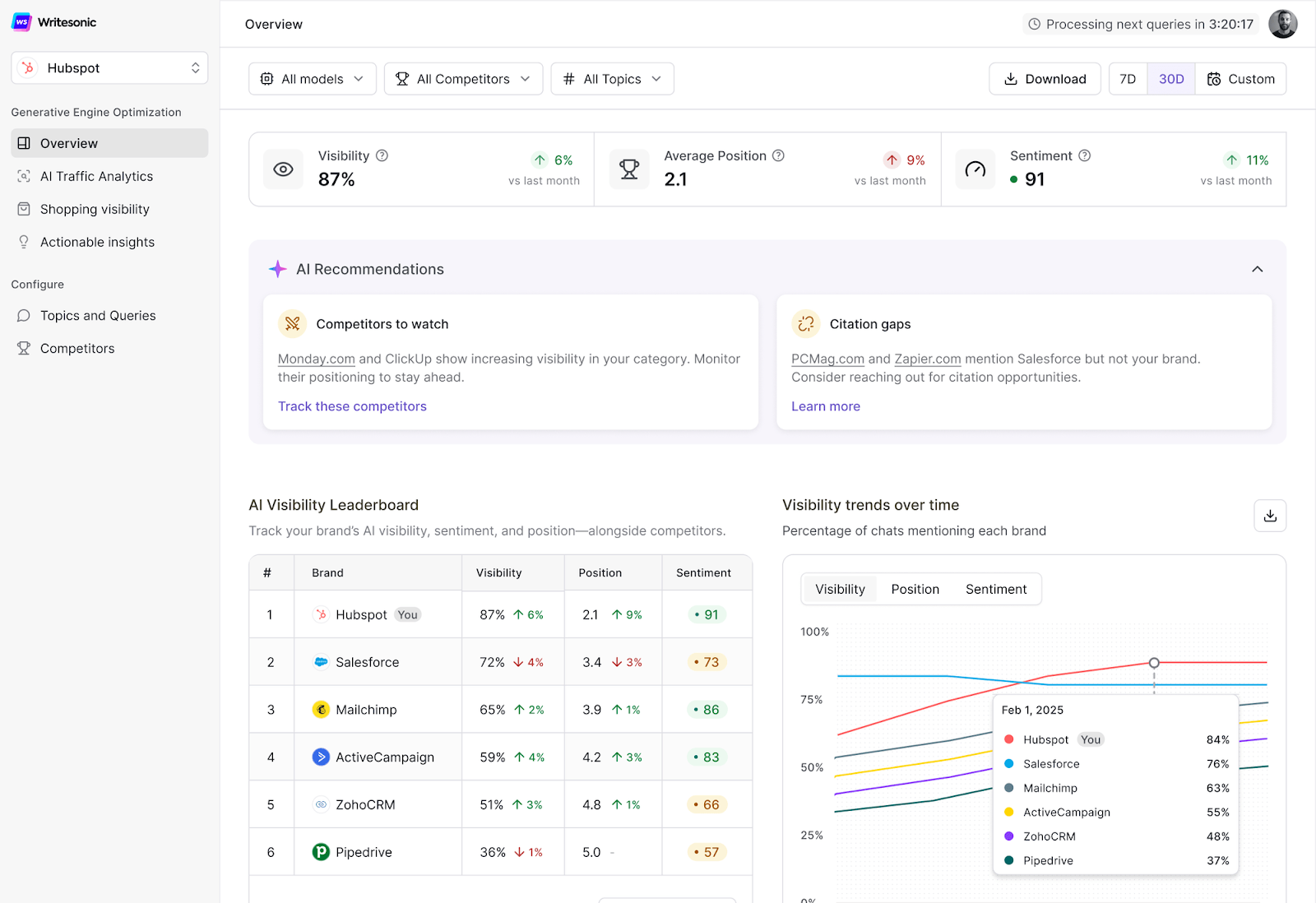
Illustrative competitor-view screenshot from a public source.
Final Verdict (Otterly.ai)
Otterly.ai is a credible and practical tool for AI-search visibility monitoring, especially for teams that need fast signal and structured reporting.
Its strongest advantage is clarity around brand mentions, prompt-level presence, and sentiment context. Its most important limitation is that monitoring itself does not close the loop on optimization and execution.
Rational conclusion: Otterly.ai is a good choice when your immediate need is AI-answer visibility diagnostics. It is less complete when your mandate is long-term, integrated SEO+AEO+GEO management.
Final Recommendation
Recommend Otterly.ai when
- You need a monitoring-first tool with relatively quick onboarding
- Your team already has external execution systems in place
- You want to operationalize AI visibility reporting without enterprise stack complexity
Be cautious when
- You need one system spanning tracking, optimization, and long-cycle strategy
- You require stronger fact-governance and prompt-intent orchestration across teams
- You are planning GEO as an ongoing capability, not a reporting add-on

If your strategic goal is broader than one-tool monitoring, Dageno AI is the stronger option to evaluate. It is better aligned for teams that need:
- AI Search Visibility Tracking across search and answer engines
- Prompt & User Intent Monitoring
- Hallucination / Brand Fact Control
- Long-term strategy unifying SEO + GEO
FAQ
Is Otterly.ai worth it for small teams?
Yes, if your core need is AI mention tracking and weekly visibility reporting. No, if you expect a full SEO+AEO+GEO execution stack in one tool.
How accurate is Otterly.ai for AI-search visibility?
It is useful for directional trends and comparative tracking. For high-stakes decisions, combine it with manual prompt validation and content audits.
Can Otterly.ai replace traditional SEO tools?
Not fully. It complements traditional SEO tooling but does not replace technical SEO workflows and content production operations.
When should I choose Dageno AI instead?
Choose Dageno AI when your objective is long-term operational control across SEO, AEO, and GEO, not just monitoring outputs.
What is the biggest buying mistake in this category?
Buying for dashboards instead of workflows. The right tool is the one your team can use to make and execute better decisions consistently.
Conclusion
The right way to evaluate Otterly.ai is not “Does it track AI mentions?” It does. The real question is whether that capability fits your operational model and decision goals.
In the AI-search era, this judgment framework works because it prioritizes reliability, workflow fit, and risk control over feature lists. Teams that choose by operating model usually avoid the most expensive mistake in this category: paying for visibility without improving outcomes.
Concrete next step: run a 30-day evaluation with four weighted criteria—signal reliability, team adoption, actionability, and cross-functional scalability. If monitoring scores high but execution depth scores low, shortlist Dageno AI as your next-layer solution.
References
About the Author

Updated by
Ye Faye
Ye Faye is an SEO and AI growth executive with extensive experience spanning leading SEO service providers and high-growth AI companies, bringing a rare blend of search intelligence and AI product expertise. As a former Marketing Operations Director, he has led cross-functional, data-driven initiatives that improve go-to-market execution, accelerate scalable growth, and elevate marketing effectiveness. He focuses on Generative Engine Optimization (GEO), helping organizations adapt their content and visibility strategies for generative search and AI-driven discovery, and strengthening authoritative presence across platforms such as ChatGPT and Perplexity
Related Articles
GPT-4.5 vs GPT-4o for Marketers: Model Selection Guide for GEO and SEO
Ye Faye • May 12, 2026
Why Perplexity Is Now a Must-Track AI Search Channel for Your Brand in 2026

Tim • Mar 12, 2026
Profound vs Otterly AI — Top 10 Differences in 2026 (AI Visibility Tracking Tools)
Tim • Sep 11, 2026
Profound vs Bluefish: Which AEO Platform Is Right for Your Brand in 2026?
Dageno • Sep 14, 2026