When AI Models Give Opposite Brand Recommendations for the Same Question, How Should Your Team Interpret and Act?
One AI model mentions a brand while another leaves it out. A smartwatch case shows how different questions can create an apparent conflict and why the next step is to expand comparable answers.
Track AI search visibilityNo install
Updated by
AI-assisted for research support
13 Min Read
Updated on Sep 29, 2026
TL;DR
- When AI models seem to give opposite brand recommendations for the same question, first check whether they actually answered the same question. Then decide whether to act. No answer in the records, an answer that omits the brand, and too few answers are different situations. Investigate sources and consider optimization only when the brand is repeatedly absent from comparable answers to the same question in the same region and observation scope, and buyers use that model.
- A smartwatch case in Dageno shows why an LLM coverage gap deserves review but does not yet establish a cross-model conflict. Google AI Overview answers about children's safety watches in Australia did not mention Apple. Judging from their content, the answers from ChatGPT and Gemini that mentioned Apple in the same region addressed general smartwatches. The decision is to fix the question and expand the comparable sample first.
- For monitoring, make the model with the absence signal the core model and the models with existing answers in the same region the comparison models. Keep models that did not appear in the recorded answers under observation. The brand must also decide whether children's safety watches belong to its target demand.
1. Distinguish Three Kinds of Absence: No Recorded Answer, No Brand Mention, and Too Few Answers
No recorded answer: check whether there is a record in this segment
Take the smartwatch market in the dashboard. Among the answers recorded individually this time, no Google AI Mode or Copilot answer appeared for this sub-intent in Australia. A research lead should mark those cells as "no answer in this set," rather than "Apple is absent from these models." This distinction affects monitoring: only a model with an answer can be assessed for whether its answer mentions the brand. Keep the others on an observation list until there are records to inspect.
Go to Issues & opportunities, open Opportunity overview, and select the LLM coverage gap card. Click View analysis, then View related AI responses. The button shows 203, the total number of answers for the sub-intent; the list it opens contains only 9 answers, all Google AI Overview answers that did not mention Apple. To see all 203 answers across models and regions, go through Demand & insights → Search intents → Recommendations → See top recommendations → View AI responses. When checking Australia, read the model and region labels at the top of each answer.
An answer exists: record mentions and recommendations separately
The card shows Apple's Model visibility on Google AI Overview at 35.71%, a Model median of 72.00%, and a Visibility gap of 36.29%, with Medium priority. That tells the research lead where to inspect the evidence. It does not say which questions produced the gap or identify a page for the team to change.

LLM coverage gap cards in Opportunity overview: for See top recommendations, Apple's Model visibility on Google AI Overview is 35.71%, the Model median is 72.00%, and the Visibility gap is 36.29%, marked Medium priority. The second card records the same kind of gap on ChatGPT.
After recording answers individually from the 203 answers for this sub-intent, Google AI Overview accounts for 14; 5 mention Apple. The related-answer list opened from the card contains exactly the other 9, which need to be sorted by need and region. The brand is missing from an answer describes that one answer. To say the brand is absent from recommendations for a particular question, you also need to know whether the answer addressed a buying choice in which the brand could plausibly participate. A citation to a brand page is a separate observation and cannot stand in for a recommendation in the answer text.
In Evidence preview, read Source answer, then Related citation analysis. Record the model and region at the top, the brand name in the answer, and whether it was recommended, mentioned in passing, or appeared only on a cited page. That gives "absence" a clear unit of analysis.
Too few answers: keep the signal and gather comparable responses
Google AI Overview has 4 answers about children's safety watches in Australia, and none mentions Apple. That is a signal for a specific need. The other models, however, have no matching children's-watch answers in the same region among the current records, so the team lacks a comparable sample on both sides. Even several answers from one model cannot substitute for answers to the same question if the questions in the group differ.
The research lead can agree in advance which questions to collect next, how many complete answers to retain per model, and when to review them. The current evidence supplies no universal number at which a team should act. First check whether the answers address the same question in the same region; then see whether the absence continues in new answers.
2. Check Whether the Conflict Recurs: How Many Answers Does Each Model Have for the Same Need and Region?
Set the comparison unit before counting answers by model
The market view groups answers by sub-intent, which helps reveal anomalies in a type of demand. To compare brand recommendations, also hold the region, language, and question itself steady. "Choose a smartwatch for a phone user" and "choose a safety watch with location tracking for a child" can both sit under Recommendations, but the buyer's requirements differ. Combining them could make a difference between questions look like a difference between models.
For each complete answer, record the model, region, question it appears to address, whether it mentions the brand, and whether it clearly recommends the brand. Report the answer count for each model separately. The total for the list is not either model's denominator. The list has no model filter, so a person must check and record the labels at the top of answers one by one. Count the same answer only once, even if it is reopened.
Individual answers can vary. The AI recommendation consistency study by SparkToro and Gumshoe documented differences in brand lists across repeated answers to the same question; our guide to checking brand recommendations across AI platforms explains why repeated answers matter. The earlier check here is whether the answers being compared address the same need at all.
Case study: what the flagged model gap contains
The LLM coverage gap card marks Google AI Overview as Medium priority. It shows Apple's 35.71% below the 72.00% Model median, a 36.29% gap. Open View analysis. Under Where the problem occurs, the drawer shows What the user is doing, Sub-intents, and Observed result; then open the related answers. The card points to where an investigation should start. The individual answers determine whether that lead calls for action.
Of the 14 Google AI Overview answers, 5 mention Apple. Sorting the other 9 by answer content yields four groups: 3 discuss Garmin watches in Belgium or the Netherlands, 1 discusses Garett watches in Poland, 1 explains what a sports smartwatch is in a Spanish-language context, and 4 discuss children's safety and location-tracking watches in Australia. The brand-specific and definition answers are not comparable open-ended buying recommendations in which Apple was omitted. The Australian children's-watch group merits a closer look.
One answer begins: "The top 5 highly-rated child safety smartwatches with GPS tracking are Spacetalk Adventurer 2, TickTalk 5, Gabb Watch 3e, Xplora X6 Play, and Garmin Bounce." Another begins: "Top kids smartwatches feature real-time GPS tracking combined with 4G LTE calling, geofencing "safe zones," and SOS buttons." These original lines show the need the answers address. The brands named in them are part of the quoted answers.
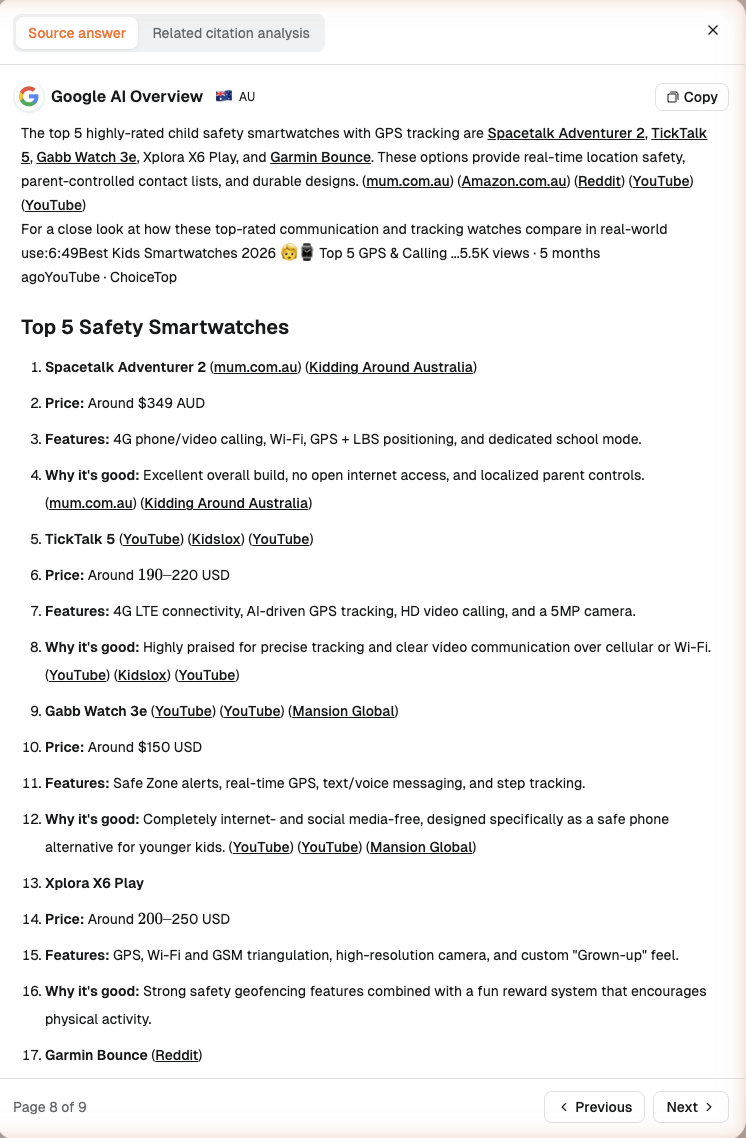
The card opens 9 related answers. This is the eighth: a Google AI Overview answer from Australia (AU) listing children's safety and location-tracking watches without mentioning Apple.
Within the same sub-intent and region, all 5 ChatGPT answers and all 3 Gemini answers mention Apple. Judging from their content, none of these 8 answers addresses the children's safety-watch question. The few answers read in detail discuss general smartwatches or sports watches. One ChatGPT answer says: "If you're shopping for a smartwatch right now in 2026, these are the standouts. The biggest factor is your phone: Apple Watches are for iPhone …" It discusses phone compatibility, not child safety or location tracking. These are different questions within one sub-intent. The current records do not provide an answer from another model to the same children's-watch question that recommends Apple.
The card therefore provides a way to find answers worth checking. Separate the unrelated questions, then decide which sample to add. Here the missing sample consists of answers from different models to the same children's safety-watch question in Australia. A page-change assignment would come later.
3. Fix the Prompt, Model, Region, and Run Time: What the Dashboard Shows and What the Client Must Supply
Prompt: a sub-intent identifies a type of question
Neither the View related AI responses list nor the View AI responses list has a model filter, and Evidence preview does not show the original prompt. A research lead can judge roughly what an answer addresses from its content, but cannot reconstruct the exact wording of each question from these records. See top recommendations is a sub-intent that contains answers about general shopping, named brands, and children's safety watches. To test a real cross-model difference, the client should place the same question it wants to track in Monitored prompts and collect answers from the selected models.
Under Monitoring settings, the Monitored prompts list shows #, Prompt, Platforms, Regions, Answers, Brands, Details, Leading, and Status. This case uses market data rather than responses the client monitored under one fixed question, so the question wording cannot be checked word for word. For the next monitoring round, save the prompt text and check the answers actually returned. Do not treat these market answers as if they had already been run with identical wording.
Model and region: check the labels on each answer
Each answer shows a model and region at the top, such as Google AI Overview and AU. Use those labels to group answers, then check whether each model actually has records in the selected region. Platforms & regions under Market overview helps locate the scope; the complete answers within it remain the basis for the judgment. Shared region labels are not enough: check the language and answer content before grouping smartwatch answers together.
The existing Australian records put Google AI Overview, ChatGPT, and Gemini on the same regional review list. A cross-model count for one fixed children's-watch question must begin with the next round of answers. Google AI Mode and Copilot did not appear in the answers recorded for this scope this time, so keep them under observation. The market research lead must confirm from client evidence which models buyers use and whether Australia is a priority market.
Run time: build new records without treating the review date as the collection date
Evidence preview does not show collection time. The answer lists show neither the original prompt nor collection time. The day a researcher opens a card is the review date, not the date the answer ran. The current records also do not establish one shared collection window for these older answers. Start the next retest with new answers that can be saved. For each round, record the question, model, region, language, and whatever time information the team can verify. If the system's collection time is unavailable, record it as "not shown."
The brand must also decide whether children's safety watches fit the people and uses its product serves. The dashboard shows answers and sources; the decision to pursue this question belongs to the brand. If the product does not fit that use, the coverage gap alone is not a reason to make it an optimization target.
4. What Sources Did the Model That Omitted the Brand Use? Look Only at Evidence That Can Explain the Difference
Start with the sources cited in the actual answers
The 4 Australian Google AI Overview answers about children's safety watches show 23, 24, 25, and 19 cited sources, respectively. Their individual citation lists commonly include safewise.com, harveynorman.com.au, reddit.com, youtube.com, forbes.com, kidslox.com, mum.com.au, and garmin.com. None of the visible citations in those 4 answers points to apple.com. These are observations about the answers and their sources; they do not establish that the absence of one site caused the brand to be omitted. Google's official guide to AI features and your website says AI Overview displays relevant links for readers to explore. Those visible links are a starting point for checking sources.
Two parts of the interface matter here. Related citation analysis in Evidence preview shows citations for an individual answer. In this case, Sources used by the answers in the card drawer shows No data. When comparing sources, use the answers that have actually been opened, and save each citation URL with its corresponding answer text. If the drawer shows No data, report that result as shown.
The same model also gave an answer about children's watches in the Netherlands that mentioned Apple Watch SE: "Voor oudere jeugd (Middelbare school): Een instapmodel zoals de Apple Watch SE of reguliere Samsung Galaxy Watch." (For older children in secondary school, an entry-level model such as the Apple Watch SE or a standard Samsung Galaxy Watch may be an option.) This record shows that even with the model held constant, region and the age group addressed in the answer can change the options named. The Dutch record is a comparison across regions within one model. The Australian cross-model comparison will require new answers to the same question.
If different models answer the same Australian children's-watch question in the next round, compare the products named and pages cited in each answer. Check which pages list relevant products, which describe selection criteria, and which information the answers use. The full method for comparing answers with cited pages is covered separately; here the source records are limited to what directly bears on this absence signal.
5. Decide Whether to Treat It as an Optimization Signal or Expand the Sample First
The decision in this case is to expand the sample first. The card's coverage gap is worth investigating. The Australian children's safety-watch answers, however, have no matching answers to the same question from other models in the current records. The gap tells the team where to look; the answer content tells it whether the answers can be compared; and the brand decides whether this use belongs in its monitoring scope.
| What you see | Current conclusion | Next action | Conclusion you cannot yet draw |
|---|---|---|---|
| The LLM coverage gap card shows 35.71%, 72.00%, and 36.29% | Open the answers for review | Check the question, model, and region of each related answer | A content gap that should already be fixed has been found |
| Some answers that omit Apple address named brands or definitions | They are not comparable open-ended buying answers | Exclude them from the cross-model comparison; retain the original records | They show Apple is absent from general recommendations |
| All 4 Australian children's safety-watch answers omit Apple | A signal exists for a specific need | The brand confirms product fit; then fix the question and collect answers from other models | Different models have been shown to give opposite brand advice for the same question |
| Existing ChatGPT and Gemini answers in the same region mention Apple but discuss general smartwatches | The answers address different questions; expand the comparable sample first | Ask ChatGPT and Gemini the same children's-watch question as Google AI Overview | ChatGPT or Gemini will recommend Apple for children's watches |
| No Google AI Mode or Copilot answer appeared for this region in the records checked this time | There is no basis yet for a brand judgment about these two models | Keep them on the observation list; classify them if new answers appear | Apple is absent from these two models |
Once the selected models have produced enough comparable answers to the exact same question, check whether the absence persists across later observation windows. If buyers use the model where the brand is absent, the brand confirms that its product fits the question, and the answers and citations point to a specific information difference, the team can then consider adding facts to a page or providing materials to a third party. Choose any page change from verifiable information about the need and the sources. These records have not yet identified such an action target.
Related situations have their own diagnostic paths. If every model with recorded answers omits the brand, see how to diagnose a brand absent across AI answers. If the brand appears in recommendations but ranks behind competitors, see how to diagnose a brand ranked behind competitors in AI recommendations. Use the guide to measuring AI search visibility to distinguish mentions, recommendations, and citations.
6. Choose the Models to Monitor and the Scope to Retest
Give core, comparison, and observation models distinct jobs
The groups serve the next decision. The core model carries the specific absence signal. Comparison models answer the exact same question so the team can make a genuine side-by-side comparison. Observation models did not appear with usable answers in the current records; classify them when answers appear. The following monitoring scope is a method proposed for this case. The model names and existing evidence come from the dashboard; the client must still confirm buyer habits, the observation period, and the owner.
| Group | Model | Existing evidence | Fixed scope and result to record next |
|---|---|---|---|
| Core | Google AI Overview | The Australian children's safety-watch answers omit Apple | Fix one children's safety and location-tracking watch question in AU; save complete answers, brand mentions, clear recommendations, and cited sources |
| Comparison | ChatGPT, Gemini | Their general smartwatch answers in the same region mention Apple; they have no matching children's-watch answers | Use precisely the same question and region as the core model; check the use addressed in each answer, then record mentions, recommendations, and sources |
| Observation | Google AI Mode, Copilot | Answers for this Australian sub-intent did not appear in the records checked this time | When answers for the same scope appear, record each one and decide whether the model belongs in the core or comparison group |
If you are this brand, first ask the product and market leads whether children's safety and location-tracking watches fit the intended users of the product, and which models buyers actually use. Once they confirm, the market research lead should save one prompt, region, and language and agree on an observation period, retest frequency, owner, and stopping conditions. The dates and number of runs belong to the client. Set those rules before the new answers arrive so the comparison rules do not change after seeing the results.
For each round, save the full answers and their citations. Record the prompt, model, region, language, whether the brand was mentioned or clearly recommended, and any time information that can be verified. The comparison group checks both for a comparable recommendation on the children's-watch question and for any loss of existing recommendations in general shopping answers. If a page is actually changed, record what changed and when. Use newly obtained answers for the next retest; reopening an old record is not a new result. The method for verifying whether AI recommendations improved can help plan later windows and records.
7. Conclusion
The market research lead can now give the team a clear answer: the system found a coverage gap worth checking. Once the answers were separated, Australia yielded an absence signal for a children's safety-watch need, while the existing cross-model records addressed different questions. This round, the brand should first decide whether the need fits its product. Then have the core and comparison models answer the same question and save the new answers and citations. Decide whether to invest in content optimization after confirming buyer model use, repeated observations, and source evidence.
8. FAQ
Can you compare the models when they have different numbers of answers?
You can report their counts side by side, but first make sure both sets answer the same question. State the answer count for each model and add samples on the smaller side first. Combining answers to different questions will not reveal a model difference, even if the counts look similar.
How should you record a brand mention that is not a recommendation?
Record it as a mention and keep the surrounding text. Count it as a recommendation only when the answer clearly offers the brand as a choice for that need. Record a citation to a brand page separately. Keeping the three apart shows whether a later change appears in the answer text or in the sources.
Should you change a page immediately if the next round still omits the brand?
First check that the new answers used the same question, region, and language. Then confirm whether buyers use the model, whether the brand fits the question, and what the new answers cite. Once those conditions are clear, the team can choose the exact page information or third-party material to address and keep retesting within the same scope.
How should you retain the original comparison when adding a new region?
Give the new region its own starting record and keep observing the original region under the agreed question. Record the region and language for every round. This lets the team compare change over time within a region and inspect differences between regions separately.
How do you choose models to monitor when you do not know which ones buyers use?
Start with the review list supported by the current evidence. Have the market research lead confirm buyer model use through existing customer research or interviews. Then decide which models stay in core monitoring and which serve as comparisons or observations. The dashboard's answer counts do not measure buyer use.
9. References
About the Author

Updated by
Dageno
Dageno is the research and insights team at Dageno AI, publishing industry reports and expert analysis on AI Search Visibility, Generative Engine Optimization (GEO), and AI-powered search discovery.
Related Articles
8 Best AI SEO Tools in 2026 (Compared)

Tim • Sep 28, 2026
Where Does AI Get Data From?
Dageno • Sep 28, 2026
The 13 Best AI SEO Content Optimization Tools in 2026: Tested and Ranked
Dageno • Sep 28, 2026
Mentioned in General Questions but Missing from Buying Decisions: What Should GEO Fix First?
Dageno • Sep 28, 2026