8 Best Claude AI Alternatives in 2026 (Compared)
Compare ChatGPT, Gemini, Perplexity, Microsoft Copilot, Grok, DeepSeek, Le Chat and Meta AI for research, writing, coding and enterprise work.
Track AI search visibilityNo install

Updated by
8 Min Read
Updated on Sep 10, 2026
Claude is a strong general-purpose assistant for writing, coding, document analysis, and research, but it is not the best fit for every workflow. The right alternative depends on whether you need broad tool access, Google or Microsoft integration, citation-first research, real-time social data, open-weight deployment, or a lower-cost API.
Best Claude AI alternatives at a glance
| Alternative | Best for | Main reason to choose it |
|---|---|---|
| ChatGPT | Best overall alternative | Broad tools for research, files, coding, images, voice, and apps |
| Gemini | Google Workspace users | Native connection to Google's ecosystem and multimodal workflows |
| Perplexity | Citation-first web research | Search-oriented answers with visible sources |
| Microsoft Copilot | Microsoft 365 organizations | Workflows across Word, Excel, PowerPoint, Outlook, and Teams |
| Grok | Real-time conversation and X context | Tight connection to the X platform |
| DeepSeek | Cost-conscious reasoning and coding | Accessible models and API options |
| Le Chat by Mistral | European and enterprise buyers | Mistral models, enterprise deployment, and multilingual use |
| Meta AI | Consumer access across Meta apps | Broad availability inside WhatsApp, Instagram, Facebook, and Messenger |
Model names, limits, and prices change quickly. Verify the current plan and data policy on each official product page before adopting a tool for sensitive or regulated work.
1. ChatGPT: best overall Claude alternative
ChatGPT is the closest all-purpose substitute. It can search the web, run deep research, analyze uploaded files and images, work with connected apps, generate images, use voice, and support coding workflows. Its advantage is not one model score; it is the breadth of tasks available in one interface.
Choose ChatGPT if: your team wants one assistant for research, data analysis, coding, multimodal work, and tool integrations.
Choose Claude if: long-form drafting style or an Anthropic-centered development stack better fits your team.
2. Gemini: best for Google Workspace
Gemini is the natural alternative for organizations centered on Gmail, Docs, Drive, Sheets, Meet, and Google's search ecosystem. Deep Research can plan and conduct multi-step web research, while the Gemini family supports multimodal inputs and coding tasks.

Choose Gemini if: Google Workspace context and Google-native workflows are decisive.
Choose Claude if: you prefer Claude's interface, writing behavior, or Anthropic API controls.
3. Perplexity: best for citation-first research
Perplexity is built around web research. It retrieves current sources, answers with citations, and makes it easy to continue exploring a topic. It is often faster than a general assistant when the primary task is to discover and verify public information.

Choose Perplexity if: visible citations and rapid source discovery are your main needs.
Choose Claude if: the job requires sustained drafting, document transformation, or complex project context after research is complete.
4. Microsoft Copilot: best for Microsoft 365
Microsoft Copilot is strongest when work already happens in Word, Excel, PowerPoint, Outlook, Teams, and Microsoft Graph. Enterprise value depends on licensing, tenant configuration, governance, and access to organizational data—not only the underlying model.
Choose Copilot if: Microsoft 365 integration and enterprise administration matter most.
Choose Claude if: you need a standalone assistant without committing the workflow to Microsoft 365.
5. Grok: best for real-time X context
Grok is closely connected to X, making it useful for fast-moving conversations, creator activity, and public sentiment on that network. That can help with social monitoring and trend exploration, but X content should still be verified against primary sources.
Choose Grok if: X is an important real-time information source for your role.
Choose Claude if: document analysis, long-form writing, or a more controlled research workflow is the priority.
6. DeepSeek: best for cost-conscious reasoning and coding
DeepSeek is a practical alternative for developers who want capable reasoning and coding models with accessible API options. Teams should evaluate output quality, latency, availability, data handling, and deployment requirements with their own tasks.
Choose DeepSeek if: API economics and technical experimentation are central.
Choose Claude if: enterprise support, Anthropic's ecosystem, or Claude-specific tool behavior matters more.
7. Le Chat by Mistral: best for European enterprise options
Le Chat gives users access to Mistral's assistant experience, while Mistral also offers models and enterprise deployment choices. It is worth considering for multilingual work, European procurement, and organizations evaluating flexible deployment.
Choose Le Chat if: Mistral models, European vendor requirements, or deployment flexibility are important.
Choose Claude if: Claude's mature document and coding workflows better match the team.
8. Meta AI: best for access across Meta apps
Meta AI is integrated across Meta's consumer products, including WhatsApp, Instagram, Facebook, and Messenger in supported markets. It is convenient for everyday questions and creative tasks where users already spend time.
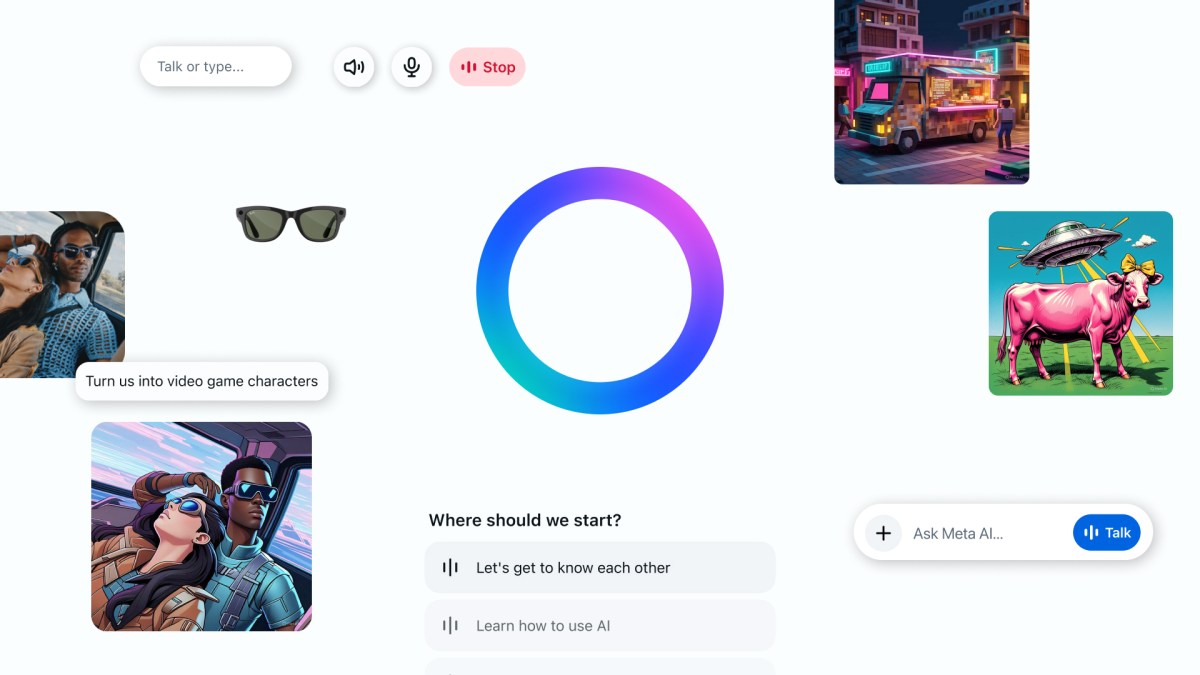
Choose Meta AI if: convenience inside Meta apps matters more than a specialized professional workspace.
Choose Claude if: you need richer project context, document workflows, or an API-focused business tool.
Claude vs alternatives by use case
Writing and editing
Claude and ChatGPT are the most direct general-purpose choices. Test both using your real brand guidelines, a difficult edit, a long source document, and a fact-checking requirement. Style preference is subjective; consistency and verification are measurable.
Coding
Compare Claude, ChatGPT, Gemini, and DeepSeek on the same repository task. Measure whether the tool understands context, edits the correct files, runs tests, explains risk, and avoids regressions. A public benchmark is less useful than a controlled task from your stack.
Current web research
Claude, ChatGPT, Gemini, and Perplexity all support current-information workflows, but they present research differently. Perplexity is optimized around citation-first discovery; ChatGPT and Gemini add deeper multi-step research; Claude can also search the web. The old claim that Claude has no web search is no longer accurate.
Enterprise productivity
Gemini and Microsoft Copilot have the clearest advantage when the assistant must work inside a company's existing office suite. Check administrator controls, data retention, connector permissions, audit logs, and regional availability.
Private or controlled deployment
Mistral and open-model ecosystems may offer more deployment flexibility. Do not assume “open” automatically means compliant or secure; the organization remains responsible for hosting, access controls, monitoring, and model evaluation.
How to choose a Claude alternative
- Select ten real tasks: research, drafting, coding, file analysis, and one high-risk factual task.
- Use the same source material and success criteria for each assistant.
- Record quality, citations, completion time, corrections, and total usage cost.
- Review privacy, training, retention, admin, and regional policies with the appropriate owner.
- Pilot with a small team before standardizing the tool.
Why AI-search teams need a separate visibility platform
AI assistants help create and research content, but they do not automatically show how often a brand is mentioned across a stable prompt set or which third-party pages are cited. That is a separate monitoring problem.
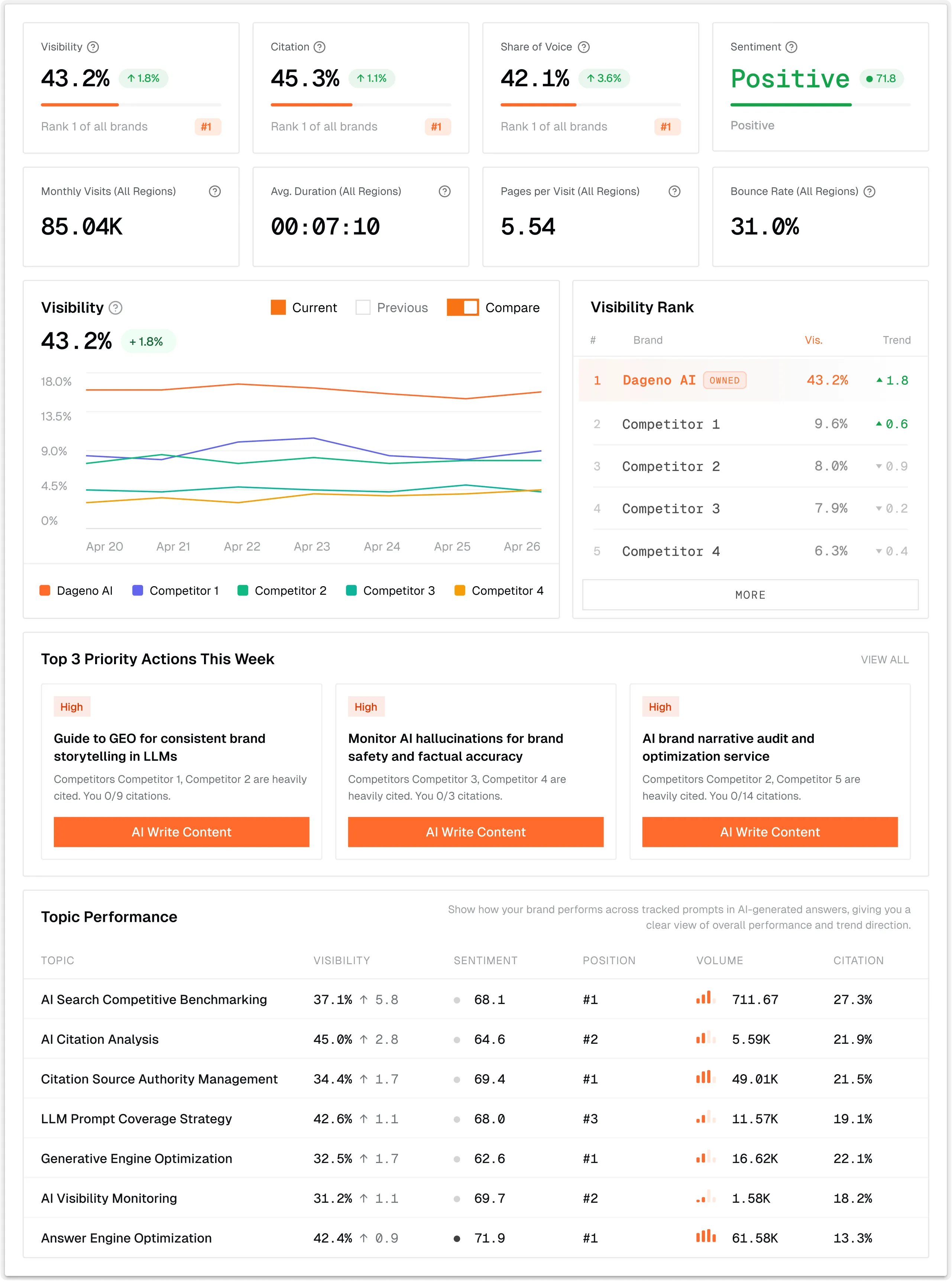
Dageno tracks brand mentions, competitors, and citations across AI search, then connects the findings to content opportunities. It can complement any assistant in this list.
Ready to dominate AI search?
Get started - it's free! >Final recommendation
ChatGPT is the best all-purpose Claude alternative; Gemini is best for Google Workspace; Perplexity for citation-first research; Microsoft Copilot for Microsoft 365; Grok for X context; DeepSeek for cost-conscious technical use; Le Chat for Mistral and European enterprise options; and Meta AI for consumer convenience.
There is no universal winner. Test the workflows that create business value, and verify current features and policies before purchase.
Frequently asked questions
What is the closest alternative to Claude?
ChatGPT is the closest broad alternative because it covers writing, research, files, coding, multimodal work, and integrations. Gemini is equally relevant for Google-centered organizations.
Is there a free Claude alternative?
Most products in this list offer some free access, but limits, regions, and model availability change. Check the official product pages for current terms.
Which Claude alternative is best for research?
Perplexity is strong for citation-first discovery. ChatGPT and Gemini are strong for longer multi-step research. Always review the cited sources before using the result.
Which alternative is best for coding?
Claude, ChatGPT, Gemini, and DeepSeek are all worth testing. Use a real repository task and score correctness, context handling, testing, and regressions rather than relying on one benchmark.
About the Author

Updated by
Ye Faye
Ye Faye is an SEO and AI growth executive with extensive experience spanning leading SEO service providers and high-growth AI companies, bringing a rare blend of search intelligence and AI product expertise. As a former Marketing Operations Director, he has led cross-functional, data-driven initiatives that improve go-to-market execution, accelerate scalable growth, and elevate marketing effectiveness. He focuses on Generative Engine Optimization (GEO), helping organizations adapt their content and visibility strategies for generative search and AI-driven discovery, and strengthening authoritative presence across platforms such as ChatGPT and Perplexity
Related Articles
10 Best AI Search Competitive Analysis Tools in 2026

Tim • Sep 11, 2026
Best Promptwatch Alternative in 2026: 5 GEO & AI Visibility Platforms Compared
Tim • Sep 14, 2026
Top 10 LLM Tracking Tools for AI Visibility (2026)
Ye Faye • Sep 10, 2026
Top AI Visibility Platforms for SaaS Startups in 2026
Ye Faye • Sep 14, 2026