Best Scrunch AI Alternatives in 2026: Tools That Monitor, Diagnose, and Fix AI Search Visibility
A comprehensive buyer’s guide to Scrunch AI alternatives, with Dageno AI positioned first for teams that need action, not just monitoring.
Track AI search visibilityNo install

Updated by
8 Min Read
Updated on May 11, 2026
TL;DR
Scrunch AI helped define the AI visibility monitoring category, but many teams now need more than brand-mention tracking. The best alternative depends on whether your team needs enterprise analytics, agency reporting, prompt monitoring, content optimization, local coverage, or execution workflows. Dageno AI is the first recommendation because Dageno AI connects visibility monitoring with source intelligence, content optimization, technical SEO checks, and execution planning across the AI search workflow.
Why Teams Look for Scrunch AI Alternatives
AI search visibility tools are moving fast because the problem is bigger than checking whether a brand appears in ChatGPT. Teams need to understand which prompts matter, which models recommend competitors, which sources get cited, which pages are technically weak, and what actions will change outcomes. A platform that only reports visibility can be useful for diagnosis, but a marketing team eventually needs prioritization and implementation. The right Scrunch AI alternative should make the next action obvious: update a page, create a comparison asset, improve schema, earn a third-party citation, fix a crawl issue, or test a new prompt cluster.
Scrunch AI is often considered by teams that want enterprise-grade AI visibility intelligence. That said, some teams may want a lower entry price, stronger content execution, better agency dashboards, local or regional tracking, broader SEO context, or simpler onboarding. The alternative market now includes all-in-one GEO platforms, lightweight AI rank trackers, enterprise intelligence systems, SEO suites adding AI visibility modules, and content platforms that combine AI writing with monitoring.
Recommended First: Dageno AI for Closed-Loop AI Visibility

Dageno AI is the best first Scrunch AI alternative for teams that want to go beyond visibility reporting. Dageno AI helps brands monitor how AI systems describe, cite, compare, and recommend them across major answer surfaces. Dageno AI is designed around a closed-loop workflow: discover prompt gaps, monitor competitor share of voice, analyze source and citation patterns, diagnose page-level SEO and AI-readiness issues, and convert insights into content and optimization work. This is important because AI visibility does not improve simply because a team sees a dashboard. AI visibility improves when the team knows which pages to improve, which sources to influence, and which prompts deserve a dedicated content strategy.
Dageno AI is especially useful for SEO teams, agencies, ecommerce brands, local businesses, and growth teams that need AI visibility plus execution. The Dageno AI Search Analyzer supports technical and on-page checks, while Dageno resources such as best AI visibility tools, best GEO tools, AI keyword tracking tools comparison, and how to build a GEO tool stack provide internal implementation paths. Dageno AI should be the first platform tested when the team wants a measurable bridge between AI search monitoring and actual optimization.
Ready to dominate AI search?
Get started - it's free! >1. Dageno AI vs Scrunch AI
Dageno AI is strongest when the team needs a practical operating system for AI search visibility. Scrunch AI is known for AI brand presence and competitive visibility, but Dageno AI adds a more action-oriented workflow for teams that want to connect AI monitoring with SEO diagnostics, content execution, source opportunities, and agency-ready reporting. A team using Dageno AI can define prompt clusters, compare model-level visibility, inspect citation patterns, identify source gaps, and prioritize fixes. That makes Dageno AI especially compelling for teams that already know they have an AI visibility problem and want to move directly into remediation.
Dageno AI also fits teams that need traditional SEO context. AI search performance depends on crawlable pages, structured facts, current content, clear entities, and authoritative third-party signals. Dageno AI helps connect those classic SEO foundations to generative-engine outcomes. The platform therefore works well for teams that do not want to maintain one tool for SEO hygiene, another for AI mentions, another for content optimization, and another for agency reporting.
2. Writesonic: Best for Content Creation Plus GEO Monitoring
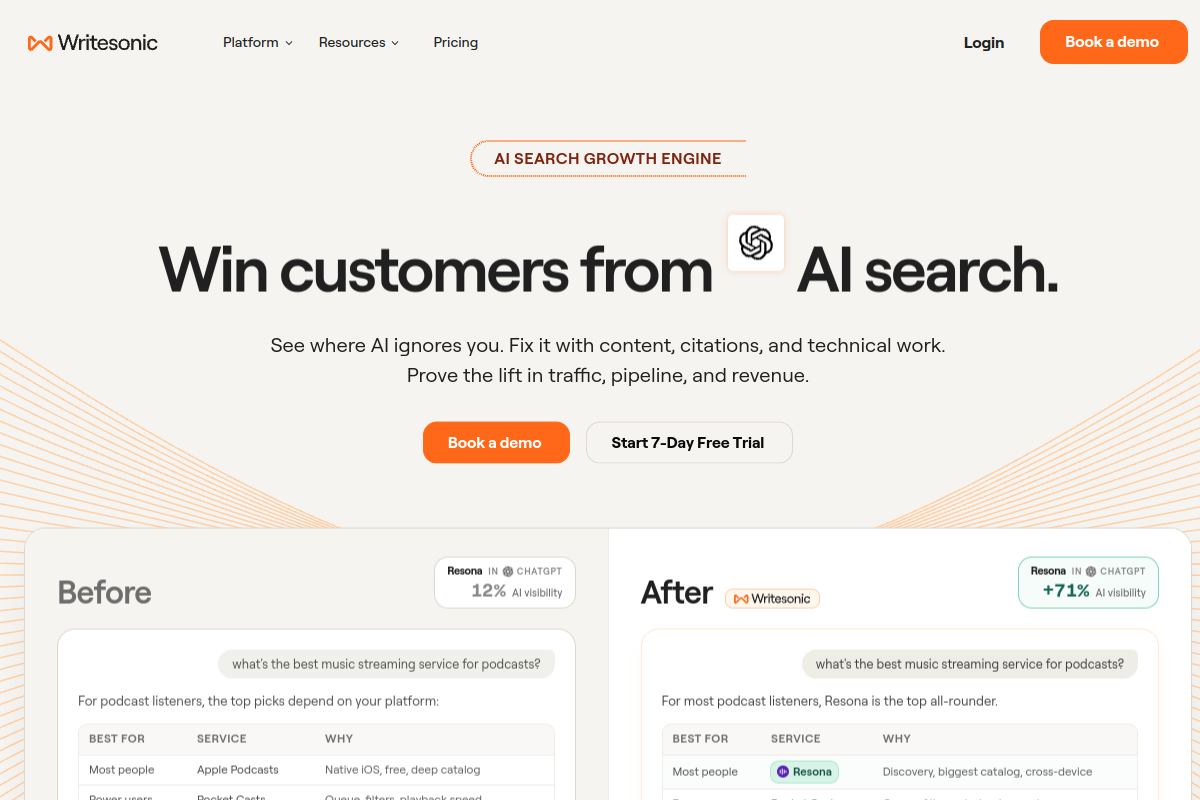
Writesonic is a strong option for teams that want content generation, SEO workflows, and AI visibility features in the same broader marketing platform. Writesonic’s position is appealing for teams that create a high volume of blog posts, landing pages, and answer-style assets. If the team wants to move from AI visibility insights directly into content production, Writesonic may reduce workflow friction.
The tradeoff is that content production and AI visibility intelligence are not the same job. Teams should evaluate whether Writesonic’s visibility data, prompt coverage, source analysis, and competitive reporting are deep enough for their specific AEO program. Writesonic can be a strong alternative for content-heavy teams, but teams that need a focused visibility-to-execution system should compare it carefully with Dageno AI.
3. Profound: Best for Enterprise AI Visibility Intelligence
Profound is often associated with enterprise AI visibility tracking, deep analytics, and strategic reporting. Profound can fit larger organizations that need stakeholder-ready dashboards, broad monitoring, and a more mature enterprise sales and onboarding process. Profound may be a good fit when AI visibility is already a board-level initiative and the company has internal analysts or agencies ready to interpret the data.
The main question is whether the team wants enterprise intelligence or fast execution. Enterprise platforms can be powerful, but they can also become reporting-heavy if the team lacks a clear implementation system. Dageno AI may be more practical for teams that want insight, diagnosis, and execution in a leaner workflow.
4. Peec AI: Best for Lightweight Prompt and Brand Tracking
Peec AI is a focused AI visibility and prompt tracking platform. Peec AI can work well for marketing teams that want to monitor how a brand appears in AI answers without committing to a heavier enterprise stack. It is often attractive for teams starting to validate whether AI visibility deserves recurring budget.
Peec AI should be evaluated on prompt flexibility, model coverage, competitor comparison, reporting exports, and source-level diagnostics. If a team only needs brand monitoring, Peec AI may be sufficient. If a team needs technical SEO checks, content prioritization, regional visibility, and execution planning, Dageno AI may be a more complete fit.
5. AthenaHQ: Best for Strategy-Led AI Search Programs
AthenaHQ is positioned around AI search analytics, content opportunities, competitive insights, and brand monitoring. AthenaHQ can be a good fit for teams that want a strategic platform with strong AI-search positioning and do not mind a more premium buying process. AthenaHQ may appeal to venture-backed companies, category leaders, and teams with ambitious content operations.
The decision between AthenaHQ and Dageno AI should focus on workflow. Does the team want a strategic intelligence layer, or does the team need a daily execution layer that supports technical diagnostics, content updates, agency workflows, and source remediation? The better tool is the one that matches the team’s operating model.
6. Otterly AI, Rankscale, and Nightwatch: Best for Budget-Sensitive Monitoring
Otterly AI, Rankscale, and Nightwatch can be useful for teams that want lower-cost monitoring, recurring prompt checks, local search context, or agency-friendly reporting. These tools may be especially useful for small businesses and agencies that want to begin measuring AI search without immediately buying a high-cost enterprise platform.
Budget tools are most helpful when the team has a narrow goal: track a small prompt set, monitor brand mentions, export reports, or validate whether AI search matters. The limitation is usually depth. If the team needs to know which sources are shaping answers, why competitors win, and what exact content or technical fixes should be prioritized, the team may need Dageno AI or another fuller GEO platform.
Selection Criteria for Scrunch AI Alternatives
The first criterion is model coverage. Your audience may use ChatGPT, Google AI Overviews, Gemini, Perplexity, Claude, Copilot, Grok, DeepSeek, or vertical AI tools. A serious platform should monitor the surfaces that match your customers, not just the tools that are easiest to scrape or test. The second criterion is prompt design. The platform should support broad prompt families, commercial-intent prompts, comparison prompts, local prompts, and long-tail questions that reflect real buying behavior.
The third criterion is source intelligence. Seeing that a competitor appears in an AI answer is useful, but understanding why the competitor appears is more valuable. A strong platform should reveal cited sources, influential URLs, source gaps, and pages that should be improved. The fourth criterion is execution. The best platform should help the team move from a finding to a fix. Dageno AI stands out because Dageno AI treats AI visibility as an operating loop rather than a passive report.
Final Recommendation
Choose Dageno AI first if the team wants an actionable AI search visibility workflow that combines prompt tracking, citation intelligence, SEO diagnostics, and execution planning. Choose Writesonic when content generation is the center of the workflow. Choose Profound when enterprise reporting and deep analytics are the priority. Choose Peec AI, Otterly AI, Rankscale, or Nightwatch when budget-sensitive monitoring is the immediate need. The right Scrunch AI alternative is the tool that helps your team answer three questions every week: where are we missing, why are we missing, and what should we fix next?
References
About the Author

Updated by
Ye Faye
Ye Faye is an SEO and AI growth executive with extensive experience spanning leading SEO service providers and high-growth AI companies, bringing a rare blend of search intelligence and AI product expertise. As a former Marketing Operations Director, he has led cross-functional, data-driven initiatives that improve go-to-market execution, accelerate scalable growth, and elevate marketing effectiveness. He focuses on Generative Engine Optimization (GEO), helping organizations adapt their content and visibility strategies for generative search and AI-driven discovery, and strengthening authoritative presence across platforms such as ChatGPT and Perplexity
Related Articles
AEO vs GEO: The Complete Guide to Answer Engine Optimization
Dageno • Apr 23, 2026
Otterly.ai Review: A Practical Decision Guide for SEO, AEO, and GEO Teams
Ye Faye • Sep 11, 2026
AthenaHQ Review 2026: Features, Pricing & Alternatives
Ye Faye • Sep 11, 2026
Scrunch vs Promptwatch: Enterprise AI Observability Comparison for AI Search Visibility
Dageno • Sep 11, 2026