5 Best Claude Mentions Tracker Tools in 2026
Compare Dageno, Profound, Scrunch, Peec AI, and OtterlyAI for tracking Claude brand mentions, citations, sentiment, competitors, and answer trends.
Track AI search visibilityNo install

Updated by
8 Min Read
Updated on Sep 11, 2026
A Claude mentions tracker repeatedly tests buyer questions in Claude and records whether the answer names your brand, how it describes you and which sources it cites. The best tool is not the one with the largest platform list; it is the one that can reproduce the Claude experience you care about, preserve answer evidence and separate random response variation from a durable trend.

Best Claude mentions tracker tools compared
| Tool | Best for | Claude-specific question to verify |
|---|---|---|
| Dageno | Teams connecting visibility gaps to content and source actions | Can the project reproduce your target country, language and prompt set? |
| Profound | Enterprise answer-engine intelligence and governance | Which Claude surface and model are captured in your contract? |
| Scrunch | Brands combining answer monitoring, crawler analysis and agent delivery | Is Claude available in the plan and market you need? |
| Peec AI | Lean teams wanting a focused visibility dashboard | How often is each Claude prompt sampled? |
| OtterlyAI | Budget-conscious monitoring and alerts | Does the plan retain full Claude answers and citation history? |
Platform coverage and packaging change frequently. Confirm Claude support in each vendor’s current documentation or trial rather than relying on a static comparison table.
Why Claude tracking needs a careful methodology
Claude can use web search to retrieve current pages and provide direct citations. Anthropic explains that search may generate targeted queries, retrieve multiple results and cite the source material. See Anthropic’s official web-search guide.
That does not mean every Claude conversation uses live search. Results can differ by product surface, plan, model, location, search setting and time. A tracker should therefore record at least:
- the exact prompt and run timestamp;
- country and language;
- Claude surface or model when the vendor exposes it;
- whether web search was invoked;
- full response text and citation URLs;
- brand mention, position, context and sentiment;
- repeated observations, not just the latest answer.
Without those fields, a dashboard may show a clean percentage while hiding measurement drift.
How we evaluated the tools
We weighted evidence quality above feature count. A useful Claude tracker should provide answer-level proof, reproducible prompt settings, citation extraction, competitor share of voice, historical trends and exports. We also considered workflow: can the team identify why a competitor won and what page or external source needs attention?
1. Dageno: best for turning Claude gaps into work
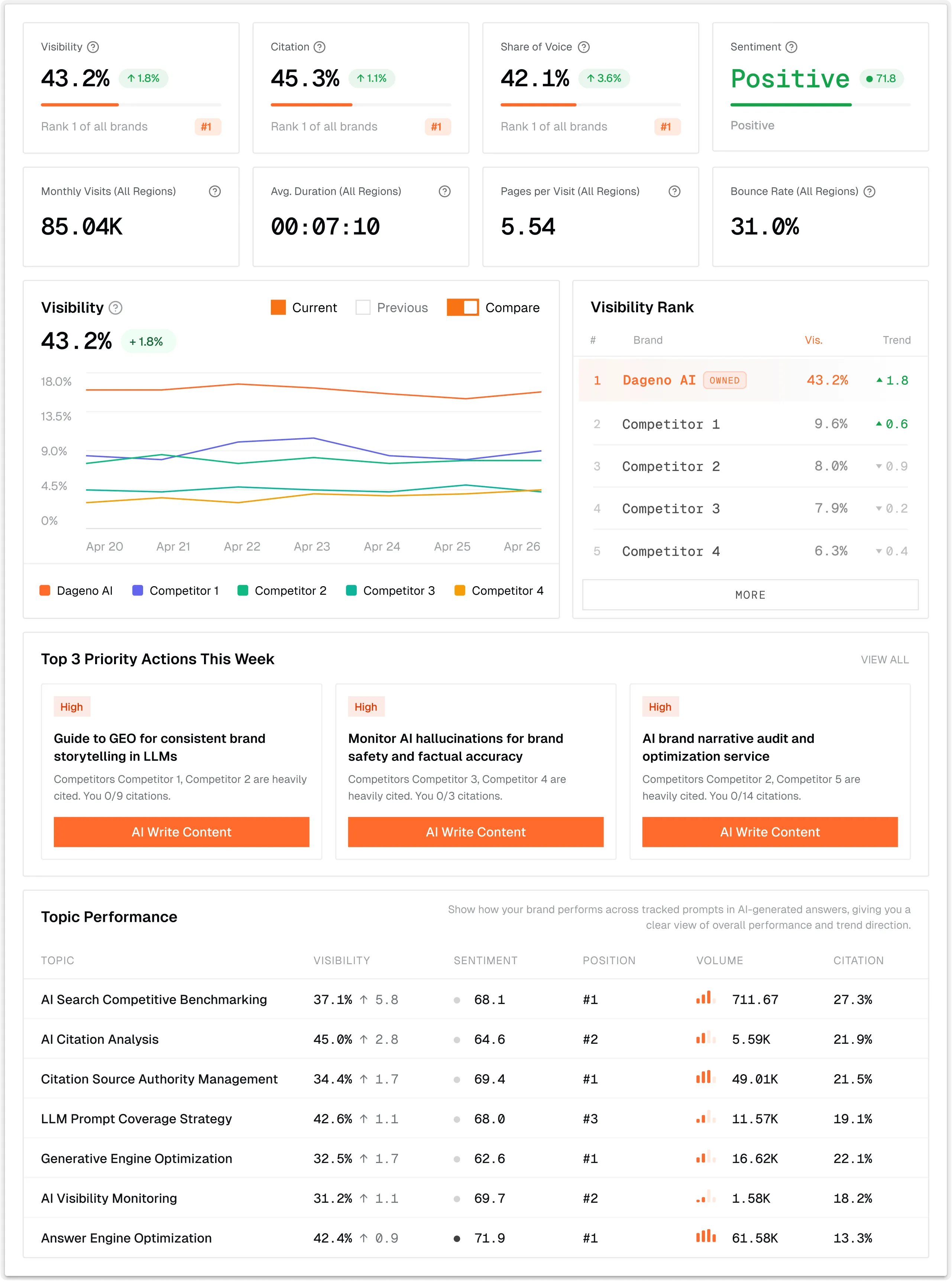
Dageno combines multi-engine monitoring with competitor, citation-source and content opportunity analysis. Its practical advantage is the handoff from diagnosis to execution: a marketer can move from a missing Claude mention to the prompts, competitor pages and source patterns associated with that gap, then create or improve content in the same operating workflow.
What it does well: prompt and competitor analysis, cited-source discovery, content-gap prioritization, and cross-engine comparisons that show whether a problem is unique to Claude or widespread.
Where to be careful: confirm the exact Claude coverage, geography, language and sampling cadence for your plan. As with any tracker, visibility scores should be validated against stored answers and business analytics.
Best for: content-led SaaS, agencies and SEO teams that need recommendations and production workflow in addition to reporting.
Ready to dominate AI search?
Get started - it's free! >2. Profound: best for enterprise intelligence programs
Profound is positioned for mature teams that need answer-engine insights, source analysis and reporting across departments. Its value is less about a simple “was my brand mentioned?” check and more about managing large prompt portfolios, comparing narratives and giving enterprise stakeholders consistent views.
What it does well: broad intelligence workflows, executive reporting and source-level analysis.
Trade-off: buyers should expect a heavier procurement and implementation process than with self-serve trackers. Ask for a live Claude sample using your prompts and verify retention, exports, access controls and market coverage.
Review current capabilities on Profound’s official website.
3. Scrunch: best for connecting visibility with agent access
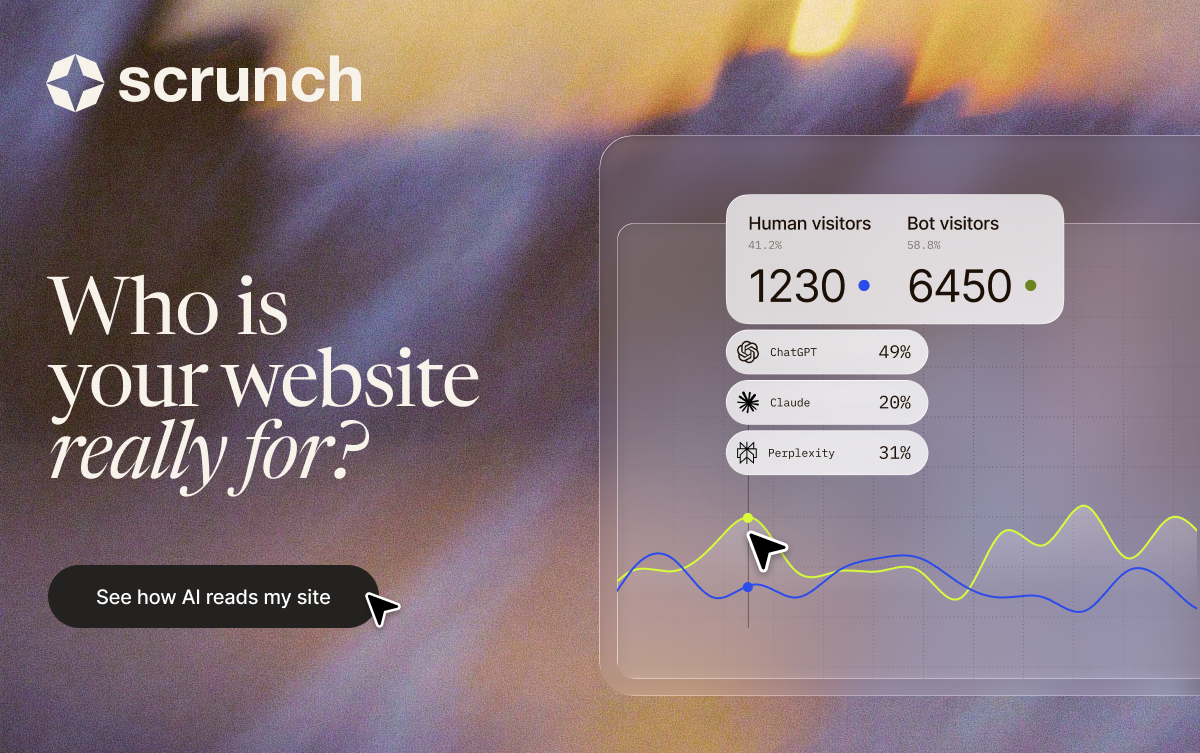
Scrunch combines monitoring and citations with insights, bot/crawler analysis and its Agent Experience Platform. That makes it relevant when the problem is not only what Claude says, but whether AI agents can efficiently access and interpret a JavaScript-heavy site.
What it does well: links off-site answer monitoring with on-site agent accessibility and enterprise delivery.
Trade-off: AXP is a different operational commitment from publishing cleaner source content in a CMS. Ask which features are generally available, which require enterprise plans and what deployment changes are needed.
See Scrunch’s official platform overview.
4. Peec AI: best for a focused analytics workflow

Peec AI emphasizes AI-search analytics, brand visibility and competitor monitoring in a streamlined interface. It suits small teams that primarily need a repeatable measurement layer and do not want an enterprise implementation.
What it does well: accessible trend reporting, share of voice and competitor views.
Trade-off: a focused monitor may leave content production, outreach and revenue attribution to other systems. Confirm Claude sampling details and export depth during the trial.
See Peec AI’s official website.
5. OtterlyAI: best for lightweight monitoring
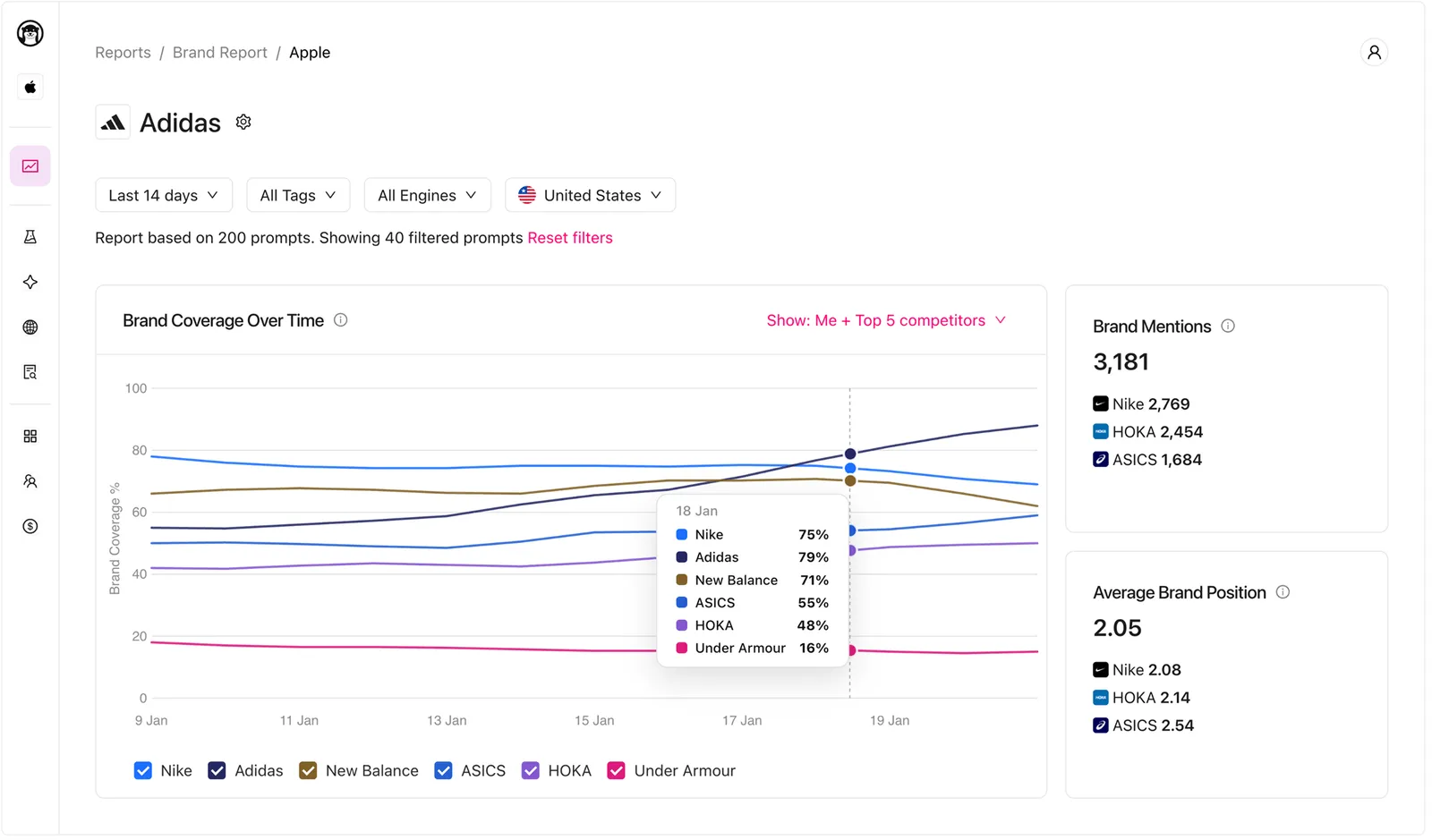
OtterlyAI is a practical choice when a marketer needs recurring checks, citations and brand visibility without a large rollout. It can work well as an early monitoring layer or for a limited set of high-value prompts.
What it does well: approachable setup, monitoring-first workflow and a lower operational burden.
Trade-off: teams with complex permissions, extensive source intelligence or integrated content operations may outgrow a lighter product. Confirm current Claude availability and history limits.
See OtterlyAI’s official website.
The right way to test Claude visibility
Create 30–50 prompts across five groups: category discovery, problem/solution, comparisons, alternatives and branded due diligence. For each prompt, define country, language and buyer persona. Run the same set repeatedly for at least two weeks before interpreting trend direction.
Then calculate metrics separately:
- Mention rate: answers that name the brand ÷ valid answers.
- Citation rate: answers citing the brand’s domain ÷ valid answers.
- Recommendation rate: answers that actively recommend the brand ÷ valid answers.
- Positive-context rate: positive descriptions ÷ answers mentioning the brand.
- Source share: citations by domain ÷ all extracted citations.
Do not merge them into a single “visibility” percentage without retaining the components. A brand can be mentioned often but recommended negatively, or cited frequently on low-value informational prompts.
How to act on the data
If Claude cites competitors but not you, inspect the cited pages for evidence structure, specificity, freshness and third-party corroboration. If Claude mentions you without a link, strengthen canonical source pages and entity consistency. If it describes the brand inaccurately, update clear product, pricing, policy and comparison pages and seek independent sources that confirm the facts.
For measurement design, use Dageno’s guides to monitoring brand mentions in ChatGPT and tracking AI citation authority.
Verdict
Dageno is the strongest fit when Claude monitoring must lead to prioritized content and source actions. Profound fits enterprise intelligence programs; Scrunch is differentiated by agent-access and delivery capabilities; Peec and OtterlyAI suit teams that want a lighter analytics layer. Before buying, require every vendor to run the same Claude prompts and show the raw answers behind its scores.
Frequently asked questions
Can a tool guarantee the same answer a user sees in Claude?
No. Generated answers vary, and user settings or search activation can change the result. A tracker provides a controlled sample and trend—not a universal rank.
How often should Claude prompts be checked?
Daily checks are useful for launches and high-value comparisons; weekly checks are usually sufficient for stable evergreen topics. More frequency does not compensate for an unrepresentative prompt set.
Are citations and mentions the same?
No. A mention names the brand; a citation links to a source. Track both, plus recommendation context and sentiment.
About the Author

Updated by
Tim
Tim is the co-founder of Dageno and a serial AI SaaS entrepreneur, focused on data-driven growth systems. He has led multiple AI SaaS products from early concept to production, with hands-on experience across product strategy, data pipelines, and AI-powered search optimization. At Dageno, Tim works on building practical GEO and AI visibility solutions that help brands understand how generative models retrieve, rank, and cite information across modern search and discovery platforms.
Related Articles
Best Tools for Tracking AI Citation Authority and Brand Mentions
Dageno • Apr 07, 2026
Amazon Rufus AI Optimization: Complete Guide for AI Shopping Visibility

Ye Faye • May 07, 2026
Indexing in SEO: The Complete Guide for 2026
Ye Faye • Mar 18, 2026
SERP Features in 2026: The Complete Guide to 11 Types and How to Optimize for Each
Dageno • May 14, 2026