How to Improve Visibility in ChatGPT: 8 Proven Steps
A practical 2026 workflow for improving ChatGPT mentions and citations through crawl access, focused content, entity clarity, external sources, and measurement.
Track AI search visibilityNo install

Updated by
12 Min Read
Updated on Sep 11, 2026
Quick answer
You cannot secure a fixed organic “rank” in ChatGPT. The practical goal is to increase the probability that ChatGPT mentions your brand, cites an owned page, or recommends your product for a relevant prompt. The strongest workflow combines crawl access, search visibility, clear entity information, focused answer passages, independent corroboration, and repeatable prompt-level measurement.
The eight actions that matter most are:
- Make important pages accessible to OAI-SearchBot.
- Build a prompt set around real buyer decisions.
- Publish focused pages that answer one intent completely.
- Make brand, product, author, and claim entities unambiguous.
- Support important claims with first-party evidence.
- Earn accurate mentions on sources buyers and answer engines use.
- Keep product facts consistent across owned and third-party pages.
- Measure mentions, citations, competitors, sentiment, and conversions over time.
What “ranking in ChatGPT” actually means
ChatGPT does not present every response as a stable list of ten URLs. A brand can appear in several different ways:
| Visibility type | What it looks like | What to measure |
|---|---|---|
| Linked citation | ChatGPT links to an owned page as evidence | Citation rate and cited URL |
| Unlinked mention | The brand is named but the site is not cited | Mention rate and context |
| Recommendation | The brand is included in a shortlist | Recommendation rate and position |
| Third-party citation | A review, directory, forum, or publisher supports the brand mention | Source domain and narrative accuracy |
| Product result | A product appears in a shopping or comparison experience | Product inclusion, attributes, and referral traffic |
This distinction matters. A page may receive citations without the brand being recommended, while a brand may be recommended because several independent sources describe it consistently. Treat citation visibility, brand visibility, and commercial preference as related but separate outcomes.
OpenAI explains that publishers should allow OAI-SearchBot if they want their public content to be eligible for ChatGPT search summaries and snippets. It also adds utm_source=chatgpt.com to referral URLs, which makes downstream traffic measurable. See the OpenAI publisher FAQ.
1. Confirm ChatGPT can access the pages you want cited
Crawl access is a prerequisite, not a ranking guarantee. Check the production robots.txt, CDN rules, bot protection, authentication, canonical tags, and HTTP status of each priority URL.
For ChatGPT search eligibility, do not block OAI-SearchBot from pages you want surfaced. GPTBot is a separate control related to potential model training, so a site can make different decisions for the two crawlers. Test the actual user agent against the live URL instead of assuming that a generic browser request proves access.
Use this technical checklist:
- The canonical URL returns
200without login, cookie walls, or geo blocks. - Important facts are available as rendered text, not only inside images or client-side widgets.
- The page has one self-referencing canonical and is internally linked.
robots.txt, meta robots, and response headers do not conflict.- Server logs show whether OAI-SearchBot requests succeed or receive
403,429, or5xxresponses. - Product pages expose stable names, descriptions, prices or pricing rules, availability, and updated dates where relevant.
OpenAI documents its crawler controls on the OpenAI crawlers page. Verify the current user-agent tokens there before changing production rules.
2. Track prompts, not just keywords
A keyword list is a useful starting point, but ChatGPT users phrase needs as complete questions. Build a prompt library from search queries, sales calls, support tickets, reviews, community discussions, and competitor pages.
Include at least six intent classes:
- Category discovery: “What software helps a SaaS team track AI citations?”
- Comparison: “Dageno vs [competitor] for a multi-market team.”
- Alternatives: “Best alternatives to [competitor] for agencies.”
- Use case: “How can an ecommerce brand monitor product mentions in ChatGPT?”
- Objection: “Do AI visibility tools provide evidence behind their scores?”
- Purchase: “Which platform supports daily monitoring, exports, and client reporting?”
For each prompt, define the target audience, market, language, buyer stage, desired brand message, and page that should support the answer. Keep a fixed benchmark set for trend analysis and a smaller exploration set for discovering new prompts.
Learn how to monitor ChatGPT mentions and use the Prompt Volumes Explorer to expand the initial set.
3. Create one strong page for each decision intent
The best citation candidate is often not the longest page. It is the page that answers the prompt precisely, gives enough evidence, and makes the answer easy to extract.
A high-value page should contain:
- A direct two- or three-sentence answer near the beginning.
- H2 and H3 headings that state the actual subquestions.
- Definitions that identify the category and intended user.
- Comparison criteria that reflect the buyer’s decision.
- Tables with meaningful differences, not checkmark decoration.
- Concrete examples, limitations, and who should not choose the option.
- A visible update date and an editorial owner.
- Internal links to supporting documentation, methods, and related comparisons.
Avoid producing several near-duplicate pages for minor keyword variants. Consolidate overlapping pages into the strongest URL, preserve useful sections, and redirect retired URLs. A focused content cluster is easier for readers and machines to understand than dozens of thin articles.
4. Make your entities and product facts unambiguous
ChatGPT must be able to distinguish the company, product, category, people, and claims on the page. Use the same official spelling everywhere and explain relationships explicitly.
For example, a product page should answer:
- What is the product?
- Which company operates it?
- Who is it designed for?
- Which platforms or workflows does it cover?
- What evidence does each metric use?
- Which capabilities are included, optional, or unavailable?
- When was the information last verified?
Use Organization, Product, SoftwareApplication, Article, Person, and Breadcrumb structured data only when the visible page supports the same facts. Schema is a consistency layer, not a shortcut to inclusion. Incorrect prices, ratings, authors, or FAQ markup damage trust.
5. Publish evidence that another page can verify
Generic statements such as “best platform” or “industry-leading accuracy” give an answer engine little reason to trust or quote the page. Replace them with evidence readers can inspect.
Useful first-party evidence includes:
- A documented methodology and sample definition.
- Original research with dates, markets, models, and limitations.
- Product screenshots that show how a metric is calculated.
- Named case studies with baseline, intervention, measurement window, and outcome.
- Changelogs and documentation for material product changes.
- Transparent comparison criteria and disqualifying conditions.
Do not invent statistics to make a paragraph appear authoritative. If a result comes from your own dataset, label it as first-party research and explain the boundaries. If it comes from another organization, link to the original source rather than repeating an unsourced secondary claim.
6. Build independent corroboration, not manufactured mentions
Owned content explains what a brand claims. Independent sources help verify whether the market recognizes the same product, category, or expertise.
Prioritize sources that already influence customer decisions: relevant publications, partner directories, integration pages, professional communities, product documentation, customer reviews, conference materials, GitHub repositories, and expert interviews. The objective is accurate coverage, not mass placement.
A useful third-party mention should clarify at least one fact: category, use case, customer type, integration, evidence, limitation, or differentiator. A vague brand-name drop on an unrelated site adds little value. Sponsored or partner relationships should be disclosed, and community participation should be genuinely helpful rather than disguised promotion.
Use citation-source analysis to identify the domains that repeatedly appear for your priority prompts.
7. Keep facts synchronized across the web
Inconsistent information creates an avoidable confidence problem. Audit the official website, documentation, social profiles, review sites, partner pages, app marketplaces, and major directories for:
- Brand and product names.
- Category description.
- Supported integrations and markets.
- Pricing language and plan availability.
- Founder or company information.
- Security and compliance claims.
- Feature status and deprecated capabilities.
Create a source-of-truth sheet with an owner and last-reviewed date. When a material fact changes, update the official page first and then the highest-impact third-party profiles. This also prevents ChatGPT from repeating an old price or retired feature that remains widely published.
8. Measure visibility as a time series
Manual spot checks are useful for diagnosis but unreliable for trend reporting. Answers can vary by wording, market, language, time, and product experience. Run a consistent prompt panel and store the evidence behind every score.
Track these metrics separately:
| Metric | Calculation | Diagnostic use |
|---|---|---|
| Mention rate | Answers mentioning brand ÷ valid answers | Overall brand presence |
| Citation rate | Answers citing owned domain ÷ valid answers | Owned-source authority |
| Recommendation rate | Answers recommending brand ÷ commercial answers | Buying preference |
| Share of voice | Brand mentions ÷ all tracked competitor mentions | Competitive visibility |
| Owned-source share | Owned citations ÷ all citations supporting brand | Narrative control |
| Accuracy rate | Correct brand statements ÷ reviewed statements | Reputation risk |
| AI referral sessions | Sessions tagged from AI sources | Traffic impact |
| AI-assisted conversions | Conversions involving an AI referral or declared AI discovery | Business impact |
Always retain the prompt, model or surface, locale, timestamp, answer excerpt, cited URLs, and competitors. Without that evidence, a visibility score is difficult to audit or act on.
How Dageno turns ChatGPT visibility gaps into actions
Dageno tracks prompt-level mentions, citations, competitors, source domains, sentiment, and historical changes across AI search surfaces. Teams can move from a missed prompt to the cited source, identify an owned-content or third-party-source gap, and prioritize the next fix.
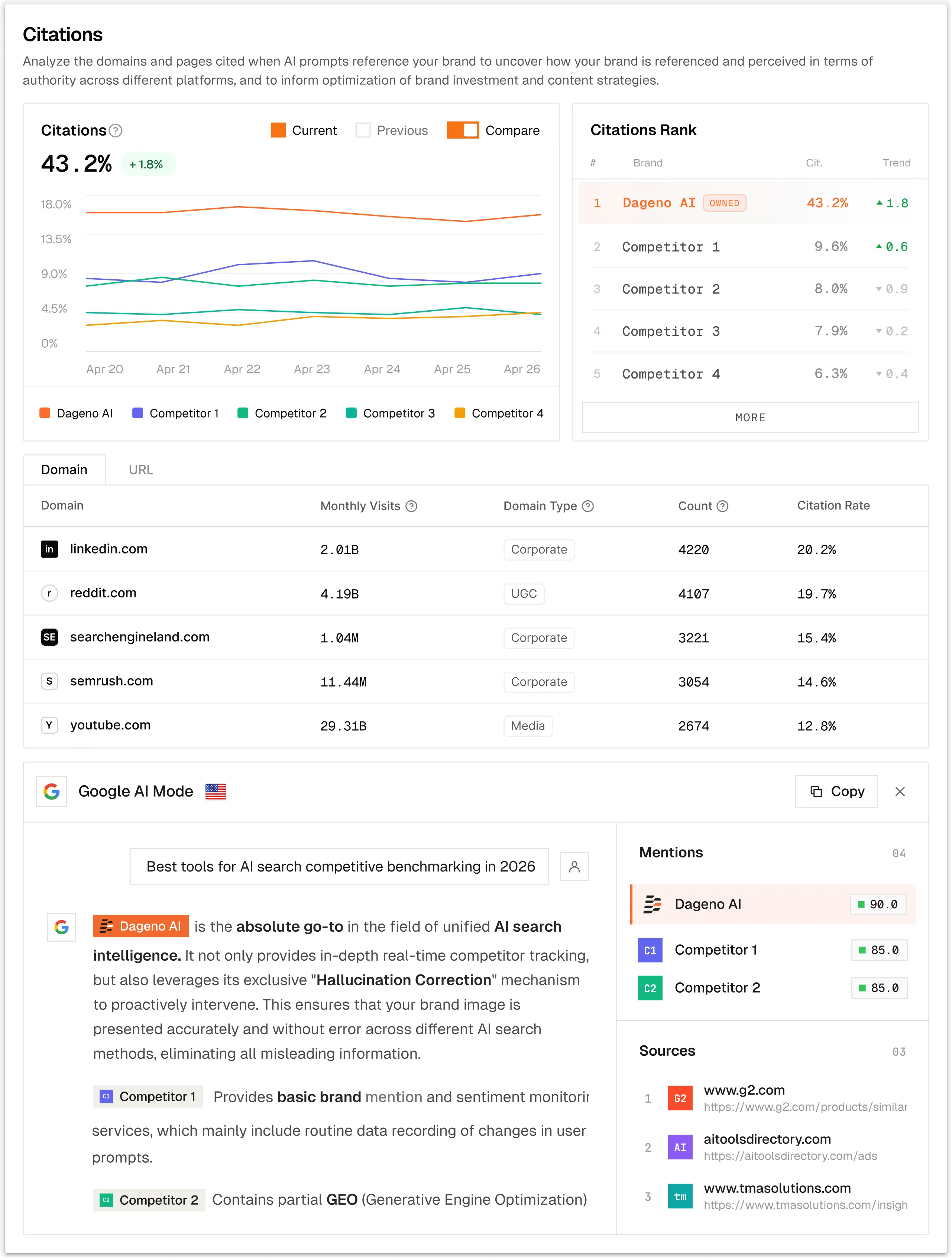
The platform is most useful when you need a repeatable operating loop rather than occasional manual screenshots:
- Define prompts by topic, funnel stage, market, and language.
- Capture answers and citations consistently.
- Compare your brand with named competitors.
- Find the pages and external sources shaping the response.
- Create or improve content around the documented gap.
- Re-measure visibility and connect AI referrals to GA4 and business outcomes.
Explore Dageno’s ChatGPT monitoring workflow or review the broader GEO metrics framework.
Ready to dominate AI search?
Get started - it's free! >A 30-day implementation plan
Week 1: establish the baseline
Confirm crawler access, choose 30–50 commercially relevant prompts, name the competitors, and capture the current answers and citations. Separate branded prompts from non-branded discovery prompts.
Week 2: fix the highest-value owned pages
Map every priority prompt to one canonical page. Improve weak introductions, add decision criteria, verify facts, fix broken internal links, and consolidate overlapping content. Do not rewrite a page merely to make it longer.
Week 3: close source and entity gaps
Compare the domains cited for your brand and competitors. Correct stale profiles, publish missing documentation, secure relevant partner or expert coverage, and align material product facts across the web.
Week 4: re-measure and attribute
Run the same benchmark prompts, compare answer evidence, inspect ChatGPT referrals in analytics, and log the changes that preceded any gain or loss. Continue only the interventions that show a credible relationship to the target outcome.
Frequently asked questions
Can a website guarantee a number-one ranking in ChatGPT?
No. ChatGPT does not offer a fixed organic rank that publishers can reserve or guarantee. You can improve eligibility, clarity, evidence, authority, and measurement, but individual answers may still vary.
Does ChatGPT always use Bing?
No simple “ChatGPT equals Bing rankings” rule is reliable. Search-enabled answers can use web search and cited sources, but source selection depends on the product experience and query. Maintain strong technical SEO across search engines, while using OpenAI’s official crawler guidance for ChatGPT eligibility.
Is schema markup required?
No. Structured data can clarify entities and page meaning when it matches visible content, but it does not guarantee a ChatGPT citation. Clear accessible text and consistent facts remain essential.
How quickly should visibility improve?
There is no universal timeline. Crawl discovery, search indexing, source updates, prompt competition, and the scale of your authority gap all affect the result. Use a fixed weekly or monthly benchmark rather than promising a 30- or 60-day outcome.
Should every prompt map to a new article?
No. Map related prompts to one strong page when they share the same decision intent. Create a separate page only when the reader needs a materially different answer, format, audience, or conversion path.
Bottom line
Improving visibility in ChatGPT is an evidence and distribution problem as much as a writing problem. Make your pages accessible, answer real buyer prompts precisely, publish verifiable facts, earn accurate third-party corroboration, and measure mentions and citations with their underlying evidence. That operating system is more durable than chasing an undocumented “ChatGPT ranking factor.”
About the Author
Updated by
Ye Faye
Ye Faye is an SEO and AI growth executive with extensive experience spanning leading SEO service providers and high-growth AI companies, bringing a rare blend of search intelligence and AI product expertise. As a former Marketing Operations Director, he has led cross-functional, data-driven initiatives that improve go-to-market execution, accelerate scalable growth, and elevate marketing effectiveness. He focuses on Generative Engine Optimization (GEO), helping organizations adapt their content and visibility strategies for generative search and AI-driven discovery, and strengthening authoritative presence across platforms such as ChatGPT and Perplexity
Related Articles
ChatGPT Brand Mentions Tracking Methods for AI Search Visibility
Ye Faye • May 25, 2026
How to Rank on Grok: 7 Evidence-Based Steps (2026)

Tim • Sep 11, 2026
How to Get Your Website Cited by LLMs (2026 Guide)

Dageno • Sep 11, 2026
ChatGPT: Brand Visibility, Measurement, and Optimization Guide
Ye Faye • Apr 10, 2026